

- Industries
Industries
- Functions
Functions
- Insights
Insights
- Careers
Careers
- About Us

AI Agents as the Primary Customer Interface







The way customers interact with businesses is undergoing a fundamental transformation, as traditional touchpoints like websites, mobile apps, IVR systems, and human support desks are no longer sufficient on their own. AI agents are emerging as the primary customer interface intelligent, conversational, and autonomous touchpoints that mediate nearly every stage of the customer journey. Far beyond answering questions, these agents understand intent, retain context, orchestrate workflows across systems, and continuously improve through learning. They operate seamlessly across channels, providing always-on support and consistent experiences without the friction of handoffs or silos. As organizations pursue speed, personalization, and efficiency at scale, AI agents are becoming not just a support layer but a strategic interface that reshapes how customers perceive and engage with the enterprise.
From Static Interfaces to Intelligent Interactions
Traditional customer interfaces were designed around navigation rather than conversation, forcing customers to adapt to menus, forms, and fragmented channels and often repeat themselves as they moved between systems, resulting in friction, dissatisfaction, inefficiency, and rising service costs. AI agents reverse this dynamic by shifting the burden from the customer to the system, using natural language understanding, contextual memory, and reasoning capabilities to learn how customers think and speak and transform interactions into fluid, human-like conversations that adapt in real time. These agents unify previously disconnected touchpoints into a single, continuous experience that persists across channels and moments. This evolution marks a decisive move from interface-led experiences to intent-led experiences, where understanding user goals, anticipating needs, and delivering outcomes matter far more than clicks, screens, or rigid workflows, fundamentally redefining how value is created in customer interactions.
What Makes AI Agents Different from Chatbots
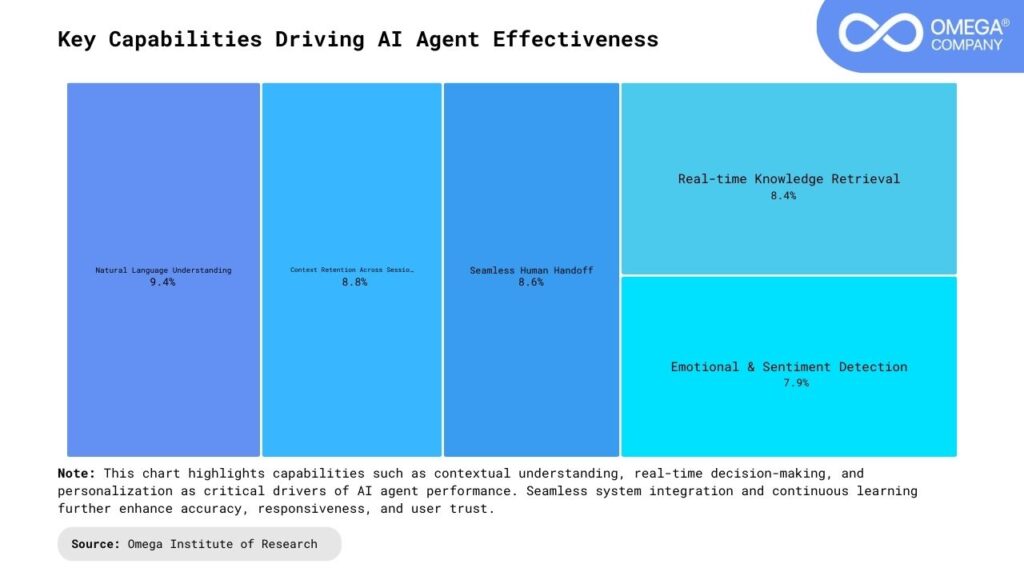
While chatbots focused on scripted responses and predefined flows, AI agents operate with a far broader mandate. They are autonomous, goal-oriented, and deeply integrated into enterprise systems.
Contextual Awareness: AI agents retain memory across interactions, allowing them to understand customer history, preferences, and prior outcomes rather than treating every conversation as a fresh start. This continuity enables more relevant responses, smoother handoffs across channels, and a personalized experience that feels consistent over time. By maintaining context, agents reduce repetition, build trust, and significantly improve customer satisfaction.
Decision-making Capabilities: Unlike rule-based chatbots that follow predefined scripts, AI agents evaluate multiple options and select the most appropriate action based on intent, context, and real-time data. They can prioritize tasks, handle exceptions, and adapt their responses as situations evolve. This ability to reason and decide makes interactions more outcome-driven and resilient to complex or unexpected customer needs.
System Orchestration: AI agents seamlessly connect and coordinate across enterprise systems such as CRM, ERP, billing, logistics, and analytics platforms. They can trigger workflows, retrieve or update records, and resolve issues without human intervention or manual transfers. This orchestration eliminates silos, accelerates resolution times, and ensures customers receive end-to-end support in a single interaction.
Continuous Learning: AI agents continuously improve by learning from feedback, behavioral data, and real-world interactions rather than remaining static after deployment. Over time, they refine their understanding of customer intent, optimize decision paths, and enhance response quality. This learning loop allows organizations to scale service excellence while reducing operational costs and reliance on constant rule updates.
AI Agents Across the Customer Lifecycle
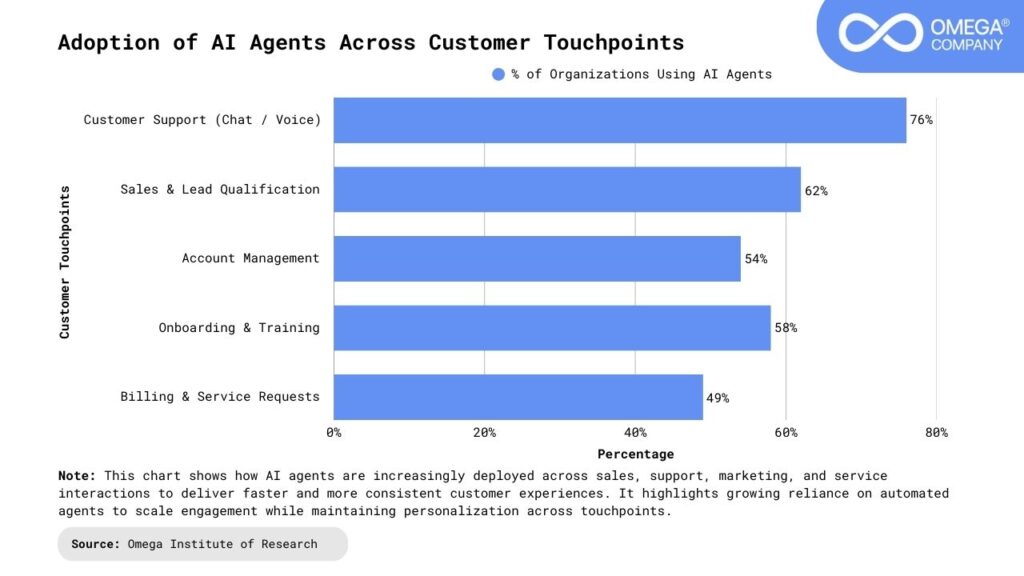
Discovery and Engagement: AI agents greet customers at the very first touchpoint websites, messaging apps, voice assistants, and social platforms creating an immediate, conversational entry into the brand experience. They guide users, recommend relevant products or services, and personalize messaging based on behavior, industry, or real-time intent. By responding instantly and adapting dynamically, they capture attention at the moment of interest and turn passive browsing into active, meaningful engagement that drives deeper exploration.
Sales and Conversion: In sales contexts, AI agents qualify leads, answer complex product questions, generate tailored proposals, and even negotiate pricing within predefined boundaries. They maintain continuity across conversations, ensuring prospects never lose momentum due to delays or handoffs. For both B2B and B2C environments, this reduces friction, shortens sales cycles, and accelerates decision-making without sacrificing personalization or accuracy.
Onboarding and Activation: AI agents simplify onboarding by walking customers through setup, configuration, and initial usage in a guided, conversational manner. They adapt explanations to user expertise, proactively identify points of confusion, and offer just-in-time assistance when users get stuck. This personalized support shortens time-to-value, boosts early adoption, and significantly reduces the risk of churn during critical first interactions.
Support and Retention: As the primary support interface, AI agents handle high-volume queries, diagnose issues, execute resolutions, and escalate only when human intervention is truly necessary. They provide consistent, 24/7 support while learning from each interaction to prevent recurring issues. This approach ensures faster resolution, higher satisfaction, and stronger retention, while preserving human effort for high-empathy or high-complexity cases where it matters most.
Personalization at Scale Without Compromise
One of the most compelling advantages of AI agents as customer interfaces is their ability to deliver hyper-personalization at scale without creating operational overload, enabling every interaction to be tailored in tone, content, timing, and recommendations based on real-time signals and historical context. Unlike human agents, AI agents maintain consistent quality and responsiveness across millions of interactions while still adapting to the unique needs, preferences, and intent of each individual user. This allows organizations to move beyond one-size-fits-all experiences and create interactions that feel genuinely personal, relevant, and timely. When designed responsibly, such personalization is grounded in transparency, consent-driven data usage, and clear value exchange, ensuring privacy is respected rather than compromised. Over time, this balance between scale, intelligence, and ethics helps build durable trust, strengthens customer relationships, and turns personalization into a sustainable competitive advantage rather than a short-term tactic.
Operational and Strategic Benefits for Organizations
Making AI agents the primary interface delivers value far beyond customer satisfaction:
Cost efficiency through automation of repetitive interactions: AI agents automate high-volume, routine conversations such as FAQs, status checks, and basic troubleshooting, significantly reducing reliance on human agents for low-value tasks. This lowers operational costs while freeing human teams to focus on strategic, creative, or high-empathy work. Over time, organizations benefit from improved margins without compromising service quality.
24/7 availability without geographic or time-zone constraints: AI agents provide uninterrupted support and engagement across regions and time zones, ensuring customers always receive timely responses. This always-on presence eliminates delays caused by staffing limitations or regional working hours. As a result, businesses can serve global audiences with the same consistency as local ones.
Faster insights from aggregated conversational data: Every interaction handled by an AI agent becomes a source of structured, analyzable data. Organizations can quickly identify trends, pain points, intent patterns, and emerging customer needs. These insights inform product strategy, marketing optimization, and service improvements in near real time.
Scalable growth without linear increases in headcount: AI agents allow organizations to handle increasing volumes of customer interactions without proportionally expanding support or sales teams. As demand grows, capacity can be scaled digitally rather than operationally. This enables sustainable growth while maintaining speed, quality, and control over costs.
Improved consistency in messaging, compliance, and service quality: AI agents deliver standardized, policy-aligned responses across all interactions, reducing variability and human error. They can be continuously updated to reflect regulatory changes, brand guidelines, or new offerings. This ensures every customer receives accurate, compliant, and on-brand communication at every touchpoint.
Trust, Ethics, and the Human Balance
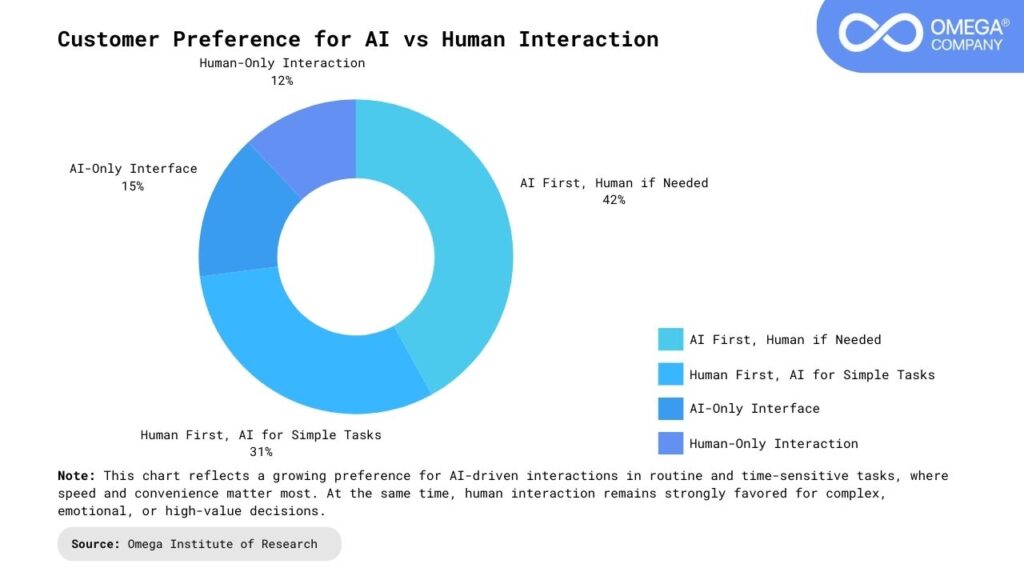
As AI agents take on greater customer-facing responsibility, trust becomes non-negotiable, making transparency about AI usage, clear escalation paths to human support, and strong governance around data use essential foundations rather than optional features. Customers must understand when they are interacting with AI, how their data is being used, and how decisions are made, ensuring confidence, fairness, and accountability throughout the experience. The future is not about replacing humans but augmenting them, with AI agents excelling at speed, scale, consistency, and operational precision while human teams focus on empathy, creativity, nuanced judgment, and complex problem-solving. When thoughtfully designed, this human–AI balance reduces burnout, improves service quality, and strengthens organizational culture. Ultimately, trust-driven, ethical AI deployments create customer experiences that feel not only efficient but also responsible, humane, and aligned with long-term brand values.
The Future: AI Agents as Living Interfaces
Looking ahead, AI agents will evolve into living interfaces adaptive, proactive, and deeply embedded in everyday customer interactions capable of anticipating needs, initiating conversations, and acting on behalf of customers across entire ecosystems rather than within single brands. These agents will move beyond reactive support to become continuous digital companions that coordinate services, make intelligent recommendations, and execute actions seamlessly across platforms and touchpoints. As they mature, AI agents will increasingly operate in the background, reducing friction and effort while enhancing convenience and relevance. For organizations, the question is no longer whether AI agents will become the primary customer interface, but how intentionally they design, govern, and integrate them to ensure ethical use, customer trust, and long-term strategic advantage. Done right, living interfaces will redefine customer experience from isolated interactions to ongoing, value-driven relationships.
Conclusion
AI agents as the primary customer interface represent a fundamental shift in how businesses communicate, serve, and build relationships, moving from static systems to intelligent, conversational engagement that unlocks unprecedented levels of personalization, efficiency, and trust. By seamlessly blending automation with contextual understanding, these agents reshape customer journeys into more responsive, proactive, and meaningful experiences. They not only streamline operations but also create opportunities for deeper customer insight, loyalty, and long-term engagement. Organizations that embrace this transformation early while thoughtfully balancing advanced technology with ethics, transparency, and genuine human connection will be best positioned to define and lead the next era of customer experience, setting new standards for how value is delivered and relationships are nurtured.
- https://www.forbes.com/sites/davidarmano/2023/12/07/ai-agents-and-the-era-of-the-intelligent-interface/
- https://blogs.nvidia.com/blog/ai-agents-customer-service/
- https://www.emerald.com/ijchm/article-abstract/37/9/3240/1276002/Artificial-intelligence-AI-agents-and-the-future?redirectedFrom=fulltext
- https://www.simon-kucher.com/en/insights/future-isnt-one-click-away-how-ai-agents-will-revolutionize-your-customer-experience-cx
- https://www.leewayhertz.com/ai-agent-for-customer-service/
Subscribe
Select topics and stay current with our latest insights
- Functions