

- Industries
Industries
- Functions
Functions
- Insights
Insights
- Careers
Careers
- About Us

Asteroid Mining: The Next Gold Rush in Space







Centuries of human exploration have pushed us from oceans to continents and now into the vast expanse of space. Among the most exciting possibilities emerging from this cosmic horizon is asteroid mining, a concept once reserved for science fiction but now rapidly becoming a real and potentially trillion-dollar industry. As nations and private companies race toward the stars, asteroid mining is being hailed as the next gold rush, one that could transform global economics, fuel the space economy, and reshape life on Earth. With breakthroughs in robotics, propulsion, and AI, the dream of harvesting precious metals and rare elements from space is moving closer to reality. These celestial resources could help solve Earth’s material shortages while powering future space missions. What once felt impossible is now becoming the next bold step in humanity’s pursuit of progress and prosperity.
What Is Asteroid Mining?
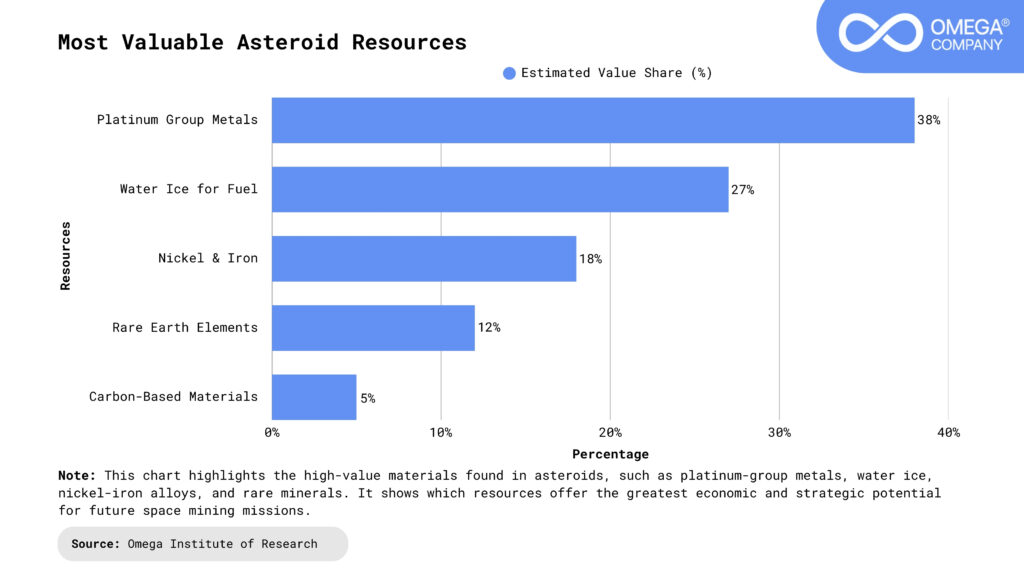
Asteroid mining refers to the extraction of valuable minerals, metals, and other resources from asteroids orbiting the Sun. These space rocks contain an abundance of materials that are rare or expensive on Earth, including:
Platinum-Group Metals (PGMs): Platinum-group metals such as platinum, palladium, and iridium are among the most valuable elements found on asteroids, holding immense importance for electronics, clean energy, and industrial applications. Their extreme scarcity on Earth makes them expensive, but many asteroids contain them in surprisingly high concentrations. Extracting PGMs from space could provide a new supply chain that reduces pressure on Earth’s limited reserves while making advanced technologies more affordable. This abundance could reshape global markets, fuel innovation, and drive a multi-trillion-dollar space resource economy.
Nickel, Cobalt, and Iron: Nickel, cobalt, and iron are widely found in metallic asteroids and are crucial for building spacecraft, space stations, and futuristic off-Earth habitats. Mining these metals directly in space eliminates the need to launch heavy materials from Earth, significantly lowering mission costs. Their availability makes them ideal for large-scale space manufacturing, allowing machinery, structural beams, and key components to be produced on-site. This capability could enable modular construction in orbit and accelerate the development of permanent space infrastructure for science, tourism, and exploration.
Water (Hydrogen + Oxygen): Water is one of the most valuable asteroid resources because it supports both human survival and spacecraft operations. When broken into hydrogen and oxygen, water becomes a powerful rocket propellant—creating opportunities for orbital refueling stations and long-duration missions. This reduces the dependency on Earth launches, making deep-space travel more feasible and cost-effective. Water can also be used for drinking, agriculture, and oxygen production, making it an essential resource for future lunar, Martian, and orbital settlements.
Silicates: Silicate-rich asteroids contain minerals ideal for construction, manufacturing, and advanced 3D printing in space. These materials can be transformed into tools, equipment, and building components directly on-site, reducing the need to transport supplies from Earth. Local production using silicates will play a crucial role in building self-sustaining colonies on the Moon, Mars, or orbital stations. By enabling lightweight, scalable, and cost-efficient construction, silicates will support humanity’s long-term vision of expanding into and thriving across the solar system.
Why Asteroid Mining Matters
Asteroid mining is more than a futuristic idea; it could solve several of Earth’s most pressing challenges.
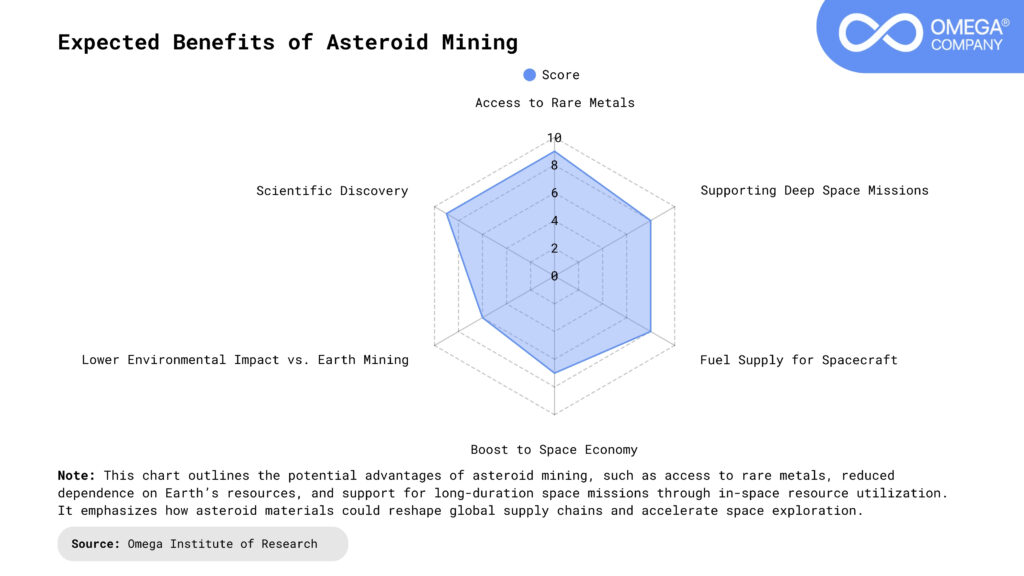
Resource Scarcity on Earth: Many high-value metals used for electronics, renewable energy, and advanced manufacturing are becoming increasingly difficult and expensive to source on Earth. Asteroids contain these materials in far higher concentrations than any terrestrial mine, offering a nearly limitless supply. As technological dependence grows, securing these resources is critical for maintaining innovation and economic stability. Asteroid mining could reduce geopolitical tensions around resource competition and ensure industries never run short of essential minerals.
Fueling the Space Economy: Water-rich asteroids can be transformed into hydrogen and oxygen key ingredients for rocket fuel dramatically reducing the cost and complexity of deep-space missions. Instead of launching heavy fuel loads from Earth, spacecraft could refuel at orbital stations built from asteroid resources, making long-distance travel more affordable and efficient. This capability opens the door to permanent lunar bases, Martian missions, and exploration of the outer solar system. A fully functioning in-space refueling network could redefine how humanity moves through space.
Reducing Environmental Impact: Traditional mining leads to deforestation, soil degradation, carbon emissions, and water contamination, placing enormous strain on Earth’s ecosystems. Asteroid mining bypasses these environmental harms entirely by shifting extraction into space, where no ecosystems are disrupted. This transition could significantly reduce humanity’s ecological footprint while still meeting global resource demands. By protecting Earth’s landscapes, asteroid mining aligns with long-term sustainability goals and supports a cleaner industrial future.
Economic Boom and New Industries: Asteroid mining could ignite an entirely new economic sector focused on space resource extraction, advanced robotics, AI-driven exploration, and orbital manufacturing. This growth would create thousands of high-tech jobs and stimulate innovation across aerospace, engineering, and energy industries. As more companies enter the market, new business models from space refueling services to off-world construction—will begin to emerge. The resulting economic expansion could rival past industrial revolutions and redefine global wealth distribution.
The Science Behind Asteroid Mining
Asteroid mining depends on three key breakthroughs:
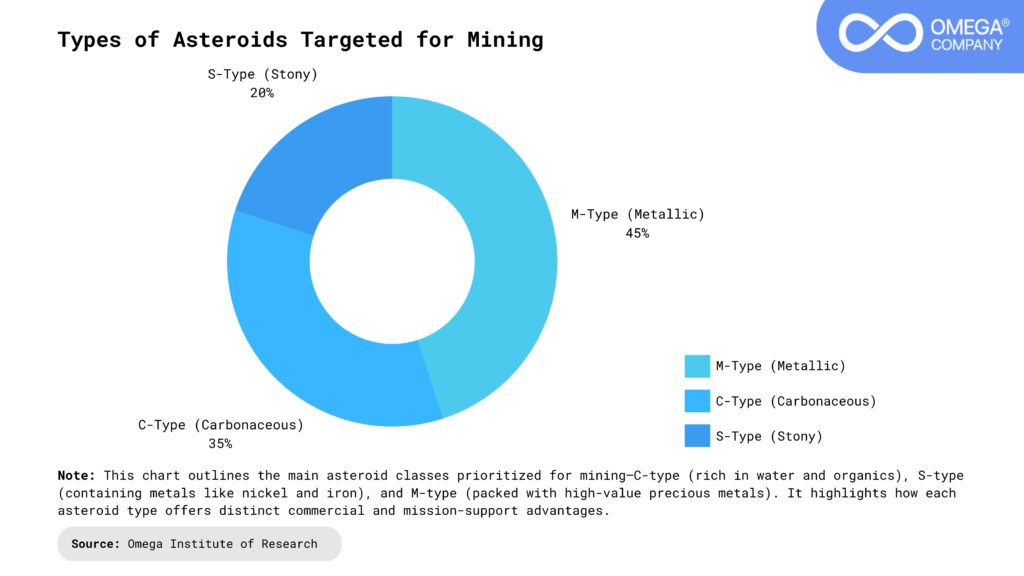
Identifying the Right Asteroids: Using telescopes and space probes, scientists analyze asteroid surfaces through spectroscopy to determine their composition and mining potential. The most promising targets include C-type asteroids rich in water, S-type asteroids containing iron and nickel, and M-type asteroids filled with precious metals like platinum. Each type offers unique benefits for fuel production, construction, or economic return. Choosing the right asteroid is crucial for mission success and long-term profitability.
Robotics and Autonomous Mining: Because sending humans into deep space is extremely costly and risky, mining operations rely heavily on robotics and autonomous systems. Advanced drilling robots, AI-powered rovers, and 3D-mapping technologies work together to explore, extract, and process materials in harsh space environments. These machines can operate continuously without human intervention, increasing efficiency and reducing mission costs. In-space manufacturing units will further enhance productivity by turning raw materials directly into usable components.
Transporting Resources: Once materials are extracted, they can be processed on-site, stored in orbital depots, or transported back to Earth depending on their value and purpose. Some resources, such as water or metals, may be used immediately in space to build habitats, fuel spacecraft, or support long-duration missions. Others, like platinum-group metals, may be sent to Earth for commercial use. Efficient transport systems ensure that asteroid mining becomes both practical and economically viable.
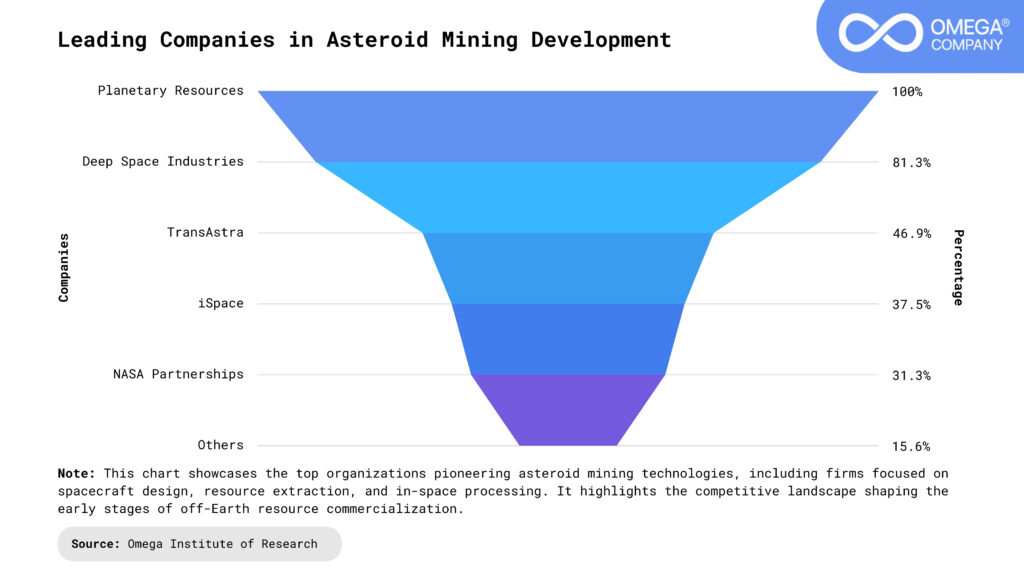
Who Is Leading the Space Mining Race?
Several countries and private companies are already placing their bets:
NASA: NASA is at the forefront of asteroid exploration, most notably through its OSIRIS-REx mission, which studied the near-Earth asteroid Bennu and successfully returned samples in 2023. These samples provide crucial insights into asteroid composition, helping scientists evaluate their mining potential. NASA’s ongoing research aims to develop better mapping, navigation, and extraction technologies that future missions will rely on. With its vast experience and technological leadership, NASA continues to shape the direction of the global asteroid mining ecosystem.
European Space Agency (ESA): The European Space Agency is heavily investing in in-orbit resource utilization, focusing on technologies that will allow humans to use space materials directly rather than transporting everything from Earth. ESA’s missions and research programs explore how asteroid resources can support sustainable space operations and long-term human presence beyond Earth. Their work includes robotic extraction techniques, fuel production concepts, and partnerships with private companies. By enabling on-site manufacturing and resource processing, ESA plays a critical role in building a scalable space economy.
Japan’s JAXA: Japan’s space agency, JAXA, has achieved historic breakthroughs by returning samples from asteroids Ryugu and Itokawa making Japan one of the first nations to bring back material from multiple asteroids. These missions have advanced global understanding of asteroid chemistry, water content, and resource availability. JAXA’s sophisticated sample-return technology demonstrates the precision needed for future mining missions. By leading in this field, Japan positions itself as a key contributor to the science and strategy behind asteroid resource extraction.
Planetary Resources: Planetary Resources was one of the first private companies to publicly embrace the idea of asteroid mining, pioneering early concepts and raising global awareness of the industry’s potential. Although the company shifted focus in recent years, its legacy continues through the technology, partnerships, and research it inspired. Planetary Resources helped establish commercial interest in off-world materials, pushing asteroid mining into mainstream conversation. Its early innovations continue to influence how new companies approach exploration, robotics, and mission planning.
Deep Space Industries: Deep Space Industries focused on developing advanced spacecraft designed specifically for asteroid exploration and mining missions. The company worked extensively on propulsion systems, small exploration vehicles, and resource extraction techniques suitable for low-gravity environments. Although it later pivoted to other space technologies, its research laid essential groundwork for future mining efforts. Deep Space Industries played a vital role in shaping industry standards and demonstrating the feasibility of small, efficient spacecraft for deep-space resource missions.
SpaceX & Blue Origin: SpaceX and Blue Origin may not be mining asteroids directly, but they are enabling the industry by dramatically reducing launch costs. Affordable and reusable rockets make it possible for mining missions to become financially viable, lowering barriers for both governments and private companies. Their advancements in reusable launch vehicles and heavy-lift rockets create the infrastructure needed to send mining equipment, robots, and processing units into space. By transforming space logistics, these companies act as the backbone of the future space mining economy.
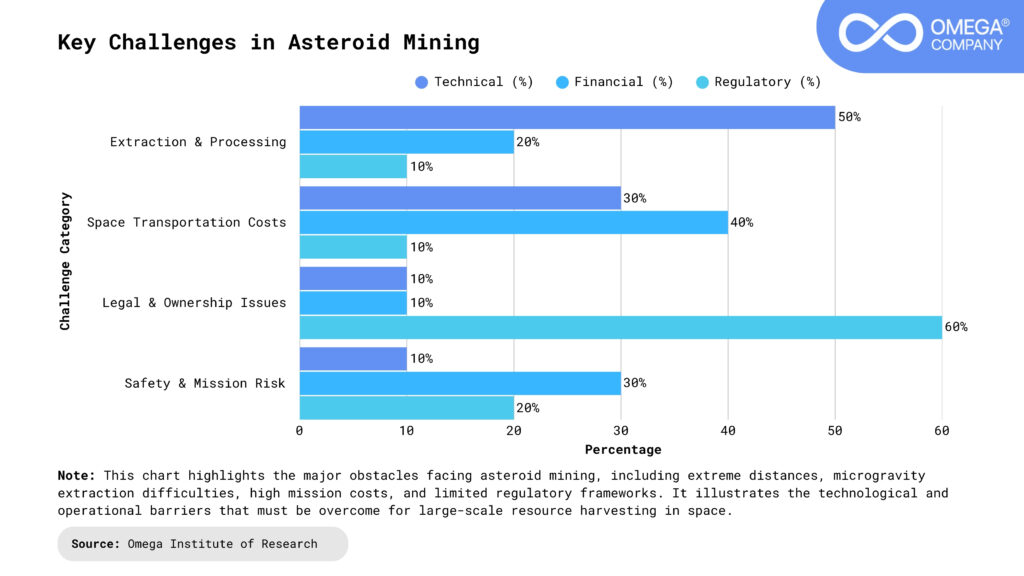
Challenges and Risks
While promising, asteroid mining faces several challenges:
Technological Barriers: Mining in microgravity is extremely complex and demands advanced robotics, autonomous systems, and powerful energy sources capable of operating far from Earth. Equipment must be able to drill, extract, sort, and process materials in harsh environments where traditional mining techniques do not work. Reliable communication systems, long-lasting materials, and self-repairing machines will also be crucial for mission success. These technologies are still in development, and creating robust, space-ready mining systems remains one of the industry’s biggest hurdles.
High Costs: Launching, testing, and operating asteroid mining missions require massive financial investments, often reaching billions of dollars. The cost of building spacecraft, preparing mining equipment, and conducting deep-space missions remains extremely high despite recent reductions in launch expenses. Long development timelines make it difficult for investors to forecast returns, slowing private-sector involvement. Until costs decrease and technologies mature, asteroid mining will remain a high-risk venture accessible only to governments and major aerospace companies.
Regulatory Uncertainty: Space law is still evolving, particularly around resource ownership, environmental guidelines, and the ethical use of extraterrestrial materials. There is no global consensus on who can claim, mine, or profit from asteroid resources, leading to legal ambiguity for companies planning missions. International treaties attempt to guide fair use of space, but many details remain unclear or outdated. Without strong and unified regulations, asteroid mining companies face significant uncertainty that could delay progress and discourage large-scale investment.
Market Instability: An influx of precious metals from asteroids could dramatically shift global supply and demand, potentially lowering market prices and reducing profitability. Investors may hesitate to support asteroid mining if they fear economic volatility or price crashes caused by sudden changes in resource availability. Companies must carefully plan extraction rates, market timing, and distribution strategies to avoid destabilizing existing industries. Balancing resource supply with market sustainability will be essential to making asteroid mining financially viable.
Ethical and Environmental Considerations: Although asteroid mining avoids harming Earth’s ecosystems, it raises new ethical questions about space stewardship, long-term sustainability, and the potential creation of space debris. Mining operations could damage celestial bodies, alter orbital paths, or contribute to pollution in space if not properly managed. Debates continue about who should have the right to extract resources from space and how those benefits should be shared. Developing responsible guidelines will ensure that mining efforts respect both scientific integrity and the future of the space environment.
The Future: A Space Powered Civilization
Asteroid mining could mark the beginning of a truly multi-planetary economy, transforming how humanity builds, travels, and thrives in space. In the future, colonies may be constructed using metals extracted directly from asteroids, supported by fuel depots operating in Earth and lunar orbit to power long-distance missions. Regular cargo routes could connect planets and moons, enabling a steady flow of materials, technology, and supplies. Advanced 3D printing systems may produce spacecraft and habitats entirely in space, reducing reliance on Earth-based manufacturing. As private companies race to mine the most valuable asteroids, a new era of innovation, competition, and economic expansion will propel humanity into a space-powered civilization. This shift could spark breakthroughs in energy systems, robotics, and interplanetary trade, laying the foundation for a thriving off-world economy. Over time, human settlements may extend deeper into the solar system, supported by abundant resources from asteroid mining. Ultimately, this evolution could redefine our species’ destiny transforming space from a frontier into a permanent home.
Conclusion
Asteroid mining is not just a technological challenge, it is a historic opportunity that has the potential to reshape economies, industries, and the very future of human civilization. As Earth faces growing resource constraints and mounting environmental pressures, the cosmos opens a new frontier filled with abundance and possibility. With global players investing heavily in research, robotics, and space exploration, the race to unlock asteroid riches is already underway. What once seemed like science fiction is rapidly becoming the foundation of a future where humanity thrives not only on Earth but across an interconnected solar system economy. The next gold rush is here and this time, it’s unfolding among the stars. As these efforts accelerate, they could spark new alliances, technologies, and industries that redefine human progress for generations. In the end, asteroid mining may become the key that unlocks our evolution into a truly spacefaring civilization.
- https://medium.com/@roshannanddha/asteroid-mining-the-next-gold-rush-in-space-cd61786076a6
- https://www.aveva.com/en/our-industrial-life/type/article/building-an-economy-in-space-with-asteroid-mining/
- https://www.usatoday.com/story/studiog/life/2025/10/07/asteroid-mining-brings-private-companies-into-the-space-race/85710633007/
- https://www.sciencebuddies.org/science-fair-projects/project-ideas/Astro_p038/astronomy/asteroid-mining-gold-rush-in-space
- https://www.sciencefocus.com/space/space-mining-the-new-goldrush
Subscribe
Select topics and stay current with our latest insights
- Functions