

- Industries
Industries
- Functions
Functions
- Insights
Insights
- Careers
Careers
- About Us

Bio-Inspired Computing: Learning from Nature to Build Smarter Machines







Biological systems have spent billions of years evolving intelligence, efficiency, resilience, and adaptability; from neural networks in the brain to ant colonies’ self-organization and evolution through natural selection, nature has mastered problem-solving at a scale modern computing still strives to reach. While traditional computer systems rely on rigid logic and predefined rules, today’s complex and dynamic challenges demand systems that can adapt, evolve, and learn autonomously. This need has led to the rise of Bio-Inspired Computing, an interdisciplinary approach that models computational systems after biological principles to create smarter, more efficient, and self-optimizing machines that mimic natural mechanisms to operate intelligently, improve continuously, and remain robust in unpredictable environments. Drawing inspiration from the brain, immune systems, swarms, and natural evolution, this paradigm is reshaping AI, robotics, cybersecurity, healthcare, and industrial automation, marking a shift toward machines that self-organize, collaborate, and develop intelligence like living ecosystems.
What is Bio-Inspired Computing?
Bio-Inspired Computing is a field of artificial intelligence that builds algorithms and systems modeled after biological processes such as neural activity, genetic evolution, immune responses, and swarm coordination, shifting away from rigid step-by-step programming toward principles of adaptation, self-learning, and evolution to solve complex real-world problems. Unlike classical computing models rooted in strict logic, bio-inspired systems operate through probability, emergence, and continuous optimization, making them exceptionally effective in large-scale, uncertain, and dynamic environments. These systems excel at pattern recognition, decision optimization, and autonomous adaptation, enabling machines to learn from experience, respond to changing conditions, defend against threats, and collaborate toward shared objectives much like living organisms do in nature. This biological foundation gives bio-inspired computing unmatched flexibility, resilience, and intelligence, positioning it as a transformative leap in how machines think and evolve.

How Bio-Inspired Computing Works
Bio-Inspired Computing systems combine natural behavior models, adaptive algorithms, and distributed architectures to simulate nature’s intelligence. Core components include computational units modeled after biological systems, evolutionary learning cycles, local decision-making, and feedback-driven optimization.
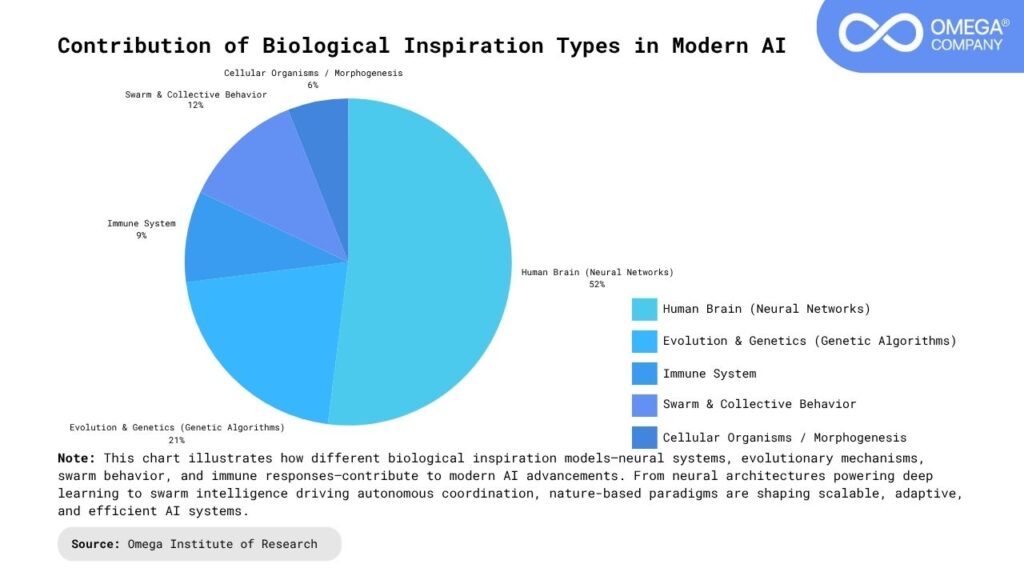
Neural Networks (Inspired by the Human Brain): Neural networks replicate how brain neurons communicate, learn, and store patterns. They receive input, connect through weighted pathways, and continually strengthen or weaken connections based on feedback. Once trained, they perform complex tasks such as image recognition, language understanding, and autonomous navigation. By simulating neural behavior, machines develop cognitive abilities like perception, memory, and pattern recognition.
Genetic Algorithms (Inspired by Evolution): Genetic algorithms apply biological evolution selection, crossover, and mutation to optimize solutions. The system generates variations, evaluates success, and evolves toward the best possible outcome. Over repeated generations, it discovers highly optimized solutions that humans may overlook. This method is widely used in engineering design, finance, robotics, and industrial scheduling.
Swarm Intelligence (Inspired by Ants, Bees & Birds): Swarm models mimic how social organisms solve problems collectively without a central leader. Each agent follows simple rules, yet complex global behavior emerges. This approach is ideal for multi-robot coordination, route optimization, search-and-rescue systems, and decentralized networks. Swarm intelligence proves that cooperation and distributed thinking can outperform centralized control.
Cellular Automata (Inspired by Cell Growth): Cellular automata simulate how simple units following basic rules lead to complex structures similar to cell growth in organisms. These systems help model biological development, disease spread, environmental dynamics, and cryptography. Their power lies in emergence intelligence that grows naturally through interaction rather than being programmed.
Key Benefits of Bio-Inspired Computing
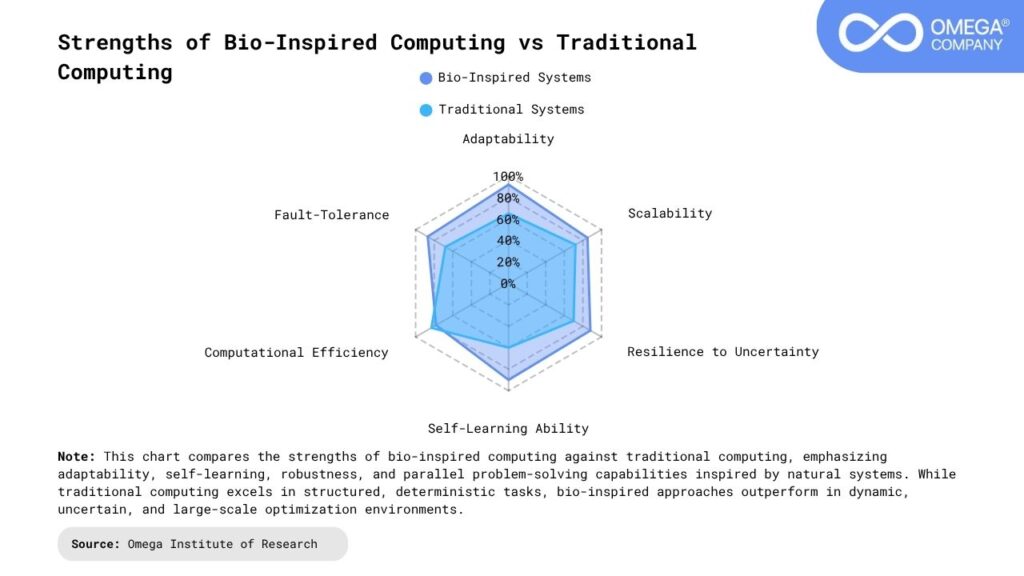
Self-Learning & Adaptation: Systems continuously improve through experience, enabling smarter decisions and optimal performance in changing environments. This adaptive behavior supports dynamic problem-solving in unpredictable or rapidly evolving systems such as supply chains, robotics, and financial trading. By learning from past outcomes and refining strategies over time, these systems become increasingly intelligent and capable of handling scenarios with minimal human intervention.
High Resilience & Security: Inspired by biological immune systems, bio-inspired models detect anomalies, defend against threats, and recover from failures automatically. This provides strong cybersecurity protection and fault-tolerant computing in critical infrastructures such as healthcare, defense, and industrial control systems. As threats evolve, these security models adapt intuitively, allowing systems to remain protected against both known and emerging risks.
Scalability & Efficiency: Nature optimizes energy and resources effectively. Bio-Inspired Computing applies the same logic to reduce computational waste, lower power consumption, and scale efficiently from microchips to large distributed networks. This approach supports sustainable AI and energy-efficient systems. The ability to scale naturally like biological ecosystems enables flexible deployment from wearable devices to global cloud platforms.
Superior Problem-Solving: Evolutionary and swarm-based approaches excel at solving complex, nonlinear problems that are too intricate for traditional logic. This makes them ideal for modeling biological systems, optimizing logistics, designing aircraft, managing smart grids, and performing scientific research. With the capability to explore multiple solutions in parallel like natural evolution, these methods uncover innovative pathways and breakthrough solutions faster than conventional computing models.
Bio-Inspired Computing in Action: Real-World Applications
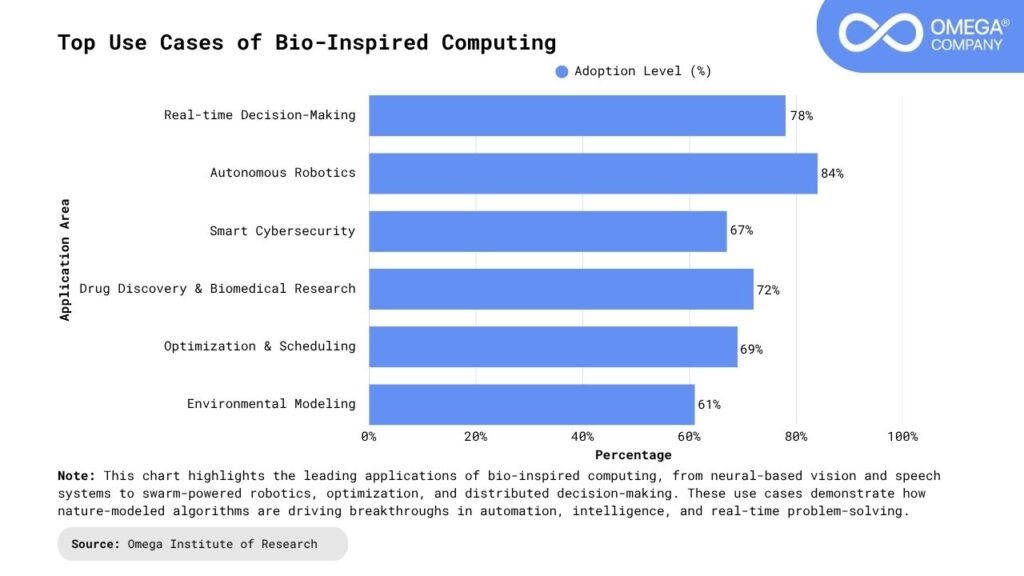
Healthcare: Bio-inspired algorithms accelerate drug discovery by simulating molecular evolution, predict disease patterns, and assist in diagnosis using neural networks. Immune-inspired cybersecurity protects medical records, and bio-robotics enhances surgical precision. These advancements improve patient outcomes and operational efficiency. With evolving machine intelligence, hospitals and research systems can respond to new diseases and medical challenges faster than traditional methods.
Robotics: Swarm robotics enables fleets of drones and robots to collaborate for delivery, exploration, and disaster-response missions. Self-learning robots adapt to environments, navigate uncertain terrain, and evolve behaviors without constant reprogramming ideal for manufacturing, space missions, and defense. As these systems continue learning autonomously, they become more capable of independent decision-making and complex real-world coordination.
Cybersecurity: Artificial immune systems detect anomalies, fight intrusions, and continuously learn new threats mirroring biological immune responses. This adaptive defense model protects finance, government, and telecom networks from evolving cyberattacks. By constantly strengthening itself against new attack patterns, this approach enhances resilience in a world of rapidly changing digital threats.
Finance: Genetic algorithms optimize investment portfolios, predict market patterns, and manage risk dynamically. Neural networks enhance fraud detection, trading automation, and real-time financial analytics, helping institutions make smarter and faster decisions. Over time, these systems refine their strategies to reflect market shifts, improving financial forecasting and competitive advantage.
Transportation & Smart Cities: Swarm intelligence powers traffic optimization, autonomous vehicle decision systems, and connected city services. Vehicles communicate like flocks of birds to avoid collisions, optimize routes, and streamline fleet management, improving safety and efficiency. As smart infrastructure evolves, bio-inspired coordination will support cleaner, faster, and more efficient urban mobility.
Challenges of Bio-Inspired Computing
Biological Complexity: Living systems are extraordinarily complex, and fully replicating natural intelligence remains difficult. Extracting simplified computational models without losing biological intelligence requires advanced scientific and engineering expertise. Researchers must strike a balance between biological accuracy and computational practicality, which often slows development.
High Computational Needs: Training large neural models and simulating evolutionary processes require significant computing power. Efficient hardware, model optimization, and energy-aware systems are essential to scale bio-inspired solutions. As models grow more sophisticated, innovations in neuromorphic chips and distributed computing become increasingly important to reduce resource demands.
Algorithm Transparency: Some bio-inspired models operate as “black boxes,” making decisions difficult to interpret or explain. Explainable AI frameworks are critical to ensure transparency in sensitive applications such as healthcare and finance. Improving interpretability without compromising performance allows organizations to build trust and meet regulatory requirements.
Scalability & System Management: Deploying and coordinating large-scale, distributed bio-inspired systems especially swarms requires careful orchestration and security. Maintaining consistency, version control, and fault tolerance remains challenging in multi-agent environments. Continued advancements in decentralized control and robust coordination frameworks will be key to real-world deployment.
The Future of Bio-Inspired Computing
Neuromorphic Hardware: Chips modeled after the brain will enable ultra-fast, low-power computing for robotics, autonomous vehicles, and edge intelligence. These systems process information like neurons, enabling real-time learning and inference. As neuromorphic technology matures, it will drive breakthroughs in cognitive machines capable of perception, reasoning, and adaptive decision-making similar to biological brains.
Bio-Hybrid Machines: Future robots may combine artificial intelligence with biological tissues or materials, enabling self-healing, flexible, and organic-style movement. This revolution will transform medicine, automation, and material science. In the long run, hybrid biological–synthetic systems could interact seamlessly with living organisms, opening doors to regenerative medicine and advanced prosthetics.
Evolutionary AI: AI that evolves autonomously will design new algorithms, optimize itself, and solve complex problems without human programming. This could lead to major breakthroughs in engineering, chemistry, and scientific discovery. With self-driven improvement cycles, evolutionary AI could surpass human-designed architectures and accelerate innovation at unprecedented speeds.
Eco-Inspired Computing & Sustainability: Nature-driven optimization will power energy-efficient computing, smart grids, and sustainable automation. These models will help reduce carbon footprints and improve resource utilization across industries. As industries adopt greener technologies, bio-inspired sustainability frameworks will support climate-smart cities, circular economies, and resilient global infrastructure.
Conclusion
Bio-Inspired Computing marks a pivotal shift from traditional rule-based systems to adaptive, evolving, and intelligent computing modeled after nature itself, harnessing principles from the brain, immune systems, evolution, and collective animal behavior to create machines that learn, self-optimize, collaborate, and grow smarter over time. As industries increasingly require resilient systems capable of handling complexity and uncertainty, bio-inspired intelligence will power breakthroughs in automation, scientific discovery, cybersecurity, and sustainable technology. Organizations that adopt these strategies will unlock transformative advantages — developing computing systems that don’t just execute tasks but think, adapt, and evolve like living organisms. With rapid advancements in neuromorphic chips, swarm robotics, and hybrid biological-AI systems, the future belongs to machines that are not merely engineered but inspired by life itself, ushering in a new era of intelligent, self-organizing, and resilient technology.
- https://openbioinformaticsjournal.com/VOLUME/16/ELOCATOR/e187503622305100/FULLTEXT/
- https://www.sciencedirect.com/science/article/pii/S2314728818300631
- https://arxiv.org/html/2411.15243v1
- https://www.inderscience.com/jhome.php?jcode=ijbic
- https://link.springer.com/book/10.1007/978-3-031-78937-3
Subscribe
Select topics and stay current with our latest insights
- Functions