

- Industries
Industries
- Functions
Functions
- Insights
Insights
- Careers
Careers
- About Us

Build vs Buy AI: A Strategic Decision Framework for Leaders







Artificial Intelligence has transitioned from an experimental capability to a core pillar of enterprise strategy, with organizations no longer questioning whether to adopt AI but instead determining how deeply and how quickly to integrate it into business processes, customer experiences, and decision-making systems. At the center of this transformation lies a critical strategic dilemma: whether to build AI internally or buy AI solutions externally. This decision extends far beyond simple technology selection, influencing long-term innovation capacity, cost structures and ROI timelines, data ownership and competitive advantage, as well as organizational agility and scalability. It also determines how effectively organizations can differentiate themselves in increasingly AI-driven markets while responding to evolving customer expectations and competitive pressures. In addition, the choice impacts the organization’s ability to control intellectual property, ensure compliance, and adapt AI capabilities over time as business needs evolve. Leaders must recognize that AI is not merely a tool but a fundamental shift in the operating model, and therefore, the Build vs Buy decision should be treated as a board-level strategic priority rather than an isolated IT choice.
Understanding the Build vs Buy AI Spectrum
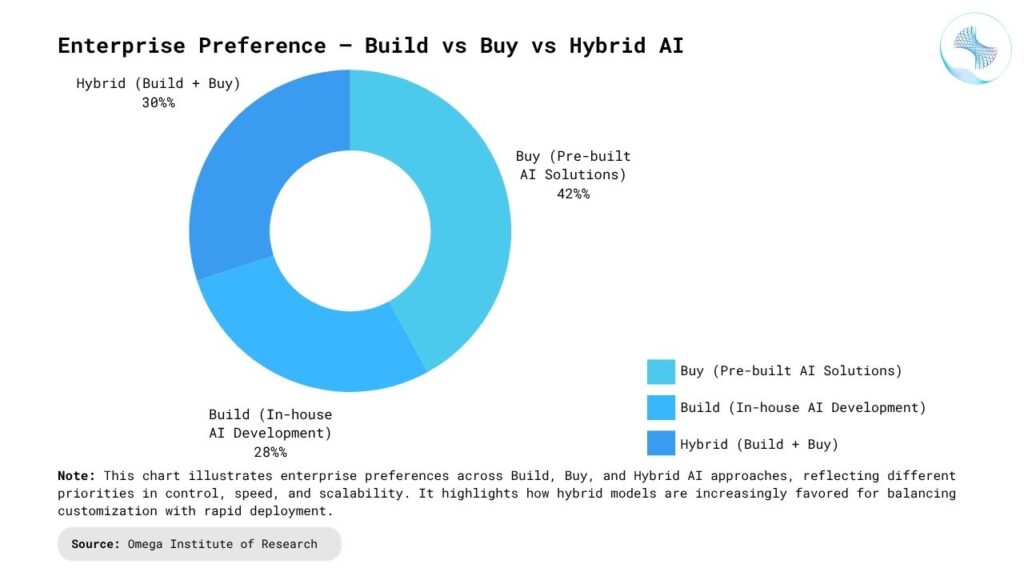
The traditional thinking of “build or buy” in AI strategy is increasingly outdated, as most organizations now operate across a continuum of adoption models rather than choosing a single approach. At one end is the build, or full ownership model, where organizations develop algorithms and models from scratch, create proprietary data pipelines, and manage infrastructure and deployment internally; this approach provides maximum control and differentiation but demands significant investment, talent, and time. At the other end is the buy, or consumption model, which involves leveraging SaaS-based AI tools, pre-trained models, APIs, and AI-powered enterprise platforms to prioritize speed, simplicity, and cost efficiency, enabling rapid adoption without deep technical expertise. Between these extremes lies the hybrid, or orchestrated model, which has become the most common and effective approach, where organizations combine third-party platforms with internal customization, build only the components that drive competitive advantage, and seamlessly integrate external capabilities into their internal ecosystems to balance innovation, scalability, and efficiency.
Why This Decision Matters More Than Ever
The urgency around Build vs Buy AI has intensified due to several macro trends:
Explosion of AI Capabilities: The rapid rise of generative AI, automation, and predictive analytics has significantly expanded the scope of AI applications across industries. Organizations now have access to advanced capabilities that can transform operations, customer engagement, and decision-making. This growth makes the Build vs Buy decision more complex, as the range of possibilities continues to evolve quickly.
Democratization of AI: AI is no longer confined to large technology companies with vast resources and specialized talent. With the availability of cloud platforms, pre-trained models, and APIs, even mid-sized organizations can implement sophisticated AI solutions. This accessibility has lowered entry barriers, making the decision less about feasibility and more about strategic alignment.
Competitive Pressure: Organizations that adopt AI faster are gaining a significant competitive edge in their respective markets. They are achieving higher operational efficiency, deeper customer insights, and faster innovation cycles compared to slower adopters. As a result, the Build vs Buy decision directly impacts an organization’s ability to compete and grow.
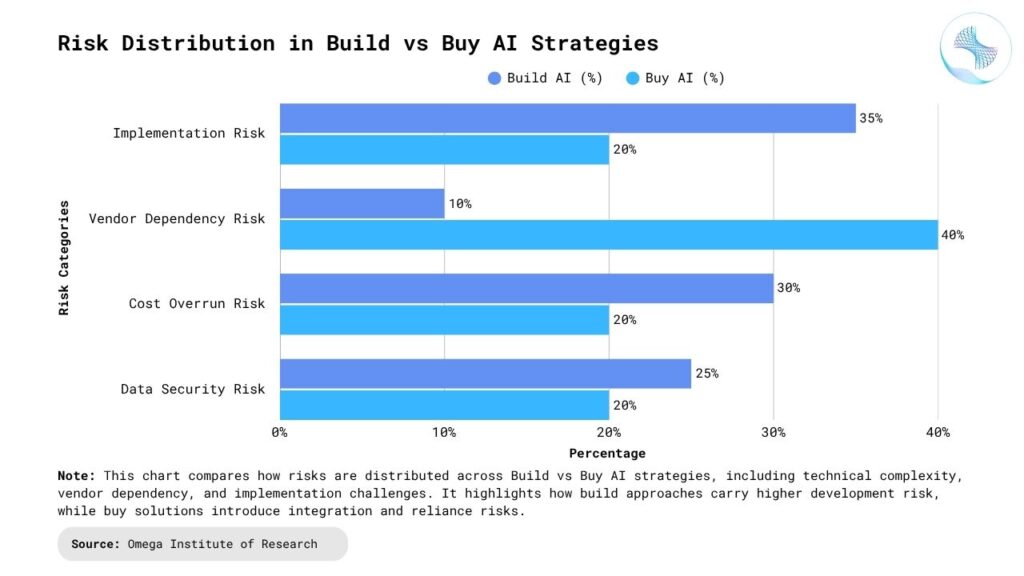
Strategic Risk: Making the wrong Build vs Buy decision can introduce substantial long-term risks for organizations. These include accumulating technical debt, becoming dependent on specific vendors, and missing critical market opportunities. Therefore, leaders must carefully evaluate their choices to avoid constraints that could limit future growth and flexibility.
The Strategic Decision Framework
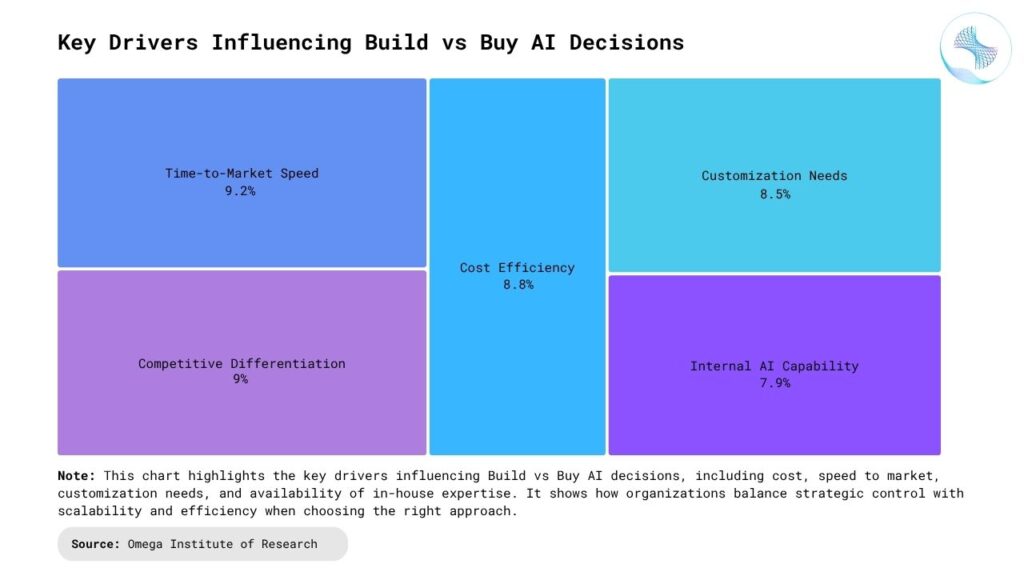
Business Value and Strategic Differentiation: This is the most critical factor in the Build vs Buy decision, as it determines whether AI will create a lasting competitive advantage. Leaders must evaluate whether AI contributes to their unique market position and whether it is central to their core offerings. Organizations should build AI when differentiation depends on proprietary algorithms and insights that competitors cannot replicate, while buying is more suitable for standardized functions where uniqueness is not required. If every competitor can access the same AI capability, it cannot serve as a sustainable differentiator. The decision must align with how AI strengthens long-term strategic value.
Speed to Market: In fast-moving markets, speed often outweighs perfection in delivering business value. The build approach requires time for development, testing, and iteration, making it suitable for long-term strategic initiatives. In contrast, the buy approach enables rapid deployment, allowing organizations to experiment and validate use cases quickly. Many high-performing organizations adopt a phased strategy by buying first and building later for scale. This balance between immediate impact and long-term value is a key strategic consideration.
Cost and Total Cost of Ownership (TCO): AI costs are often underestimated when organizations focus only on initial investments. Building AI involves expenses such as hiring specialized talent, infrastructure setup, and continuous model maintenance and scaling. Buying AI includes subscription fees, licensing, and integration costs that can accumulate over time. Leaders must evaluate the total cost of ownership rather than short-term affordability. While building requires higher upfront investment, it can deliver stronger returns at scale.
Talent and Capability Readiness: AI success depends heavily on the availability of skilled talent and organizational readiness. Building AI requires expertise in data science, machine learning, MLOps, and governance, which are in high global demand. Buying AI reduces the need for deep technical skills and shifts focus toward implementation and usage. However, organizations still need internal capability to manage and scale solutions effectively. The shortage of AI talent makes in-house development challenging for many organizations.
Data Availability and Ownership: Data is the foundation of AI, making its availability and uniqueness critical in decision-making. Organizations should build AI when they have large volumes of proprietary, high-quality data that can generate unique insights. Buying AI is more suitable when data needs are generic and pre-trained models are sufficient. The real advantage lies in leveraging exclusive data assets for differentiation. Leaders must assess the strategic value of their data before deciding.
Customization and Flexibility: The need for customization plays a key role in choosing between build and buy approaches. Building AI offers full control over model design and allows adaptation to complex and evolving requirements. Buying AI provides limited customization and depends on vendor capabilities. For organizations with unique processes, off-the-shelf solutions may not deliver optimal results. The decision should reflect how much flexibility the business requires.
Scalability and Integration: AI systems must integrate seamlessly with enterprise systems, data platforms, and workflows to deliver value. Building AI is preferred when deep integration and complex scalability requirements are needed. Buying AI works well when vendors offer plug-and-play solutions for standard needs. Integration challenges are often underestimated and can delay adoption. Organizations must evaluate how well AI fits into their existing ecosystem.
Risk, Compliance, and Governance: AI introduces risks such as data privacy issues, bias, and regulatory challenges. Building AI provides full control over governance but also places complete responsibility on the organization. Buying AI shares responsibility with vendors but creates dependency on their compliance and transparency. Regardless of the approach, responsible AI practices are essential for trust and reputation. Leaders must prioritize governance as a core part of AI strategy.
The Hybrid Approach: Best of Both Worlds
Most leading organizations adopt a hybrid AI strategy to balance speed, cost, and competitive differentiation effectively. In this approach, companies use external AI platforms for foundational capabilities while building proprietary models in areas that directly drive strategic advantage. Both internal and external components are then integrated into a unified ecosystem that aligns with business processes and data systems. This model enables faster implementation and reduces initial investment while still maintaining control over critical capabilities. It also allows organizations to experiment with new technologies without committing excessive resources upfront. Over time, they can scale what works best while continuously refining their AI capabilities for greater impact. Additionally, this approach provides flexibility to adapt to changing market conditions and technological advancements. It ensures that organizations are not locked into a single strategy and can evolve their AI investments as business needs grow.
Future Outlook: The Evolution of AI Decision-Making
The Build vs Buy decision will continue to evolve as new technologies and platforms reshape how organizations adopt AI. The rise of low-code and no-code AI platforms is making it easier for non-technical users to develop and deploy AI solutions, reducing reliance on specialized teams. At the same time, the increasing availability of powerful foundation models is enabling organizations to leverage advanced capabilities without building from scratch. The growth of AI ecosystems and marketplaces is further expanding access to ready-to-use solutions and integrations. As a result, organizations will have more flexible and dynamic options to design AI strategies that balance speed, cost, and innovation. This shift will also encourage greater experimentation, allowing businesses to test and iterate AI use cases more rapidly. Additionally, partnerships between technology providers and enterprises will play a larger role in shaping AI adoption strategies. Over time, decision-making will become more continuous and adaptive rather than a one-time strategic choice.
Conclusion
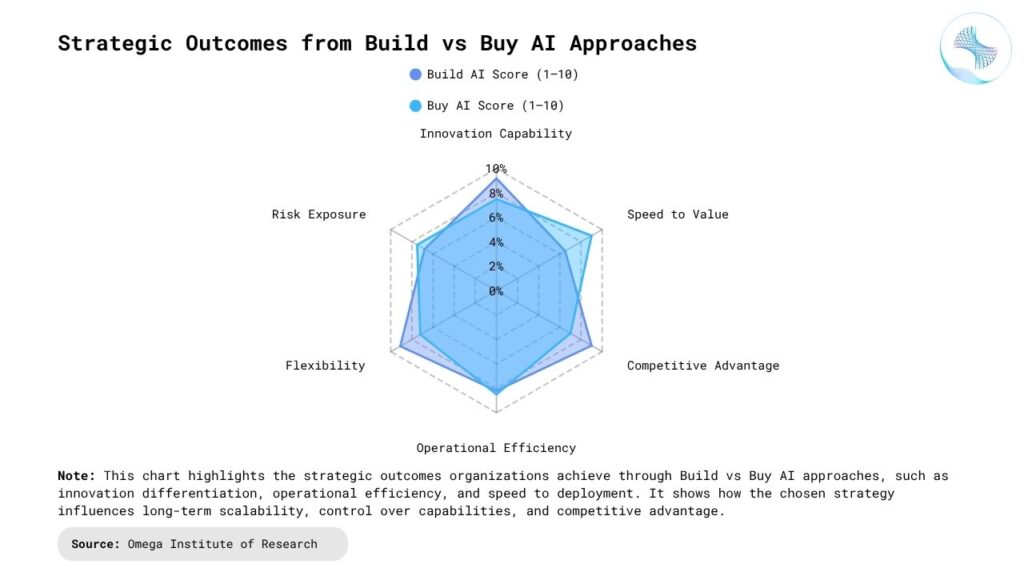
The Build vs Buy AI decision is not merely a technological choice but a strategic one that shapes value creation and long-term competitive positioning. Organizations must align their approach with business goals, building AI capabilities where differentiation and competitive advantage are critical. At the same time, buying AI solutions can accelerate speed and improve operational efficiency in areas that do not require uniqueness. A hybrid approach often provides the best balance, enabling scalability while maintaining flexibility across evolving business needs. Leaders should continuously reassess their strategy as technologies and market conditions change. This ensures that AI investments remain aligned with both short-term priorities and long-term ambitions. Ultimately, the most successful organizations are those that align AI decisions closely with their broader business vision and growth objectives.
- https://codingcops.com/build-vs-buy-ai-practical-decision-framework-for-leaders/
- https://www.clickittech.com/ai/build-vs-buy-ai/
- https://productschool.com/blog/leadership/build-vs-buy
- https://hatchworks.com/blog/gen-ai/build-vs-buy-framework/
- https://www.withvayu.com/blog/build-vs-buy-ai-solutions-for-finance
Subscribe
Select topics and stay current with our latest insights
- Functions