

- Industries
Industries
- Functions
Functions
- Insights
Insights
- Careers
Careers
- About Us

Capital Strategy in 2026: Debt, Equity, or Strategic Partnerships?







The global corporate financing environment in 2026 is being reshaped by technological disruption, inflation, geopolitical uncertainty, and evolving investor expectations. Organizations are increasing investments in AI infrastructure, digital transformation, sustainability, and global expansion, making capital strategy a key business priority. Traditional financing methods are shifting toward blended capital structures that combine debt, equity, private credit, and strategic partnerships for greater flexibility and risk management. According to the OECD Global Debt Report 2026, rising AI-related infrastructure investments are significantly increasing external financing needs worldwide. At the same time, investors are emphasizing sustainable growth, governance, and long-term value creation over short-term profitability. In addition, higher interest rates and tighter monetary policies across several economies are forcing companies to become more strategic in capital allocation and financial planning. Businesses are also exploring alternative financing models such as venture debt, revenue-based financing, green bonds, and sovereign investment partnerships to support innovation while maintaining financial resilience in an increasingly volatile global market.
Expansion of Global Debt Markets
Debt financing remains one of the most widely used sources of corporate capital in 2026. Despite previous periods of rising interest rates and market volatility, debt markets have shown remarkable resilience. Improving macroeconomic stability and moderating monetary policies have created favorable borrowing conditions for many corporations. Global corporate borrowing reached record levels in 2025 and continues to rise in 2026. Organizations borrowed approximately USD 13.7 trillion through corporate bonds and syndicated loans, highlighting the increasing dependence on debt markets for expansion and infrastructure investments. The growing financing requirements associated with AI adoption, digital transformation, and large-scale operational modernization have accelerated this trend.
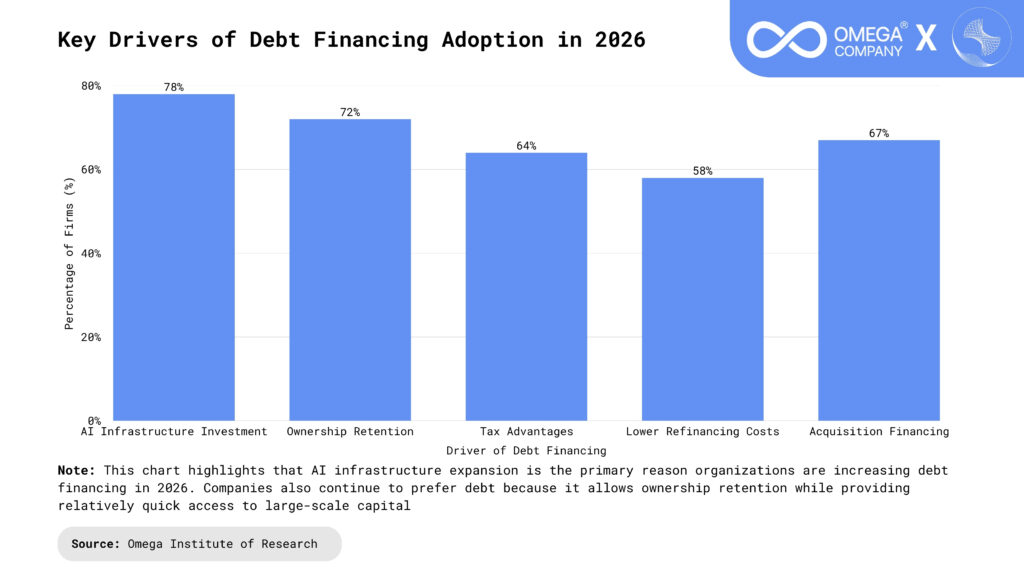
Debt financing remains attractive because it allows firms to access substantial capital while preserving ownership control. Mature organizations with stable cash flows particularly favor debt instruments because they provide predictable repayment structures and tax advantages through deductible interest payments. Furthermore, companies are taking advantage of relatively lower refinancing costs to secure long-term financing before future economic uncertainty potentially increases borrowing expenses. Technology firms have emerged as major debt issuers in recent years. Companies investing heavily in AI infrastructure and cloud computing require enormous capital expenditure, making debt financing an essential tool for scaling operations rapidly.
Advantages of Debt Financing
Debt financing offers several important strategic benefits that continue to make it an attractive funding option in 2026.
Ownership Retention: One of the primary advantages of debt financing is that organizations can raise capital without diluting ownership or surrendering equity stakes. This enables founders, promoters, and existing shareholders to retain full control over strategic decision-making and governance structures. Unlike equity financing, debt does not grant lenders voting rights or direct influence over business operations. As a result, companies can pursue expansion, innovation, or infrastructure investments while preserving managerial autonomy and long-term vision. Ownership retention is particularly beneficial for high-growth organizations that aim to maintain strategic independence and protect future profitability.
Predictable Repayment Structures: Debt financing provides organizations with clearly defined repayment schedules and fixed interest obligations, making financial commitments more predictable and manageable. This structured repayment system enables businesses to forecast cash outflows accurately and maintain greater control over long-term financial planning. Predictability in repayments supports effective budgeting, operational planning, and resource allocation across business functions. Unlike equity financing, debt obligations are established in advance, reducing uncertainty in capital costs over time.
Tax Efficiency: One of the key advantages of debt financing is that interest payments are generally tax-deductible, which lowers the organization’s taxable income and reduces the overall cost of borrowing. This tax benefit improves financial efficiency by enabling companies to retain more cash for operations, expansion, and strategic investments. Compared to equity financing, debt can therefore provide a more cost-effective source of capital.
Quick Access to Capital: Debt financing often enables organizations to secure funds more quickly than equity financing, as it typically involves fewer ownership-related negotiations and simpler approval processes. Faster access to capital allows businesses to respond promptly to growth opportunities, operational needs, and market changes maintaining business continuity.
Risks Associated with Debt Financing
Despite its advantages, debt financing also introduces significant financial and strategic risks. Fixed repayment obligations and interest costs can increase financial pressure, especially during periods of economic uncertainty or reduced business performance.
Interest Rate Risk: Although borrowing conditions may improve over time, fluctuations in interest rates can significantly increase the cost of debt financing. Rising interest expenses can place additional pressure on cash flows, reduce profitability, and affect overall financial stability. This risk is particularly significant for organizations relying on variable-rate or short-term debt instruments
Leverage Risk: Excessive reliance on debt financing increases an organization’s financial leverage and overall repayment burden. High leverage levels can make businesses more vulnerable to economic downturns, declining revenues, or unexpected market disruptions. In such situations, organizations may face liquidity challenges, reduced financial flexibility, and increased default risk.
Liquidity Pressure: Debt financing creates fixed repayment obligations that must be met regardless of business performance or market conditions. This can lead to significant liquidity challenges, especially for companies operating in volatile, cyclical, or rapidly evolving industries. Limited cash flow flexibility may restrict operational spending, investment capacity, and overall financial resilience during periods of uncertainty.
Reduced Strategic Flexibility: Debt financing agreements often include restrictive covenants and contractual obligations that can limit an organization’s operational and financial freedom. These restrictions may affect future borrowing capacity, investment decisions, mergers, acquisitions, or expansion initiatives. As a result, companies may face reduced flexibility in responding quickly to changing market opportunities or strategic priorities.
Evolution of Equity Markets
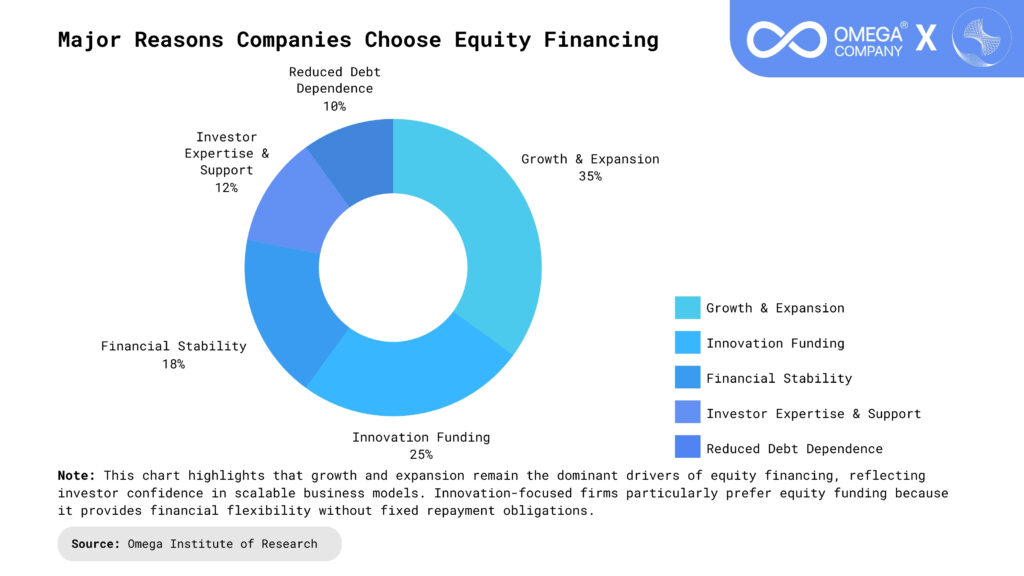
Equity financing continues to play a vital role in supporting business growth and innovation. Unlike debt financing, equity financing does not require fixed repayments, making it particularly attractive for startups, high-growth firms, and companies operating in uncertain markets. Equity markets in 2026 are witnessing renewed activity as investor confidence improves and market conditions stabilize. IPO activity has gradually recovered, while private equity and venture capital investments continue to expand globally. Investors are increasingly focusing on companies with scalable business models, sustainable growth strategies, and strong governance frameworks. Modern equity investors are not merely capital providers; they also contribute expertise, strategic guidance, and market access. Institutional investors and private equity firms increasingly emphasize operational improvement and long-term value creation rather than short-term financial engineering. Furthermore, companies are staying private longer before entering public markets. This trend reflects the growing availability of private capital and the desire among firms to maintain strategic flexibility while scaling operations.
Advantages of Equity Financing
No Mandatory Repayment: Equity financing does not require fixed interest payments or scheduled repayments, allowing organizations greater financial flexibility. This reduces pressure on cash flows and helps businesses manage operations more effectively during periods of economic uncertainty or fluctuating revenues. As a result, companies can focus more on long-term growth, innovation, and strategic investments without immediate repayment burdens.
Enhanced Financial Stability: Equity financing strengthens an organization’s balance sheet by increasing its capital base and reducing reliance on debt obligations. A stronger equity position improves financial resilience, supports long-term sustainability, and enhances the company’s ability to withstand economic uncertainties. It also helps improve investor confidence and overall creditworthiness in the market.
Leadership Evolution: The rise of AI demands that CEOs build new competencies, including a clear understanding of AI’s capabilities and limitations. They must also navigate evolving ethical and regulatory challenges while leading digital and cultural transformation. This shift requires a more hands-on, informed approach to technology. As a result, CEOs become strategic leaders who can bridge business goals with technological innovation.
Higher Risk Absorption: Equity financing enables investors to share the business risk alongside the organization, reducing the financial burden on the company itself. Unlike debt providers, equity investors do not require fixed repayments during challenging periods, providing greater operational flexibility. This allows organizations to better withstand economic downturns, revenue fluctuations, or investment-intensive growth phases.
These benefits make equity financing highly suitable for firms focused on innovation, expansion, and long-term transformation initiatives.
Challenges of Equity Financing
Despite its advantages, equity financing also involves several strategic and financial trade-offs. Organizations may face reduced ownership control, profit-sharing obligations, and increased pressure from investors regarding business performance and long-term decision-making.
Ownership Dilution: Issuing equity financing reduces the ownership stake of existing shareholders and founders by distributing shares to new investors. This dilution can limit decision-making authority and reduce control over strategic business directions. As investor participation increases, organizations may also face greater influence from external stakeholders on governance and operational priorities.
Investor Influence: Equity investors often seek board representation, voting rights, and greater involvement in corporate governance and strategic decision-making. Their influence can shape business priorities, operational strategies, and long-term growth plans. In some cases, increased investor involvement may reduce managerial autonomy and create pressure to meet shareholder expectations
Pressure for High Growth: Equity investors, particularly venture capital and public market shareholders, often expect rapid revenue growth and strong financial performance. These expectations can create significant operational pressure on management teams to deliver continuous expansion and profitability. As a result, organizations may prioritize short-term performance targets alongside long-term strategic objectives.
Complex Regulatory Requirements: Equity financing, particularly through public markets, requires organizations to comply with extensive regulatory and disclosure obligations. Companies must maintain high levels of transparency through regular financial reporting, governance standards, and compliance procedures.
Strategic Partnerships as a Capital Strategy
Strategic partnerships are emerging as a major component of capital strategy in 2026. Instead of relying exclusively on debt or equity, organizations are increasingly entering collaborative arrangements to share resources, reduce risk, and accelerate growth. Strategic partnerships have emerged as an important financing and growth mechanism for organizations in 2026. These partnerships may include joint ventures, technology alliances, co-investment structures, public-private partnerships, and strategic investor collaborations. Through such arrangements, companies can access not only capital but also advanced technology, operational expertise, industry knowledge, and new market opportunities.
This collaborative approach allows organizations to share risks, strengthen competitive capabilities, and accelerate innovation while avoiding excessive financial leverage or significant ownership dilution. The growth of private capital partnerships is reshaping global financing structures. Recent large-scale transactions increasingly combine debt, equity, and institutional partnerships to create more flexible financing models.
Benefits of Strategic Partnerships
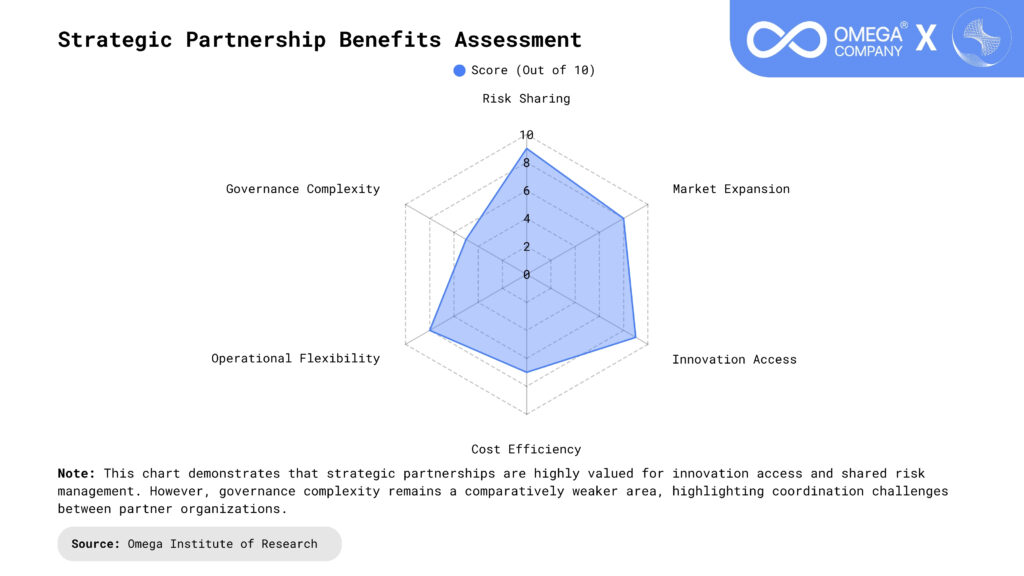
Shared Financial Risk: Strategic partnerships allow organizations to distribute investment and operational risks among multiple stakeholders. This reduces individual financial exposure and improves overall business resilience.
Shared Financial Risk: Strategic partnerships allow organizations to distribute investment and operational risks among multiple stakeholders. This reduces individual financial exposure and improves overall business resilience.
Access to Expertise and Innovation: Partnerships provide access to advanced technologies, specialized industry knowledge, and operational expertise. This helps organizations accelerate innovation and improve strategic capabilities.
Faster Market Expansion: Strategic alliances enable companies to enter new markets, customer segments, and geographic regions more efficiently. Partner networks and local expertise can significantly accelerate market penetration.
Resource Optimization: Partners can share infrastructure, technology platforms, talent, and operational resources to reduce costs and investment requirements. This improves efficiency while supporting scalable business growth.
This model is particularly valuable in industries requiring substantial infrastructure investment such as AI, renewable energy, healthcare, and telecommunications.
Challenges in Strategic Partnerships
Despite their advantages, strategic partnerships also introduce governance complexities.
Conflicting Objectives: Partners may have differing strategic goals, priorities, or investment expectations, which can create alignment challenges and affect long-term collaboration effectiveness.
Decision-Making Complexity: Consensus-based governance structures can slow decision-making, reduce organizational agility, and delay the execution of strategic initiatives.
Intellectual Property Concerns: Collaborative innovation initiatives may lead to disputes over intellectual property ownership, data rights, and the commercial use of shared technologies
Operational Integration Challenges: Integrating systems, processes, and organizational cultures across partner firms can be complex, time-consuming, and resource-intensive for organizations
Successful strategic partnerships require strong governance frameworks, clearly defined roles, and transparent decision-making structures to ensure effective collaboration. Organizations must establish aligned strategic objectives, risk-sharing mechanisms, and communication processes to minimize conflicts and improve operational coordination. Clearly defined responsibilities and performance expectations also help strengthen accountability, build trust among stakeholders, and support long-term partnership success.
Debt vs Equity vs Strategic Partnerships
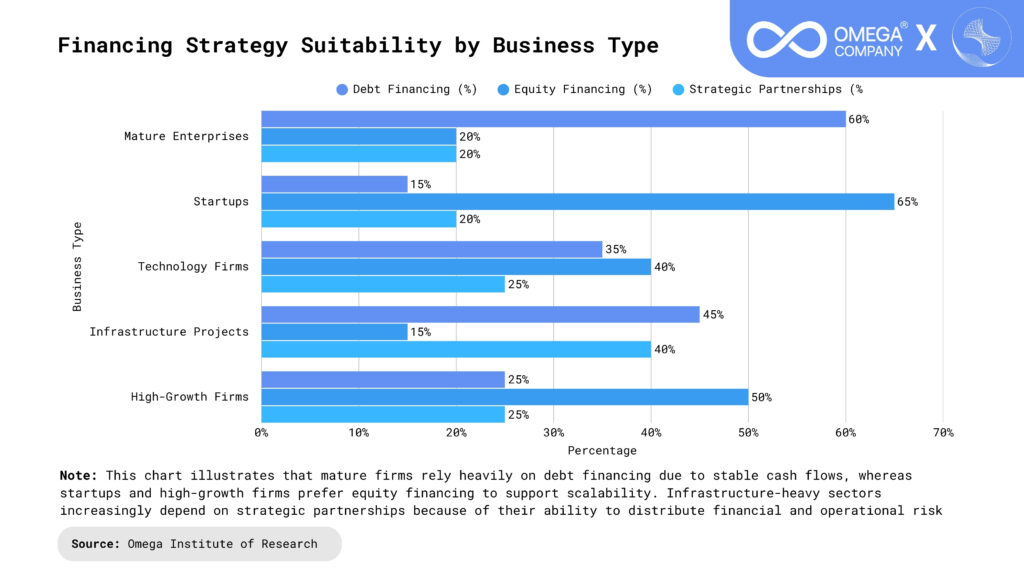
Debt financing is generally most suitable for mature organizations with stable revenues and predictable cash flows, as they can comfortably manage fixed repayment obligations. Equity financing is often preferred by growth-oriented companies seeking capital for innovation, expansion, and scalability without immediate repayment pressure. In contrast, strategic partnerships are ideal for organizations that require shared investments, technological collaboration, operational expertise, or access to new markets. The choice of financing approach ultimately depends on the company’s growth stage, risk appetite, financial position, and long-term strategic objectives. Increasingly, organizations are adopting hybrid capital models that combine debt financing, equity funding, and strategic partnerships to achieve greater financial flexibility and strategic balance. This integrated approach enables companies to diversify funding sources, reduce risk concentration, and strengthen operational resilience.
Conclusion
Capital strategy in 2026 is increasingly shaped by flexibility, strategic alignment, and long-term resilience, as organizations move beyond relying solely on traditional debt or equity financing toward more diversified and hybrid funding models. Debt financing continues to offer businesses predictable capital access while preserving ownership, whereas equity financing provides long-term financial stability along with strategic investor support and growth opportunities. At the same time, strategic partnerships are becoming essential for accelerating innovation, sharing operational risks, and enabling collaborative expansion in highly competitive markets. The most effective financing approach ultimately depends on a company’s growth objectives, financial strength, industry dynamics, and risk tolerance. As global markets continue to evolve under the influence of economic uncertainty, technological disruption, and changing investor expectations, businesses must adopt balanced and adaptable capital strategies. Organizations that succeed in 2026 will be those that treat capital not simply as a source of funding, but as a strategic enabler of innovation, resilience, scalability, and sustainable competitive advantage.
- https://www.dfinsolutions.com/knowledge-hub/blog/capital-market-trends-outlook-2026
- https://www.oecd.org/en/publications/global-debt-report-2026_e9d80efd-en/full-report/corporate-debt-market-outlook-in-a-transforming-world_cf86a220.html?
- https://www.reuters.com/world/asia-pacific/private-finance-structures-drive-bumper-japan-ma-into-2026-goldman-says-2025-12-12/?
- https://www.wsj.com/articles/tpg-boosts-credit-strategies-through-12-billion-deal-with-insurer-jackson-financial-7dc9774c?
- https://link.springer.com/chapter/10.1007/978-3-032-19672-9_4?
Subscribe
Select topics and stay current with our latest insights
- Functions