

- Industries
Industries
- Functions
Functions
- Insights
Insights
- Careers
Careers
- About Us

Federated Learning for Privacy-Preserving AI







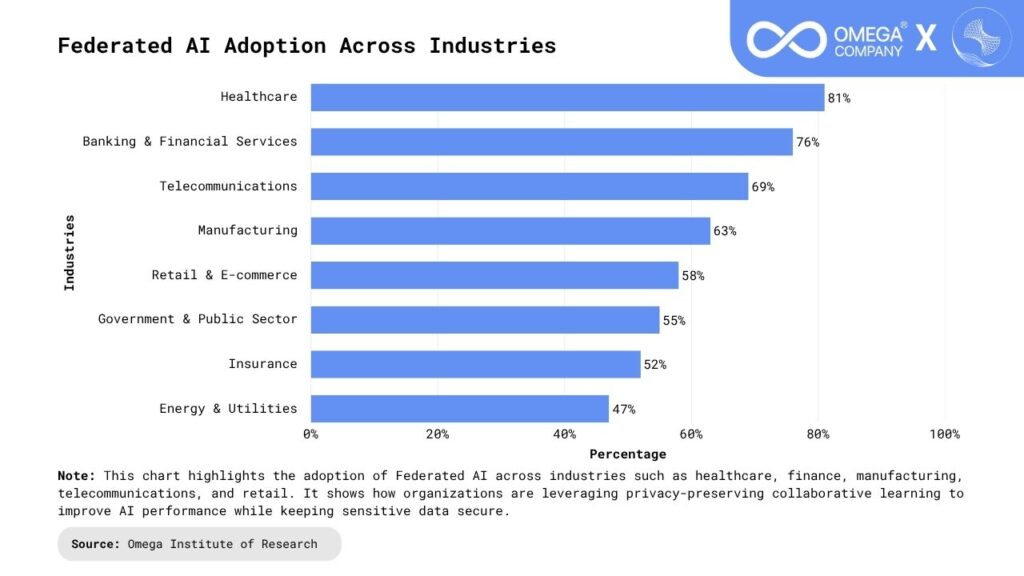
Artificial Intelligence (AI) has become a transformative technology, enabling organizations to automate processes, generate insights, personalize customer experiences, and improve decision-making. However, traditional AI relies on centralized data collection, raising significant concerns around privacy, security, regulatory compliance, and data ownership under laws such as GDPR, CCPA, HIPAA, and India’s Digital Personal Data Protection (DPDP) Act. Federated Learning (FL) addresses these challenges by enabling AI models to train locally where the data resides, sharing only model updates instead of raw data. This privacy-preserving approach reduces security risks while maintaining model performance, making Federated Learning a powerful solution for industries such as healthcare, banking, manufacturing, telecommunications, retail, automotive, and government that require secure, distributed, and compliant AI systems.
What is Federated Learning?
Federated Learning is a distributed machine learning approach that enables multiple participants, such as smartphones, hospitals, banks, edge devices, or enterprise servers, to collaboratively train a shared AI model without exchanging their underlying data. Instead of transferring sensitive information to a centralized repository, each participant keeps data locally, trains the model on its own dataset, and shares only encrypted model updates with a central server, which aggregates them to create an improved global model. This collaborative learning process is repeated over multiple training rounds, allowing the model to continuously improve while preserving data privacy. By ensuring that raw data never leaves its original location, Federated Learning enhances privacy, strengthens security, reduces the risk of data breaches, and enables organizations to develop highly accurate AI models from distributed data sources. This makes Federated Learning an ideal solution for industries handling sensitive information, where regulatory compliance, data confidentiality, and trustworthy AI are essential.
Why Privacy Matters in AI
Modern AI systems often rely on personal information such as:
Medical Records: Healthcare data contains highly sensitive personal information that must remain confidential. Privacy-preserving AI enables hospitals to build accurate diagnostic models without exposing patient records or violating healthcare regulations. This approach supports secure medical research and collaboration while maintaining patient trust and data confidentiality.
Banking Transactions: Financial institutions process millions of confidential transactions every day. Protecting this data helps prevent fraud, identity theft, and unauthorized access while supporting secure AI-driven financial services. It also enables banks to improve risk assessment and fraud detection without compromising customer privacy.
Customer Purchase Histories: Retailers use purchase history to understand customer preferences and deliver personalized experiences. Keeping this information private builds customer trust and ensures compliance with data protection regulations. Privacy-preserving AI allows businesses to generate valuable insights while safeguarding sensitive consumer information.
Location Data: Location information reveals users’ movements, routines, and daily activities, making it highly sensitive. Privacy-preserving AI allows organizations to generate valuable insights without compromising individual privacy. This enables applications such as navigation, logistics, and smart city services while protecting user identities.
Biometric Information: Biometric data, such as fingerprints, facial recognition, and iris scans, is unique and cannot be replaced if compromised. Secure AI techniques protect this information while enabling reliable identity verification and authentication. This ensures stronger security for digital services while reducing the risk of unauthorized access and identity fraud.
How Federated Learning Works
The Federated Learning process typically consists of several coordinated stages.
Initialize the Global Model: The federated learning process begins with a central server creating an initial machine learning model and distributing it to participating devices or organizations. This shared model serves as the starting point for collaborative training. Every participant receives the same model without exchanging any local data.
Local Training: Each participant trains the shared model using only the data stored within its own environment, such as hospitals using patient records, banks using transaction data, smartphones using user activity, or retailers using customer purchases. Since all training occurs locally, sensitive information never leaves the device or organization. This ensures data privacy while allowing the model to learn from diverse datasets.
Model Update Generation: After local training is complete, participants generate model updates that capture the knowledge learned during training. These updates include model weights, gradients, or training parameters instead of the original datasets. As a result, valuable insights are shared without exposing confidential or personal information.
Secure Aggregation: The central server securely collects model updates from all participants and combines them using aggregation techniques such as Federated Averaging (FedAvg). This process merges the collective learning into a single, improved global model. Since only model updates are aggregated, data privacy is preserved throughout the process.
Global Model Redistribution: The improved global model is redistributed to all participants, where it undergoes another round of local training using newly available data. This collaborative cycle continues until the model reaches the desired level of accuracy and performance. Over multiple iterations, the AI system becomes increasingly intelligent without requiring centralized data collection.
Federated Learning Architecture
A typical Federated Learning ecosystem consists of several interconnected components:
Central Coordination Server: The central coordination server acts as the core of the federated learning architecture by managing the overall training process. It distributes the global AI model to participating devices or organizations and collects their model updates after local training. Rather than accessing raw data, it aggregates learned parameters to create an improved global model. This enables collaborative learning while maintaining data privacy across all participants.
Local Devices or Organizations: Local devices or organizations, such as smartphones, hospitals, banks, and enterprises, store data and perform model training within their own environments. Since the data never leaves these locations, sensitive information remains protected from unauthorized access. Each participant contributes knowledge by sharing only model updates with the central server. This decentralized approach enhances both privacy and scalability.
Secure Communication Network: A Secure Communication Network enables encrypted transmission of model updates between participants and the central server. It protects the learning process from interception, tampering, and cyberattacks during data exchange. Secure communication protocols ensure that only authorized participants can contribute to the collaborative model. This creates a trusted environment for distributed AI training.
Aggregation Engine: The Aggregation Engine combines model updates received from multiple participants into a single, improved global model. Algorithms such as Federated Averaging (FedAvg) merge the learned knowledge without exposing individual datasets. By integrating contributions from diverse sources, the engine continuously improves model accuracy and performance. It is a critical component that powers collaborative intelligence in Federated Learning.
Privacy Protection Layer: The privacy protection layer safeguards sensitive information throughout the federated learning process using technologies such as encryption, differential privacy, and secure aggregation. These mechanisms prevent confidential data from being reconstructed or exposed during model training. They also help organizations comply with privacy regulations while strengthening trust in AI systems. As a result, businesses can develop intelligent applications without compromising data security.
Benefits of Federated Learning
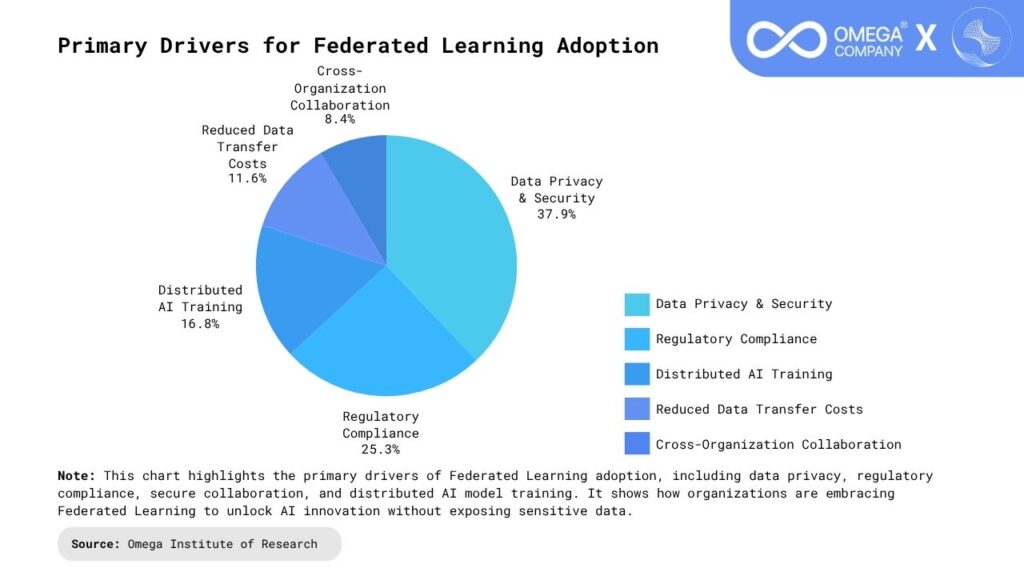
Enhanced Data Privacy: Federated Learning keeps sensitive information on local devices or within organizational boundaries, eliminating the need to transfer raw data to a central server. This significantly reduces the risk of data leakage, unauthorized access, and privacy violations. By sharing only model updates, organizations can build intelligent AI systems while maintaining strict data confidentiality. This approach strengthens user trust and supports responsible AI adoption across privacy-sensitive industries.
Regulatory Compliance: Federated Learning helps organizations comply with data protection regulations such as GDPR, HIPAA, CCPA, and India’s DPDP Act by minimizing the movement of personal information. Since sensitive data remains within its original environment, compliance requirements become easier to achieve. This reduces legal and operational risks associated with centralized data storage. It also enables businesses to deploy AI solutions while meeting evolving global privacy standards.
Improved Security: The decentralized architecture of Federated Learning minimizes the impact of centralized data breaches by ensuring that raw data never leaves participating devices or organizations. This significantly reduces the attack surface available to cybercriminals and limits the exposure of sensitive information. Advanced security techniques such as encrypted communication and secure aggregation further strengthen the training process. As a result, organizations can build more resilient and trustworthy AI systems.
Lower Data Transfer Costs: Federated Learning exchanges only compact model updates instead of transferring massive datasets across networks. This greatly reduces bandwidth consumption, communication overhead, and infrastructure costs, especially in large-scale deployments. Organizations can train AI models efficiently even when operating across geographically distributed locations. Lower network usage also improves scalability and overall system performance.
Access to More Diverse Data: Federated Learning enables multiple organizations or devices to collaboratively train AI models using knowledge from diverse datasets without physically sharing the underlying data. This results in models that are more accurate, robust, and capable of generalizing across different environments. Diverse training data helps reduce bias and improves AI performance in real-world applications. Organizations benefit from collective intelligence while maintaining complete control over their proprietary information.
Better Personalization: Devices such as smartphones, wearable devices, and edge systems can continuously personalize AI models based on individual user behavior without exposing private information. This enables more relevant recommendations, smarter predictions, and improved user experiences while maintaining privacy. Personalized learning occurs locally, ensuring that sensitive behavioral data remains protected. Users benefit from intelligent services without sacrificing control over their personal information.
Scalability: Federated Learning is designed to support millions of devices participating in collaborative model training simultaneously, making it ideal for global AI deployments. Its distributed architecture allows organizations to expand AI capabilities without requiring centralized data storage. As more participants contribute model updates, the system becomes increasingly accurate and efficient. This scalability makes Federated Learning suitable for enterprise, IoT, mobile, and large-scale cloud applications.
Challenges of Federated Learning
Communication Overhead: Federated Learning requires participants to frequently exchange model updates with the central server throughout the training process. In large-scale deployments involving thousands or millions of devices, this communication can consume significant network bandwidth and increase latency. Limited or unstable internet connectivity may further slow the synchronization process and reduce training efficiency. Organizations must adopt communication-efficient algorithms, model compression techniques, and optimized update schedules to minimize network overhead while maintaining model performance.
Non-IID Data: Data across participants is often heterogeneous, meaning it is not independently and identically distributed (Non-IID). For example, hospitals, banks, or smartphones may each contain unique data patterns that differ significantly from one another. This variation can make model convergence more difficult and reduce the overall accuracy of the global model. Advanced optimization techniques and personalized Federated Learning methods are often required to effectively handle diverse data distributions and improve model reliability.
Device Variability: Federated Learning environments include a wide range of participants with different computational capabilities, storage capacities, battery life, and network connectivity. While some devices can complete training quickly, others may be slower or temporarily unavailable, creating inconsistencies during model updates. This variability complicates coordinated training and may delay global model aggregation. Efficient scheduling, adaptive resource management, and asynchronous training techniques help address these challenges in large distributed networks.
Security Threats: Although Federated Learning improves data privacy, it remains vulnerable to sophisticated attacks such as model poisoning, backdoor attacks, gradient leakage, Sybil attacks, and malicious participants attempting to manipulate the training process. These attacks can reduce model accuracy, compromise system integrity, or reveal sensitive information through shared model updates. To defend against these risks, organizations implement secure aggregation, encryption, anomaly detection, differential privacy, and robust validation mechanisms. Continuous monitoring and advanced security frameworks are essential for maintaining trustworthy and resilient Federated Learning systems.
Future Trends
Federated learning is evolving rapidly and is expected to play a central role in the next generation of privacy-preserving artificial intelligence. Emerging innovations include its integration with generative AI and large language models, enabling secure and decentralized model training at scale. Organizations are also adopting cross-silo collaboration, federated analytics, on-device AI powered by edge computing, and blockchain-based trust mechanisms to improve transparency, collaboration, and data governance. Advances in Automated Federated Learning (AutoFL), stronger defenses against adversarial attacks, and privacy-aware AI governance are making deployment more efficient, secure, and scalable. Researchers are also developing techniques to improve communication efficiency, model personalization, and interoperability across diverse devices and enterprise environments. As governments and enterprises place greater emphasis on responsible AI, federated learning is expected to become a core component of future AI infrastructure. These advancements will enable organizations to build intelligent, compliant, and trustworthy AI systems while protecting sensitive data and meeting evolving global privacy regulations.
Conclusion
Federated Learning represents a fundamental shift in the way artificial intelligence systems are developed and deployed by enabling collaborative model training without transferring raw data, effectively balancing innovation with privacy. As organizations face stricter data protection regulations, increasing cybersecurity threats, and growing expectations for responsible AI, Federated Learning offers a secure and practical approach to building intelligent systems while maintaining data confidentiality. When combined with technologies such as differential privacy, secure aggregation, homomorphic encryption, and Edge AI, it creates a strong foundation for scalable, resilient, and privacy-preserving AI. Beyond being a machine learning technique, Federated Learning has become a strategic enabler of trustworthy AI across industries including healthcare, finance, manufacturing, government, and telecommunications. Organizations that adopt this approach today will be better positioned to accelerate AI innovation, strengthen regulatory compliance, protect valuable data assets, and build long-term trust with customers, partners, and stakeholders.
- https://stlpartners.com/articles/edge-computing/federated-learning/
- https://ieeexplore.ieee.org/document/11081017
- https://www.paloaltonetworks.in/cyberpedia/what-is-federated-learning
- https://engrxiv.org/preprint/view/4177
- https://www.refontelearning.com/blog/federated-learning-for-privacy-preserving-ai-building-trust-in-a-decentralized-world
Subscribe
Select topics and stay current with our latest insights
- Functions