

- Industries
Industries
- Functions
Functions
- Insights
Insights
- Careers
Careers
- About Us

From Vision to Execution: Why Most Executive Strategies Fail in the Middle







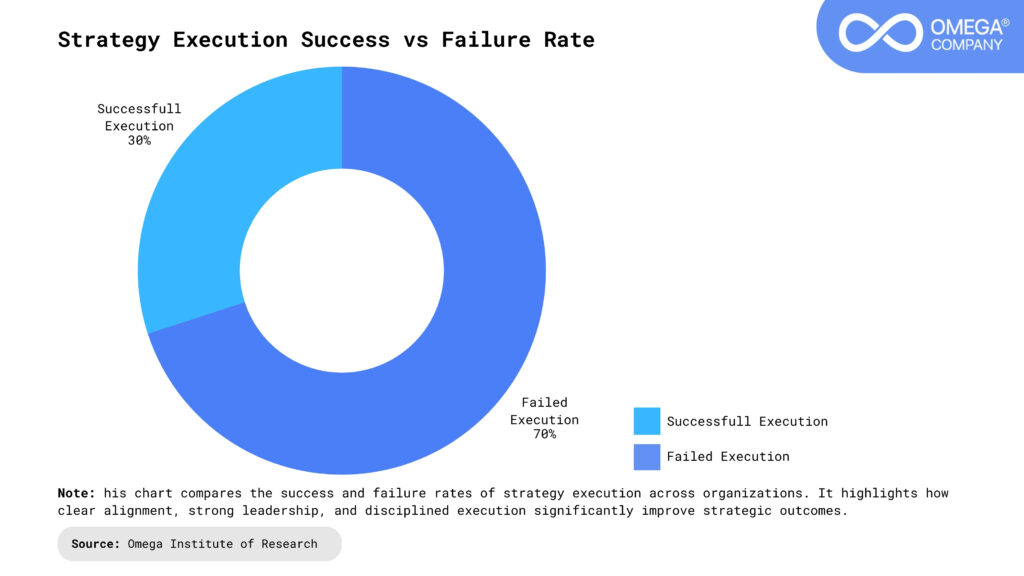
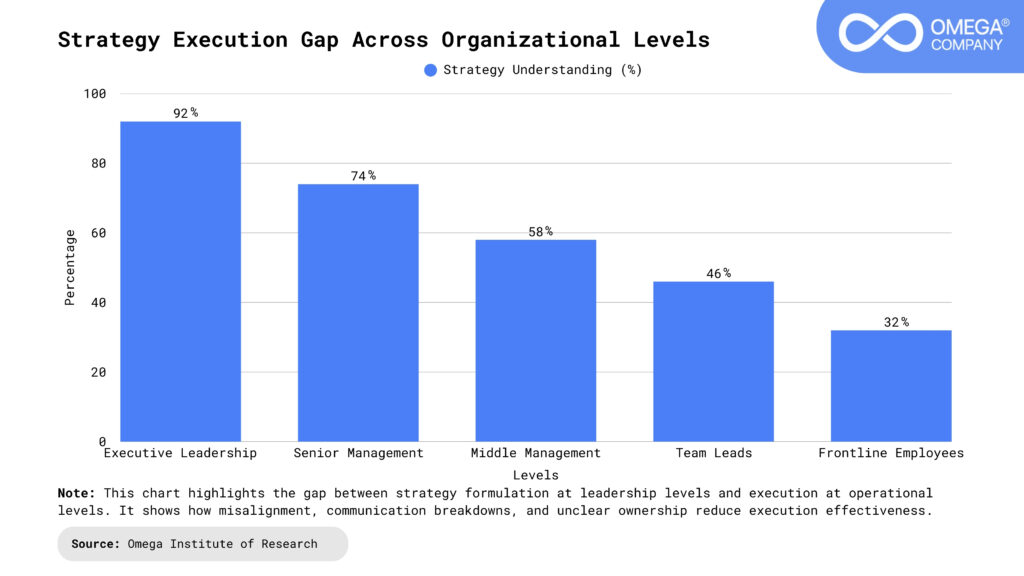
Today, organizations face a highly complex and competitive environment, and a strong strategic vision is a prerequisite for organizational survival and success. Senior managers invest a lot of time and effort into developing a strategy that outlines organizational goals, competition, and future direction. The strategy may also be based on thorough research, market analysis, and financial projections. The interesting fact, however, is that a large number of these strategies are failing, not because the strategy is poor, but because it is not executed well. The problem is that a high-level vision is not converted into consistent results for the entire organization. The gap that exists between strategy and execution is termed the “Strategy Execution Gap.” The beginning and end points are clear, and the results are also clear, but the middle part, where execution actually happens, is messy and complex and is often a failure.
Understanding the Strategy Execution Gap
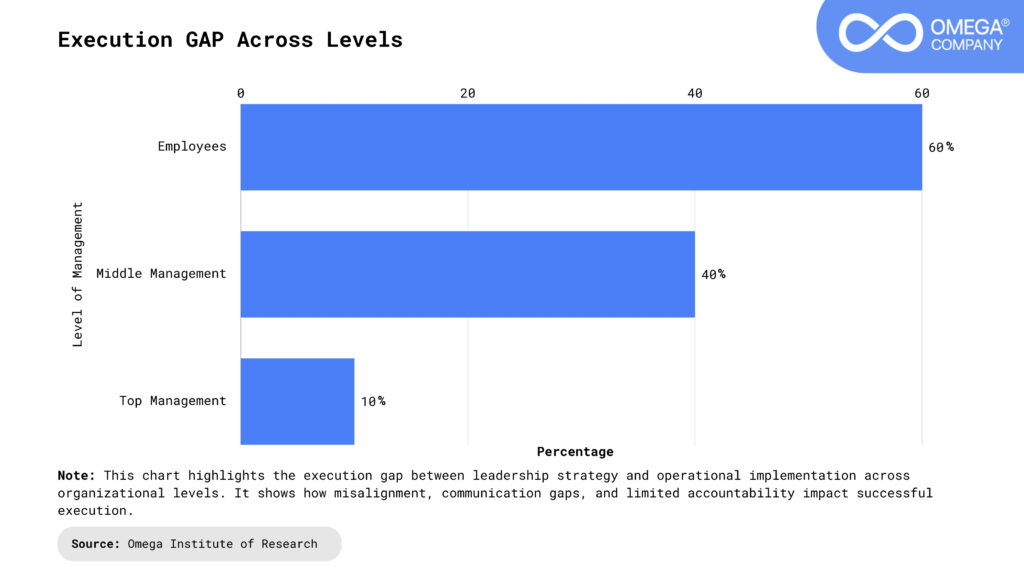
The strategy execution gap refers to the difference between what an organization intends to achieve and what it actually accomplishes in practice. While the leadership team may be fully aligned on strategic goals and objectives, this alignment often does not effectively cascade down to middle management and employees. This gap exists because strategy is largely an abstract concept, whereas execution involves tangible actions and processes. Bridging this gap requires translating ideas into concrete actions, aligning people and resources, and maintaining consistency throughout the organization. In most organizations, a common pattern is observed: strategic vision is clearly developed by leadership, followed by an enthusiastic launch. However, over time, clarity and alignment begin to fade, and execution challenges emerge. It is during this middle phase where strategies encounter real-world complexities that most strategies ultimately fail.
Why Strategies Fail in the Middle
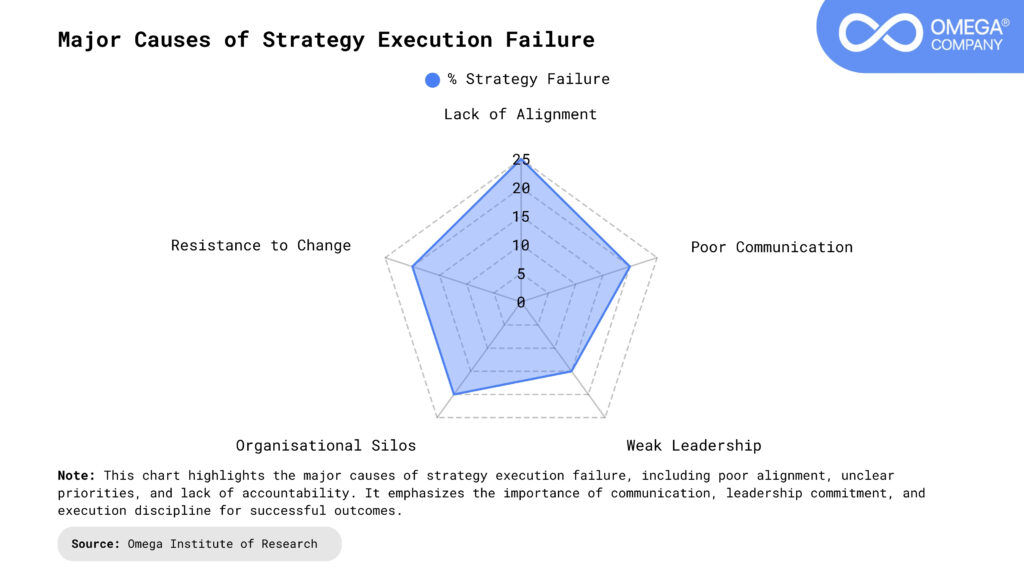
Lack of Alignment Across the Organization: Alignment is an essential factor for effective strategy execution. If different departments or teams have different understandings of the strategy, it creates fragmented efforts. Most often, people within an organization do not have a clear idea of how they fit into the overall strategy. For instance, while the top management may be working on growth or innovation, another department may be working on cost-cutting or efficiency.
Poor Communication of Strategy: However, a strategy is only as effective as the way it is communicated. In many organizations, strategies are not conveyed clearly across all levels, leading to confusion and misinterpretation. Strategic plans are often presented through complex reports or presentations that employees find difficult to understand, making it challenging for them to relate these plans to their day-to-day responsibilities. As a result, employees may struggle to see how their individual roles contribute to the overall strategy. Common communication issues in strategic management include a lack of clarity in defining objectives, inconsistency in messages across different departments, and limited opportunities for feedback and discussion, all of which hinder effective execution.
Disconnect Between Strategy and Daily Operations: One of the most significant causes of strategy failure is the gap between strategic planning and execution. While managers tend to focus on long-term goals and direction, the workforce is primarily concerned with short-term tasks, daily responsibilities, and immediate deadlines. If the strategy is not effectively integrated into everyday operations, it remains theoretical rather than actionable. As a result, employees may continue performing routine tasks that do not align with strategic objectives, performance measurements may fail to reflect strategic priorities, and decision-making may occur without considering the strategy. To bridge this gap, it is essential to embed the strategy into workflows, processes, and performance systems so that it becomes a part of daily organizational activities.
Lack of Clear Priorities and Focus: Organizations usually try to accomplish multiple strategic initiatives at the same time, and as a result, they lack focus. Having too many set priorities confuses the workforce and makes them uncertain as to what the most important priority is. The workforce is over-extended, and as a result, the organization becomes less effective. This leads to delayed projects, poor quality execution, inability to make significant progress. Execution is achieved by identifying the most important few priorities and focusing on them.
Weak Leadership Involvement and Ownership: It is equally important for leaders to be involved in the execution of strategy, not just in its formulation. It is often seen that leaders step back after formulating the strategy and expect it to be executed on its own. However, this is not possible without leaders’ involvement.
The Messy Middle Problem
The middle phase of strategy execution is often referred to as the “messy middle” because it is characterized by uncertainty, complexity, and numerous challenges. During this stage, the initial excitement surrounding the strategy begins to fade, practical difficulties start to emerge, and organizations are often forced to make compromises. Unlike the planning phase, which is structured and well-defined, the execution phase involves dealing with unexpected problems such as changing environmental conditions, limited resources, and operational inefficiencies. Organizations that are unable to effectively manage this critical phase are likely to either abandon their strategies altogether or dilute them, leading to unsuccessful outcomes.
Consequences of Execution Failure
Failure in the execution of strategies can lead to several significant consequences for an organization. One of the most immediate effects is the wastage of valuable resources, including the time, effort, and investment spent in developing the strategy. Additionally, organizations may miss important market opportunities, allowing competitors to gain an advantage. Repeated execution failures can also result in employee disengagement, as employees become demotivated by unsuccessful initiatives. Furthermore, ineffective execution can lead to a loss of competitive advantage, weakening the organization’s position in the market. Over time, these consequences can have a serious impact on the organization’s long-term growth and sustainability.
Bridging the Gap: From Vision to Execution
To effectively transition from vision to execution, organizations must adopt a systematic and disciplined approach. This begins with aligning strategy with operations by converting strategic goals into concrete, measurable objectives that are integrated into day-to-day activities, enabling employees to clearly connect their efforts to organizational outcomes. Effective communication is equally essential, as it ensures that the workforce understands the strategy and their role in its execution. Leadership involvement must be strengthened throughout the process, with leaders actively guiding, monitoring, and supporting execution efforts. Organizations should also focus on a limited number of high-impact priorities to maintain clarity and avoid resource dilution. In addition, building robust execution systems, such as performance tracking mechanisms and regular review processes, helps monitor progress and ensure accountability. Finally, fostering a supportive organizational culture that encourages participation, adaptability, and motivation is crucial for successful strategy execution.
Conclusion
One of the greatest challenges in the process of strategic management is the journey between vision and execution. While organizations are good at strategy formulation, they are poor at executing the strategy formulated. The failure of executive strategies is not due to poor planning. Rather, it is the challenges faced during the ‘middle’ of the process of strategy execution, which include alignment, communication, leadership, and execution systems. By addressing these challenges and taking a systematic approach to strategy execution, organizations can close the strategy-execution gap and turn their vision into reality. Execution of strategy is what ultimately turns strategy into a source of competitive advantage.
- https://implementconsultinggroup.com/article/closing-the-strategy-execution-gap?utm_source
- https://nobl.io/changemaker/bridging-strategy-execution-gap/?utm_source
- https://www.forbes.com/sites/tonygambill/2025/11/04/why-leadership-teams-fail-at-strategy-execution-and-how-to-fix-it/?utm_source
- https://hbr.org/2015/03/why-strategy-execution-unravelsand-what-to-do-about-it?utm_source
- https://www.pmi.org/about/press-media/2025/new-pmi-research-reveals-strategy-execution-gap-is-undermining-transformation-and-how-to-close-it?utm_source
Subscribe
Select topics and stay current with our latest insights
- Functions