

- Industries
Industries
- Functions
Functions
- Insights
Insights
- Careers
Careers
- About Us

Generative AI in Management Consulting: Use Cases and Risks







Generative AI is revolutionizing industries across the board, and management consulting is no exception. As firms seek to stay competitive in a rapidly evolving business landscape, generative AI offers transformative potential automating complex tasks, generating insights, and augmenting decision-making. However, the adoption of this technology also introduces a unique set of risks, from data privacy concerns to over-reliance on machine-generated outputs. With its ability to analyze vast datasets and simulate multiple business scenarios, generative AI is enabling consultants to deliver faster and more tailored recommendations. It also empowers firms to reduce costs, improve scalability, and enhance client engagement through real-time strategy modeling. Yet, without proper governance and ethical safeguards, its implementation can lead to unintended consequences and strategic blind spots.
What Is Generative AI?
Generative AI refers to artificial intelligence models capable of creating new content—text, images, code, or even strategic business frameworks based on learned patterns from massive datasets. Tools like OpenAI’s ChatGPT, Google’s Gemini, and Anthropic’s Claude are enabling knowledge workers to draft reports, analyze complex datasets, and create client-ready deliverables at an unprecedented scale and speed. Unlike traditional AI, which focuses on classification or prediction, generative AI produces original content that mimics human-like creativity and reasoning. It learns from diverse data inputs, allowing it to adapt to different industries, styles, and problem-solving approaches. As a result, it is becoming a foundational technology in modern consulting workflows, driving both efficiency and innovation.
Key Use Cases of Generative AI in Management Consulting
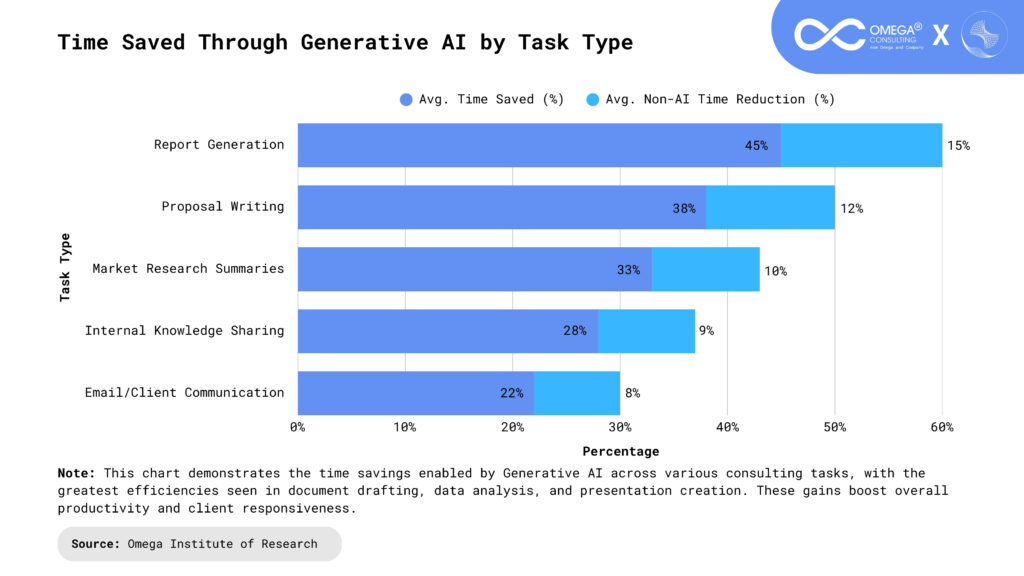
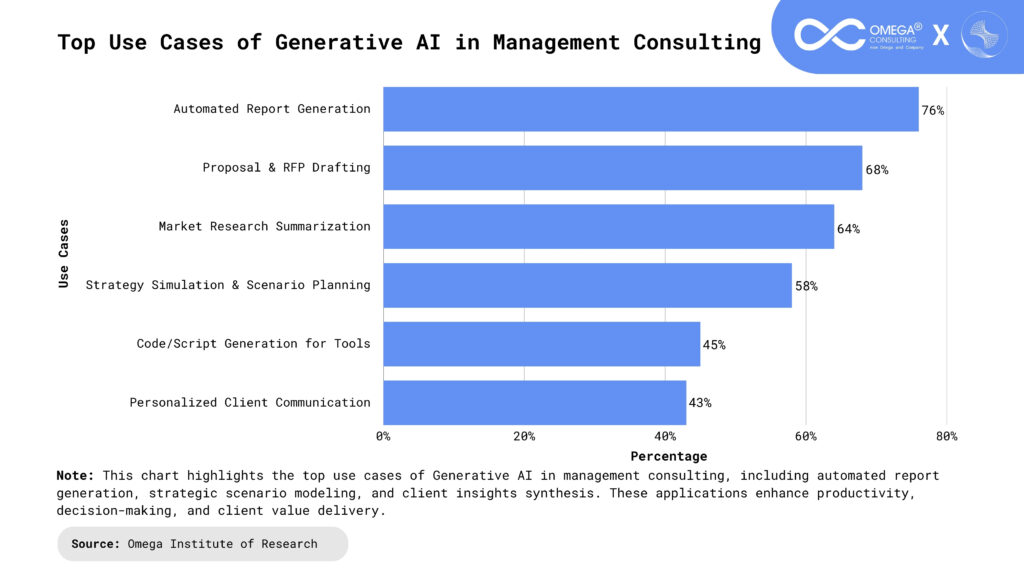
Accelerated Report Generation: Generative AI significantly streamlines the creation of client deliverables. Consultants can rely on AI to auto-generate first drafts of reports, executive summaries, and slide decks, all aligned with the firm’s standardized templates. This eliminates repetitive formatting work, ensures consistent branding, and accelerates turnaround times. Natural Language Generation (NLG) transforms raw quantitative data into business-relevant narratives, allowing consultants to dedicate more time to strategic analysis and storytelling. Additionally, AI tools support localization and brand consistency across multiple markets, ensuring that content resonates with diverse client audiences while maintaining a uniform professional standard.
Market and Competitive Intelligence: In the realm of research, generative AI offers the ability to digest and summarize vast datasets including market trends, competitor activities, and regulatory changes in real time. This enhances the quality and speed of discovery during the early phases of consulting engagements. Instead of manually constructing models, consultants can use AI to simulate strategic frameworks such as SWOT analyses or Porter’s Five Forces, all tailored to the client’s unique context. These tools help identify emerging threats and opportunities before they’re widely visible, enabling firms to deliver proactive and deeply informed insights with far less effort.
Client Personalization at Scale: Generative AI empowers consultants to deliver hyper-personalized experiences for clients at scale. Reports and communications can be automatically tailored to match a client’s industry tone, internal culture, and strategic goals, which greatly enhances relevance and engagement. AI-generated stakeholder maps and decision pathways help consultants understand internal dynamics, enabling more targeted and effective communication strategies. In addition, consultants can simulate organizational change scenarios aligned with the client’s structure, improving the success rate of transformation initiatives. These tailored experiences build stronger relationships and improve client satisfaction across all touchpoints.
Scenario Planning and Simulations: Consultants can use generative AI to model complex business scenarios, drawing from real-time data and strategic variables. Whether it’s financial forecasting through Monte Carlo simulations or testing the impacts of supply chain disruptions, AI offers a fast, accurate, and dynamic planning environment. During workshops or strategy sessions, AI tools can adapt simulations in real time based on new inputs from clients, encouraging collaboration and active participation. Clients gain valuable foresight into possible outcomes, which improves strategic decision-making and minimizes the risk of unintended consequences.
Knowledge Management and Retrieval: Generative AI transforms internal knowledge management by acting as a real-time expert system. It instantly retrieves past engagement materials, such as slide decks, templates, proven frameworks, and relevant case studies, based on the specific needs of the consultant. This significantly reduces ramp-up time for new projects and helps ensure consistent quality across teams. AI also enables seamless cross-team knowledge sharing by breaking down silos between practice areas and geographies. As a result, firms retain institutional knowledge more effectively, onboard new consultants faster, and deliver solutions backed by the full breadth of the organization’s expertise.
Code Generation and Data Analysis for Digital Strategy Projects: In digital transformation and technology-focused projects, generative AI plays a vital role in accelerating solution development. Consultants can use it to write scripts for data pipelines, generate dashboards, or automate routine digital workflows, reducing reliance on specialized IT support. AI tools can query structured data from databases and unstructured data from documents or emails, providing comprehensive insights quickly. Furthermore, generative AI can create mockups for digital solutions such as apps or portals, helping clients visualize prototypes before full-scale development begins. This enables rapid iteration and alignment, enhancing the agility and effectiveness of digital advisory services.
Risks and Challenges of Generative AI in Consulting
Data Privacy and Confidentiality: Consultants frequently handle highly sensitive client information, making data privacy a paramount concern when using generative AI. Without proper safeguards, there’s a risk of unintentional data leaks, breaches of non-disclosure agreements (NDAs), and non-compliance with data protection regulations such as GDPR or HIPAA. These issues can result in legal liabilities and damage client trust. The best way to mitigate these risks is to use secure, enterprise-level AI platforms that come equipped with built-in privacy controls. It is also critical to avoid feeding proprietary or confidential client data into public generative AI tools, ensuring that data security remains intact throughout the consulting process.
Hallucination and Inaccuracy: Generative AI models are known to “hallucinate,” meaning they may produce content that sounds credible but is factually incorrect or misleading. In a consulting context, this can lead to significant consequences such as misleading recommendations, factual inaccuracies in client deliverables, and reputational damage to the consulting firm. To counteract this risk, consultants must apply strict human verification to all AI-generated content. Cross-checking outputs against trusted and verified sources before sharing with clients ensures accuracy and maintains professional credibility. Human oversight remains essential to preserve the quality and reliability of AI-assisted work.
Over-Reliance on AI: While generative AI can significantly enhance productivity, there’s a risk of consultants becoming overly dependent on these tools. This may result in diminished critical thinking, reduced analytical depth, uniformity in outputs that lack originality, and an oversight of client-specific nuances. When AI becomes the crutch rather than the co-pilot, the strategic value of consulting diminishes. To avoid this, consultants should treat AI as a support tool rather than a replacement for human expertise. A strong hypothesis-driven approach, combined with seasoned judgment and deep contextual understanding, should remain at the core of consulting practices.
Intellectual Property Risks: Ownership of content created by generative AI—especially when derived from client data or proprietary intellectual property—poses complex legal questions. Since legal frameworks around AI-generated content are still evolving, there is an ongoing risk of unintentionally violating IP rights. This ambiguity can lead to disputes over authorship and usage rights. To navigate this challenge, firms should establish clear IP ownership policies that are agreed upon internally and with clients. It is also advisable to consult legal teams before incorporating generative AI outputs into formal deliverables to ensure compliance and avoid future litigation.
Ethical Concerns and Bias: Generative AI models are trained on large datasets that may contain historical biases. As a result, AI-generated outputs can sometimes reflect these biases, potentially leading to discriminatory or non-inclusive recommendations. This is especially problematic in consulting work focused on diversity, equity, and inclusion (DEI), where ethical integrity is critical. To address this, firms must proactively evaluate AI outputs for bias and use ethical AI frameworks to guide content creation. Additionally, involving diverse human reviewers in the review process can help ensure that recommendations are both inclusive and aligned with the client’s values and societal expectations.
Best Practices for Responsible Use of Generative AI in Consulting
Use Private and Auditable AI Platforms: To maintain client trust and comply with data protection standards, it’s crucial to use AI platforms that offer enterprise-grade security features. Private AI environments with audit trails and robust logging ensure that all actions are traceable and compliant with legal and ethical requirements. This not only helps prevent unauthorized data access but also allows firms to review and investigate any anomalies or misuse if necessary. Choosing tools with customizable access controls and encryption further enhances data privacy and operational integrity.
Train Consultants on AI Literacy: AI tools are only as effective as the people using them. It is essential that consultants are trained in AI literacy understanding the capabilities, limitations, and ethical considerations of generative AI. This includes recognizing where AI excels, such as pattern recognition and content generation, and where it can fail, such as understanding context or nuance. Educated consultants are better equipped to guide AI usage strategically, ensuring outputs are relevant, accurate, and aligned with client goals. Continuous learning programs can help keep the team updated as AI technology evolves.
Adopt a Human-in-the-Loop (HITL) Approach: Maintaining a human-in-the-loop is vital to ensure quality and accountability in generative AI usage. Consultants should be directly involved in reviewing, editing, and interpreting AI-generated content rather than relying on it blindly. This collaborative approach allows consultants to correct errors, provide domain expertise, and tailor outputs to specific client needs. It also reinforces the consultant’s role as a critical thinker and strategist, using AI as a tool to enhance not replace professional judgment.
Create AI Use Policies and Governance Structures: To minimize risks and standardize responsible use, firms should develop clear internal policies and governance frameworks around AI adoption. These should outline how and when AI can be used, define review and approval processes, and assign responsibility for ethical and legal compliance. Governance structures should also include periodic audits, feedback loops, and incident response protocols. This ensures that AI usage remains aligned with both firm values and industry regulations while promoting consistency and accountability across teams.
Align AI Use with Client Expectations and Consent: Transparency is a key principle in responsible AI use. Consulting firms should clearly communicate to clients where and how generative AI is being used in their projects. This includes obtaining client consent when necessary and setting expectations about the role AI plays in analysis or deliverables. Open discussions about AI use build trust and give clients the opportunity to ask questions, express concerns, or request alternatives. Being upfront also protects firms from future disputes regarding the origin or integrity of the work provided.
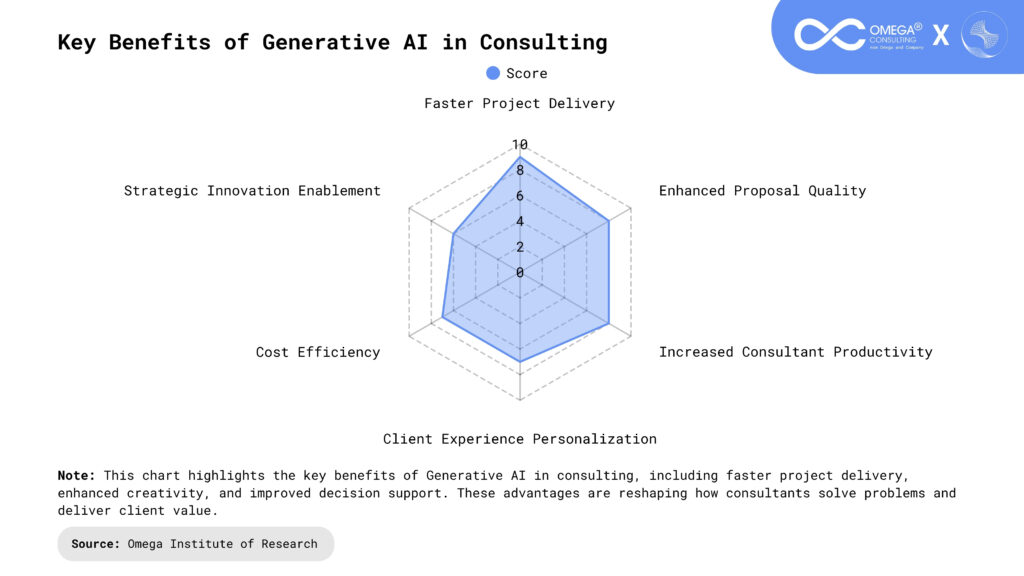
The Future of Generative AI in Management Consulting
As generative AI technology continues to mature, we can anticipate the emergence of more domain-specific AI tools tailored to the unique needs of consulting workflows, industry nuances, and stringent compliance requirements. These tools will not only enhance operational efficiency but also enable consultants to provide highly contextualized and value-driven insights to clients. Consultants who blend strategic thinking with strong AI fluency will become pivotal in unlocking a new era of value creation delivering faster insights, greater personalization, and more adaptive, agile delivery models that respond to client needs in real time. Additionally, the integration of AI into client engagements will empower firms to scale expertise, reduce repetitive tasks, and dedicate more time to complex problem-solving.
Conclusion
Generative AI is not just a technological trend; it represents a paradigm shift in how consulting firms approach problem-solving, client engagement, and knowledge-intensive work. From automating reports to simulating strategic outcomes, the breadth of use cases is already transforming daily operations and long-term planning. However, as with any powerful innovation, the true value of generative AI lies in how responsibly and ethically it is applied. Misuse or blind reliance on AI can quickly erode the trust, accuracy, and credibility that are foundational to the consulting profession. Management consultants must adapt by blending the strengths of AI with human intelligence using machines to enhance, not replace, critical thinking and creativity. Building a culture of AI literacy, governance, and transparency will be essential for firms that want to remain relevant and resilient. In the end, those who treat AI not as a shortcut, but as a strategic collaborator, will lead the way in redefining excellence in consulting.
- https://www.alpha-sense.com/blog/trends/generative-ai-consulting/
- https://www.ey.com/en_in/insights/consulting/the-future-of-consulting-in-the-age-of-generative-ai
- https://wjarr.com/sites/default/files/WJARR-2024-1276.pdf
- https://cloud.google.com/transform/101-real-world-generative-ai-use-cases-from-industry-leaders
- https://www.leewayhertz.com/generative-ai-use-cases-and-applications/
Subscribe
Select topics and stay current with our latest insights
- Functions