

- Industries
Industries
- Functions
Functions
- Insights
Insights
- Careers
Careers
- About Us

Geoengineering Innovations: Technologies to Cool the Planet







Climate change is no longer a distant risk; it’s a balance-sheet issue, a supply-chain disruptor, and a direct threat to long-term economic stability. While reducing emissions remains critical, a growing consensus among scientists and policymakers acknowledges a hard truth: cutting carbon alone may not be enough to prevent dangerous warming. This reality has propelled geoengineering once a fringe idea into serious global discussions and policy debates. For business leaders, geoengineering innovations are more than environmental experiments; they represent emerging technologies, evolving regulations, new investment opportunities, and complex ethical challenges. As governments, investors, and industries weigh large-scale interventions in Earth’s systems, strategic decisions made today could define competitive advantage, risk exposure, and corporate responsibility in a climate-altered future.
What is Geoengineering and Why It Matters to Business
Geoengineering involves large-scale technologies that intentionally alter Earth’s climate by cooling the planet or removing excess carbon from the atmosphere, going beyond traditional energy transition and offsets. For businesses, it brings major implications from climate-driven risks and regulatory shifts to emerging industries and investment opportunities making early understanding critical for resilience and long-term strategic advantage.
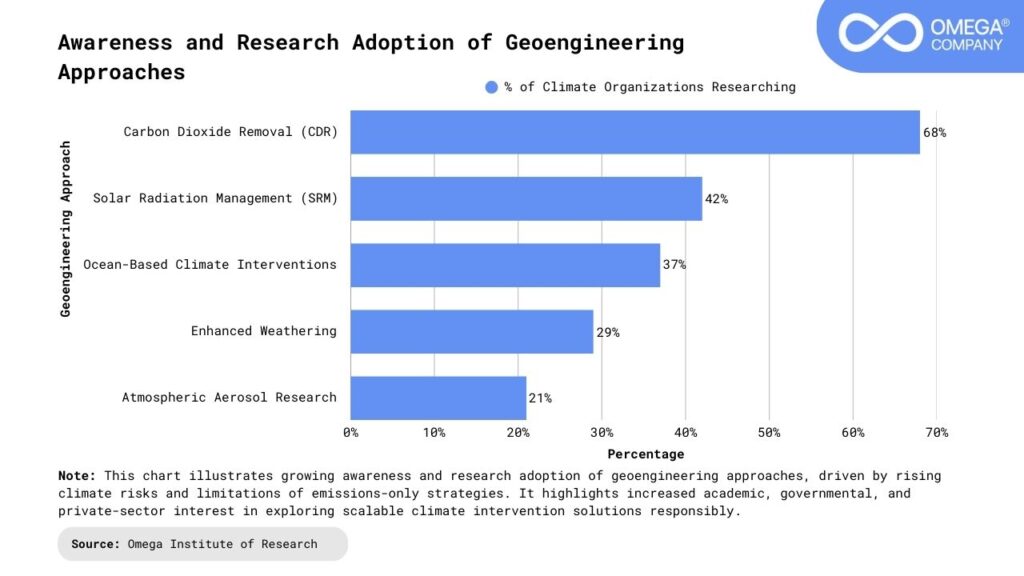
Solar Radiation Management: Reflecting Heat Away: Solar Radiation Management (SRM) uses technologies that reflect a portion of sunlight back into space to lower global temperatures, inspired by natural cooling events like volcanic eruptions. While innovations such as stratospheric aerosol injection and marine cloud brightening could rapidly stabilize climate-sensitive markets, they raise serious governance, liability, and cross-border regulatory challenges, reminding businesses that large-scale solutions must be balanced against systemic risk.
Carbon Dioxide Removal: Cleaning the Atmosphere: Carbon Dioxide Removal (CDR) focuses on extracting CO₂ from the atmosphere and storing it long term, aligning closely with corporate sustainability and net-zero goals. With technologies like direct air capture and bioenergy with carbon capture gaining traction, CDR offers businesses opportunities for long-term investment and integration with heavy industry, especially in hard-to-abate sectors.
Ocean-Based Cooling and Carbon Solutions: Because oceans absorb most excess heat from global warming, they are a key target for geoengineering approaches such as ocean alkalinity enhancement, marine biomass cultivation, and deep-sea carbon storage. These solutions intersect with maritime industries and global logistics, requiring international cooperation and careful ecosystem protection to balance economic value with environmental impact.
The Risks, Ethics, and Governance Challenge
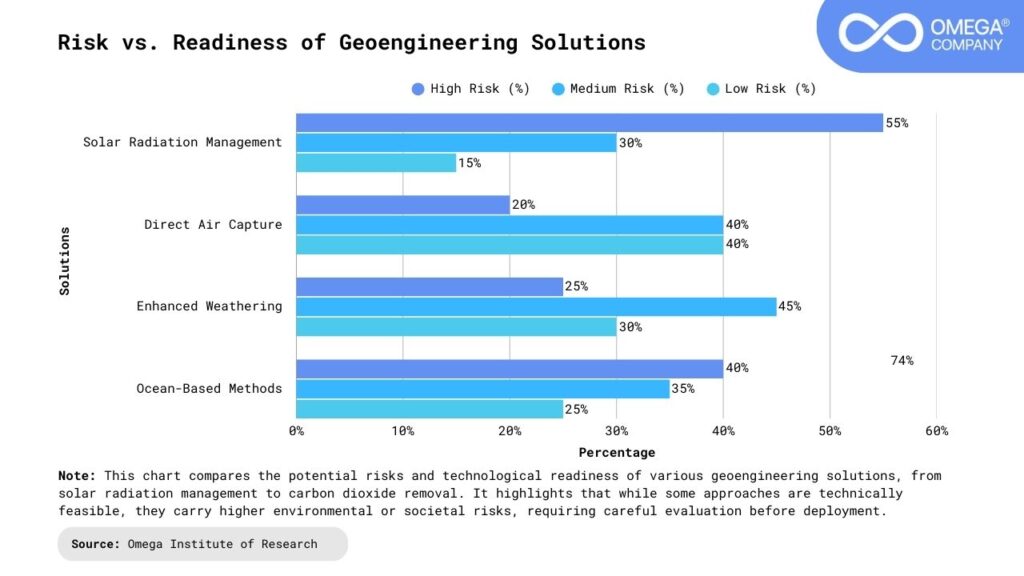
Geoengineering is not a silver bullet and business leaders must recognize the risks:
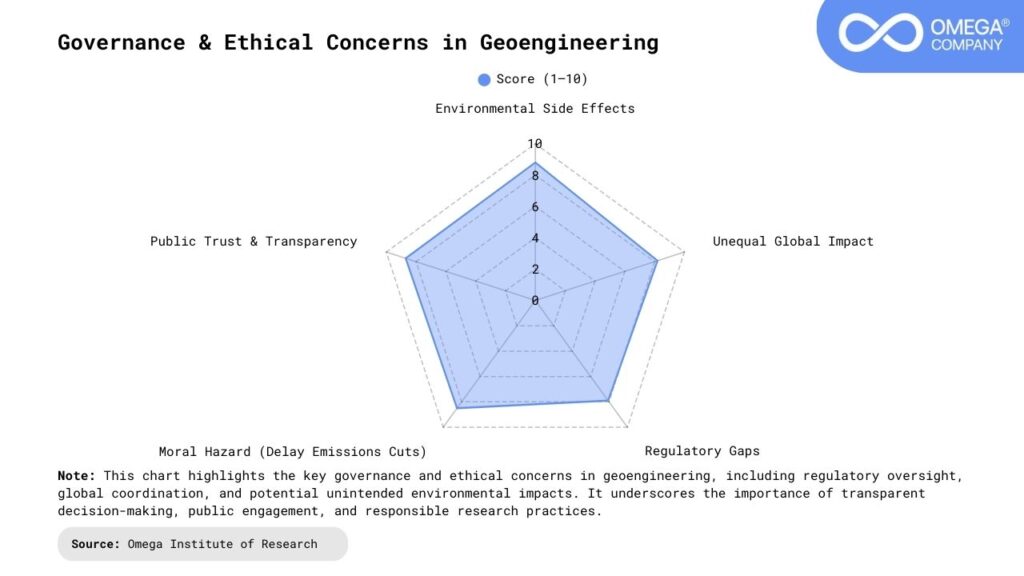
The Risks of Geoengineering: Geoengineering is not a silver bullet, and its deployment carries significant risks that businesses cannot ignore. Large-scale climate interventions could trigger unintended side effects across regions, disrupting weather patterns, ecosystems, and agricultural productivity. Such outcomes may create new forms of climate volatility, increasing operational uncertainty for global supply chains, insurance markets, and infrastructure planning. For business leaders, understanding these risks is essential to avoid costly exposure and reputational damage.
The Ethical Dilemmas: Beyond technical risks, geoengineering raises profound ethical questions about who has the authority to alter planetary systems. Decisions made by a small group of nations or corporations could have irreversible consequences for vulnerable populations with little voice in the process. Issues of consent, equity, and intergenerational responsibility place ethical pressure on companies involved in research, funding, or deployment. Businesses must therefore consider not only what is possible, but what is socially and morally acceptable.
The Governance and Regulatory Challenge: Geoengineering also exposes major gaps in global governance, as existing legal frameworks are poorly equipped to regulate planetary-scale interventions. Unclear liability, lack of international enforcement mechanisms, and geopolitical tensions create a highly uncertain regulatory environment. Governments may respond with fragmented or reactive policies, increasing compliance and political risk for businesses. Navigating this landscape will require proactive engagement, transparency, and alignment with emerging global standards.
Why Business Leaders Should Pay Attention Now
Geoengineering innovations signal a broader shift: climate response is becoming a technology-driven, capital-intensive domain. Forward-looking organizations are already:
Climate Response Is Becoming a Technology Race: Geoengineering innovations signal a fundamental shift in how the world responds to climate change, transforming it into a technology-driven and capital-intensive domain. Climate action is no longer limited to sustainability teams; it is increasingly shaped by advanced modeling, aerospace, materials science, and large-scale infrastructure. For business leaders, this means competitive advantage may depend on how quickly organizations understand and adapt to emerging climate technologies. Early movers can influence standards, shape markets, and position themselves as leaders in a rapidly evolving space.
Policy, Regulation, and Strategic Foresight: Governments and global institutions are beginning to debate geoengineering governance, signaling future regulations that could directly affect corporate operations and reporting. Forward-looking organizations are closely tracking policy discussions to anticipate shifts in compliance, liability, and disclosure requirements. This proactive awareness allows companies to reduce regulatory shock and align long-term strategies with evolving climate frameworks. Staying ahead of policy change is becoming as important as tracking market trends.
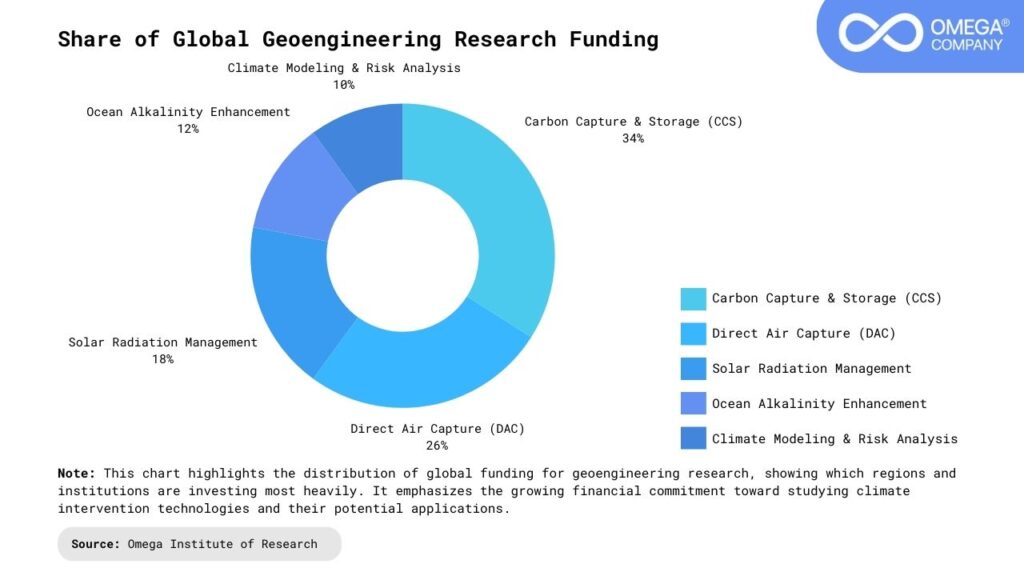
Investment, Partnerships, and Ecosystem Readiness: As climate interventions grow in scale, investment is flowing into climate intelligence, modeling tools, and next-generation climate technologies. Businesses are preparing by strengthening data capabilities, stress-testing climate scenarios, and exploring partnerships across climate-tech ecosystems. Collaboration with startups, research institutions, and governments can accelerate innovation while sharing risk. For leaders, paying attention now is not about immediate deployment—but about readiness for a future where climate strategy and business strategy are inseparable.
Looking Ahead: From Climate Risk to Strategic Opportunity
Geoengineering represents humanity’s most ambitious attempt to stabilize a planet under increasing environmental stress, reflecting how far climate response has evolved beyond traditional mitigation alone. For business professionals, it delivers a powerful reminder that climate resilience is no longer optional; it is a strategic priority that directly shapes long-term growth, risk management, and competitiveness. As innovation accelerates and large-scale climate interventions move from theory to experimentation, companies that understand these technologies early will be better positioned to navigate uncertainty, influence policy discussions, and align with emerging regulatory frameworks. By engaging responsibly and proactively, organizations can transform climate risk into strategic opportunity while contributing to a cooler, more stable, and economically resilient future.
Conclusion
Geoengineering innovations represent a bold but increasingly necessary dimension of the global climate response, moving from speculative science to strategic reality as rising temperatures place growing pressure on economies, infrastructure, and long-term business resilience. While emissions reduction must remain the foundation of climate action, technologies designed to cool the planet offer an additional layer of risk mitigation in a world running out of time. For business professionals, geoengineering will shape regulatory landscapes, investment decisions, governance expectations, and public trust, making early, responsible engagement essential. Those who understand the implications today will be better positioned to manage uncertainty, influence ethical deployment, and help steer these powerful innovations toward outcomes that support both planetary stability and sustainable economic growth.
- https://www.sciencedirect.com/science/article/pii/S2589004225005644
- https://pmc.ncbi.nlm.nih.gov/articles/PMC3596048/
- https://www.science.org/content/article/geoengineering-fight-climate-change-if-public-can-convinced
- https://news.climate.columbia.edu/2024/04/24/solar-geoengineering-to-cool-the-planet-is-it-worth-the-risks/
- https://royalsocietypublishing.org/rspa/article/475/2229/20190255/56527/Solar-geoengineering-to-reduce-climate-change-a
Subscribe
Select topics and stay current with our latest insights
- Functions