

- Industries
Industries
- Functions
Functions
- Insights
Insights
- Careers
Careers
- About Us


Hallucination Detection and Mitigation in LLMs







Artificial intelligence (AI) driven by Large Language Models (LLMs) have strategically facilitated next- generation enterprise operations. From automating complex data analysis to generating customer-oriented intelligence, LLMs allow organizations to process information at unprecedented scale. However, a critical barrier prevents their widespread, autonomous utility i.e. hallucinations. When an AI confidently generates false, inaccurate, or fabricated information, it introduces severe operational, financial, and reputational risks. For C-suite leaders, mastering hallucination detection and mitigation is a clear pathway to building secure, compliant, and trustworthy AI systems that deliver genuine enterprise value, protect brand integrity, and safeguard customer trust.
What is an LLM Hallucination?
LLM hallucination is when an AI language model generates information that sounds fluent, confident, and convincing but is actually incorrect or made up. This happens because LLMs don’t truly “know” facts, they predict the most likely next word based on patterns in their training data rather than verifying facts. As tasks become more complex, such as legal, medical, research, or technical analysis, the likelihood of these factual errors increases unless the model is properly grounded with reliable sources and validation. In high-stakes fields, hallucinations can lead to fabricated references, inaccurate summaries, misleading analyses, or unsupported conclusions. This makes fact-checking, extracting data from trusted sources, and human oversight essential when using LLMs in enterprise or critical decision-making.
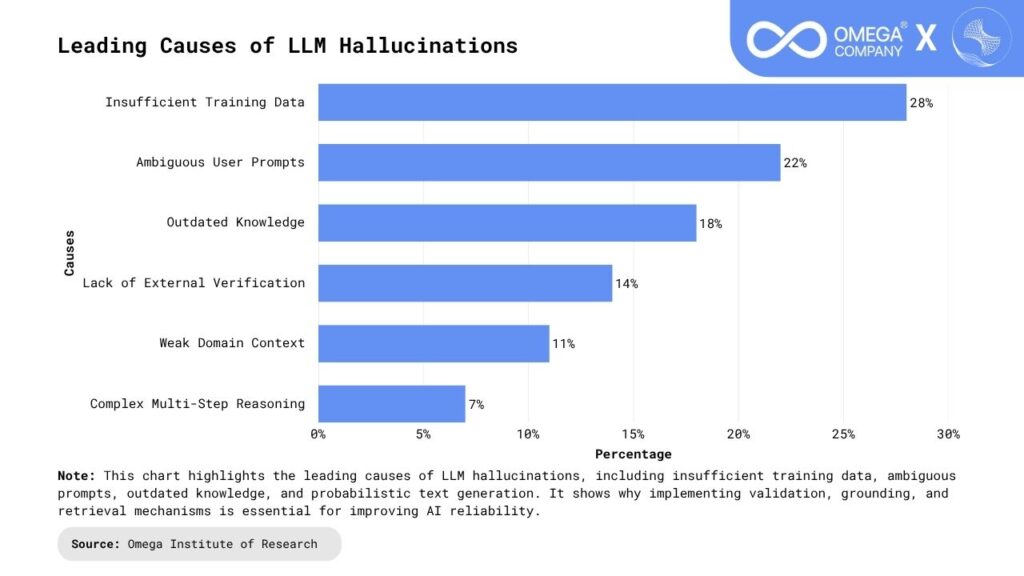
Why Hallucination Mitigation Matters
LLM hallucinations can result in incorrect information, compliance risks, poor decision-making, and potential legal or financial consequences. In enterprise environments, improving factual accuracy is essential for building trust and enabling reliable AI deployment.
Effective hallucination mitigation provides several key benefits:
Improves Accuracy: Safety mechanisms, retrieval-based techniques, and validation frameworks reduce factual and semantic errors, significantly improving the reliability of AI-generated responses. They also ensure that outputs remain grounded in verified knowledge sources, minimizing misinformation and increasing consistency across a wide range of business and technical use cases.
Builds User Trust: Hallucination mitigation helps AI express appropriate confidence levels, reducing misleading certainty and making outputs more transparent and dependable. By clearly distinguishing between verified facts, assumptions, and uncertainty, organizations can foster greater user confidence and encourage responsible adoption of AI-powered systems.
Enables Enterprise Adoption: Although many organizations are experimenting with AI, concerns over factual accuracy often delay production deployment. Mitigation strategies help bridge this gap, making AI suitable for real-world business applications. Strong governance, monitoring, and verification mechanisms also enable organizations to meet regulatory requirements while confidently integrating AI into mission-critical workflows.
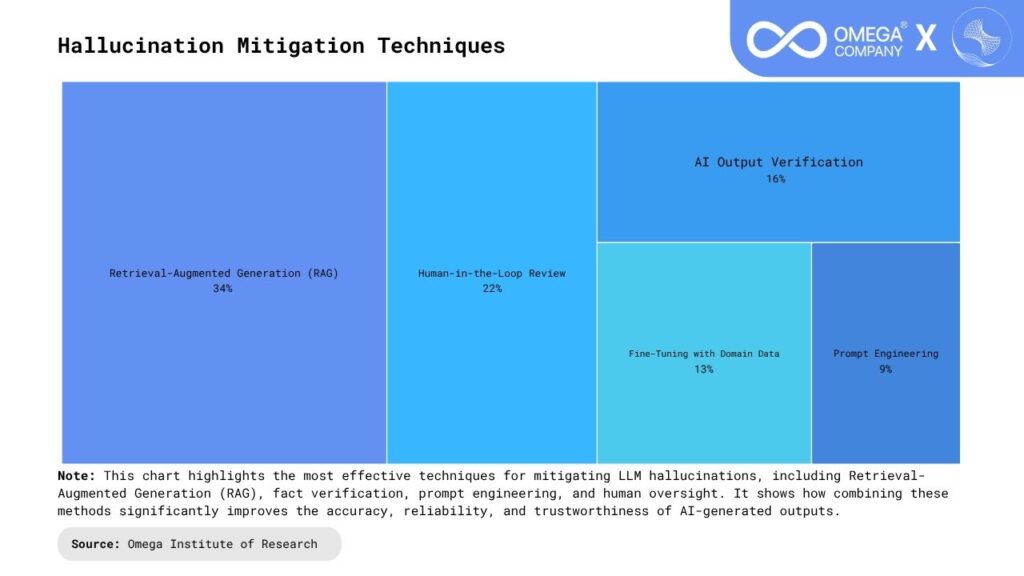
How Hallucination Detection & Mitigation Systems Work
Hallucination detection and mitigation approaches include:
Retrieval-Augmented Generation (RAG): Connects the model to trusted, up-to-date knowledge sources, ensuring responses are grounded in verified information rather than memory alone. By retrieving relevant documents before generating an answer, RAG significantly improves factual accuracy, reduces outdated responses, and enables AI systems to deliver context-aware insights for enterprise applications.
Reasoning-Based Validation: Encourages the model to evaluate its reasoning before generating a final response, reducing factual inconsistencies and improving answer quality. Multi-step reasoning and self-verification techniques help identify logical errors, validate assumptions, and ensure that conclusions are supported by reliable evidence before they are presented to users.
Real-Time Verification: Compares generated content against retrieved sources to identify unsupported claims, improve citation accuracy, and prevent misinformation from reaching end users. Continuous validation mechanisms can flag uncertain statements, request additional evidence when needed, and ensure responses remain aligned with trusted data sources throughout the generation process.
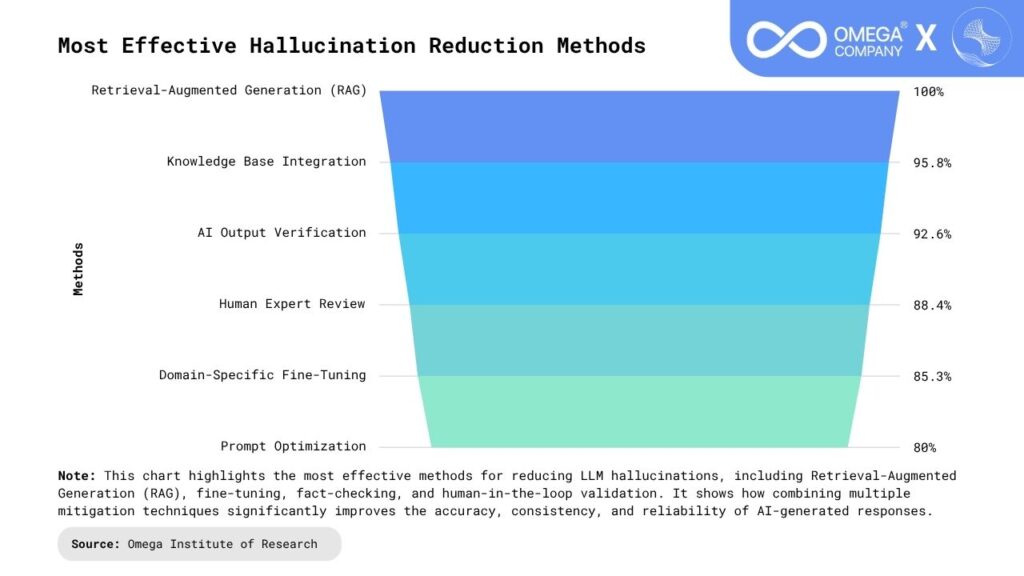
Key Benefits of Mitigating AI Hallucinations
By reducing hallucinations, organizations can improve AI reliability, enhance decision-making, and confidently deploy AI in business-critical environments.
Key benefits include:
Reduced Errors: Grounded AI systems significantly minimize factual inaccuracies, leading to more dependable outputs. By validating information against trusted data sources, organizations can reduce the risk of misinformation, improve the quality of AI-assisted decisions, and prevent costly mistakes in critical business processes. This is particularly valuable in industries such as healthcare, finance, legal services, and government, where accuracy is essential.
Improved Performance: Accurate, context-aware responses enhance efficiency and overall workflow quality, especially in data-sensitive applications. Employees spend less time verifying AI-generated content, allowing them to focus on higher-value tasks and strategic initiatives. Consistently reliable outputs also improve collaboration, accelerate decision-making, and increase productivity across enterprise teams.
Greater Reliability: Source-backed generation reduces unsupported claims and improves the consistency of AI-generated content. Continuous verification and validation mechanisms ensure that responses remain aligned with current knowledge and organizational data. As a result, users can rely on AI systems with greater confidence, even in complex or high-stakes scenarios where factual precision is critical.
Enterprise Readiness: Robust mitigation strategies help organizations meet regulatory requirements, build user trust, and scale AI adoption with confidence. Strong governance frameworks, monitoring systems, and audit capabilities provide greater transparency into AI-generated outputs. These safeguards enable enterprises to deploy AI responsibly while maintaining compliance, reducing operational risks, and supporting long-term digital transformation initiatives.
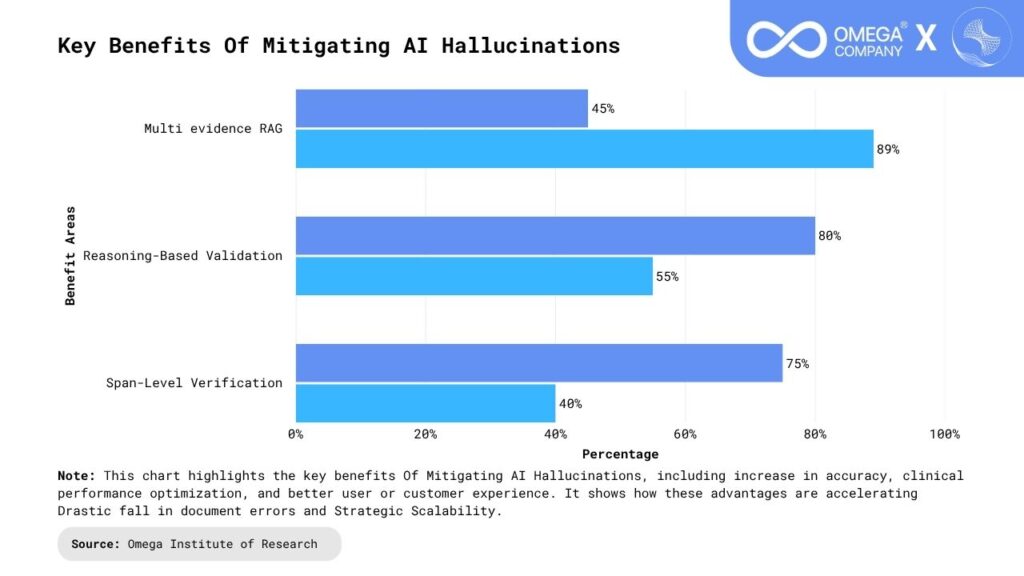
Emerging Innovations in Hallucination Mitigation
Advancements in AI safety are making Large Language Models more accurate, reliable, and suitable for enterprise use. Modern mitigation techniques focus on improving reasoning, handling uncertainty, and grounding responses in trusted data.
Key innovations in AI Hallucination mitigation:
Extended Thinking Architectures: New-generation models dedicate additional reasoning time before generating a response, allowing them to evaluate information more carefully and reduce factual and coding errors. These architectures break complex problems into multiple reasoning steps, improving logical consistency and enabling the model to identify potential mistakes before presenting an answer. As a result, they deliver more accurate, explainable, and dependable outputs for enterprise and technical applications.
Confidence-Aware Responses: Reinforcement Learning from Human Feedback (RLHF) encourages models to acknowledge uncertainty and respond with “I don’t know” when sufficient information is unavailable, rather than generating inaccurate content. This approach reduces overconfident responses, promotes transparency, and helps users better understand the reliability of AI-generated information. By expressing appropriate confidence levels, AI systems become more trustworthy and easier to integrate into decision-making workflows.
Unified Enterprise Data Platforms: Organizations are increasingly integrating LLMs with centralized, trusted data platforms using Retrieval-Augmented Generation (RAG). This ensures responses are based on verified enterprise knowledge, improving accuracy, consistency, and scalability. Integration with knowledge bases, document repositories, and business applications enables AI to access the latest organizational information while maintaining governance, security, and regulatory compliance. These connected data ecosystems also support enterprise-wide AI adoption by providing reliable, context-aware responses across multiple business functions.
Challenges and Limitations
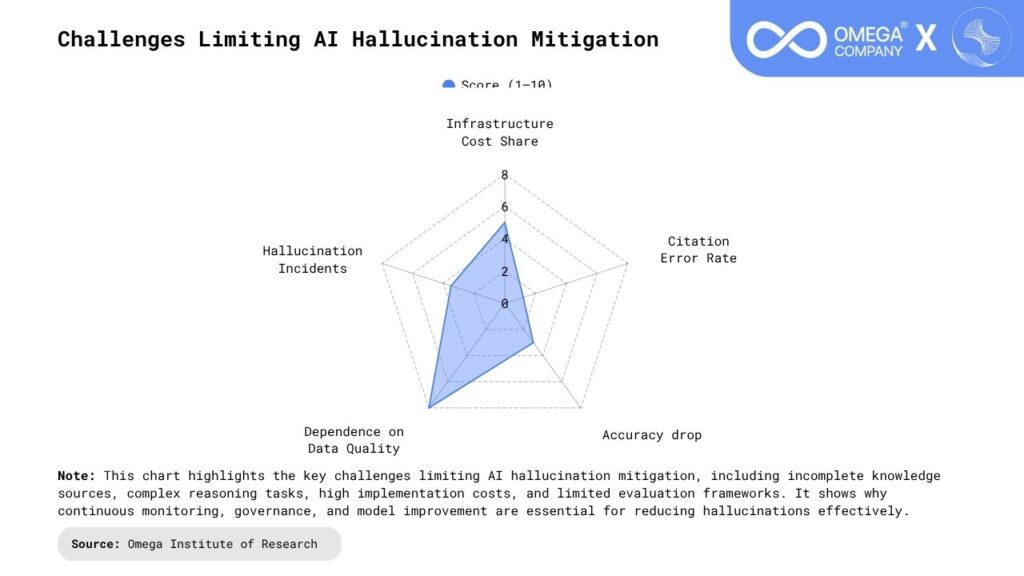
Despite significant advancements, hallucination mitigation is not without its challenges. Organizations must balance accuracy, performance, scalability, and cost when deploying reliable AI systems at scale.
Key limitations include:
Higher Cost and Response Time: Advanced techniques such as Retrieval-Augmented Generation (RAG) and multi-step verification improve accuracy but require additional computing resources, increasing infrastructure costs and response latency. Retrieving external information, validating responses, and performing multiple reasoning steps can slow down response generation, particularly in high-volume enterprise environments. Organizations must carefully balance speed, operational costs, and accuracy to maintain a seamless user experience.
Citation Reliability: Even leading AI models can generate incorrect or fabricated references, making independent verification essential for research, legal, and other high-stakes applications. Citations may appear authentic while referencing nonexistent or irrelevant sources, creating a false sense of credibility. Human review and automated source validation remain critical safeguards to ensure the reliability and authenticity of AI-generated information.
Accuracy Drop and Flexibility: Making models overly cautious can reduce hallucinations, but it may also cause them to decline valid complex queries, limiting their effectiveness in nuanced business scenarios. Excessive safety constraints can reduce creativity, problem-solving capability, and the model’s willingness to provide useful recommendations. Finding the right balance between caution and responsiveness remains a significant challenge for AI developers.
Dependence on Data Quality: Hallucination mitigation is only as effective as the quality of the underlying data. Outdated, incomplete, or inconsistent knowledge sources can still result in inaccurate responses. Organizations must continuously update, validate, and govern their knowledge repositories to ensure AI systems have access to accurate and relevant information. Poor data governance can undermine even the most advanced mitigation techniques.
Hallucination Incidents: Deploying mitigation frameworks across large enterprise environments requires robust infrastructure, continuous monitoring, and regular model updates, increasing operational complexity. Organizations must also establish processes for detecting, reporting, and analyzing hallucination incidents to improve system performance over time. Continuous evaluation is essential to identify emerging risks and maintain consistent AI reliability.
Domain Adaptability: Models trained for one industry may not perform reliably in another without additional fine-tuning and domain-specific validation. Specialized sectors such as healthcare, finance, engineering, and law require industry-specific terminology, regulations, and contextual understanding. Adapting models to these environments often requires customized datasets, expert supervision, and ongoing performance testing.
Lack of Universal Standards: There is currently no single industry-wide benchmark for measuring or defining AI hallucinations, making it difficult to evaluate and compare mitigation performance across different systems. Organizations often rely on their own evaluation metrics, leading to inconsistent assessments of AI quality and reliability. The development of standardized benchmarks and testing methodologies will be essential for improving transparency, accountability, and trust in enterprise AI systems.
The Future of Hallucination Detection and Mitigation in LLMs
The future of hallucination detection and mitigation in Large Language Models (LLMs) will focus on creating AI systems that are more trustworthy, transparent, and reliable. Future models will combine advanced reasoning, Retrieval-Augmented Generation (RAG), real-time verification, and confidence-aware responses to significantly reduce factual errors and unsupported claims. AI systems will increasingly validate information against trusted knowledge sources, clearly communicate uncertainty, and generate more accurate, evidence-based responses. Stronger AI governance, continuous monitoring, and standardized evaluation frameworks will further improve reliability while helping organizations meet regulatory and compliance requirements. As these technologies mature, LLMs will evolve into dependable enterprise systems capable of supporting complex decision-making, automating critical business processes, and enabling organizations to confidently scale trustworthy AI across industries.
Conclusion
Hallucination mitigation marks a significant step forward in the evolution of enterprise AI, transforming Large Language Models (LLMs) into more accurate, transparent, and business-ready systems. By integrating techniques such as Retrieval-Augmented Generation (RAG), verification frameworks, and continuous evaluation, organizations can improve the reliability of AI-generated outputs while reducing the risks associated with misinformation and unsupported claims. For business leaders, investing in hallucination detection and mitigation is no longer just a technical improvement but a strategic necessity for building trust, ensuring regulatory compliance, and enabling responsible AI adoption. As AI continues to evolve, organizations that prioritize robust governance, validation, and AI safety practices will be better positioned to confidently scale generative AI, enhance decision-making, and create long-term, sustainable business value.
- http://Huang, L., et al. A Survey on Hallucination in Large Language Models: Principles, Taxonomy, and Mitigation (Nature Portfolio Frameworks).
- http://Lewis, P., et al. Retrieval-Augmented Generation for Knowledge-Intensive NLP Tasks (RAG Baseline Framework).
- http://Digital Applied. AI Hallucination Rate Benchmarks 2026: 5-Model Study (Extended Thinking and Verification Data).
- http://CMARIX Research. RAG & AI Trust Statistics 2026: From Hallucinations to Reliable AI Systems.
- http://SQ Magazine. LLM Hallucination Statistics 2026: Industry and Domain Benchmarks.
Subscribe
Select topics and stay current with our latest insights
- Functions