

- Industries
Industries
- Functions
Functions
- Insights
Insights
- Careers
Careers
- About Us

Building the AI Workforce: Critical Roles to Hire and Roles to Phase Out







Artificial Intelligence (AI) is rapidly transforming the global workforce, reshaping how organizations operate, compete, and hire talent. As businesses increasingly adopt AI to automate processes, enhance decision-making, and improve efficiency, the demand for new skills and specialized roles is growing. At the same time, positions centered on routine, repetitive, and predictable tasks are becoming increasingly vulnerable to automation. This shift is forcing organizations to rethink their hiring strategies and workforce planning to remain competitive in an AI-driven economy. The future of hiring will focus on attracting professionals who can work alongside intelligent systems, leverage AI-powered insights, and drive innovation. Understanding which roles are likely to emerge and which may gradually disappear is essential for business leaders, HR professionals, and job seekers seeking to prepare for the changing world of work.
Why AI Is Reshaping Hiring
Every major technological revolution has transformed employment patterns, from the industrial revolution that automated manual labor to the computer and internet revolutions that digitized work and reshaped communication. Artificial Intelligence (AI) represents the next stage of this evolution, with the unique ability to automate not only physical tasks but also certain cognitive activities traditionally performed by knowledge workers. Modern AI systems can analyze large volumes of data, generate content, identify patterns, predict outcomes, and support complex decision-making, enabling organizations to automate tasks that once required significant human effort. As a result, businesses are reevaluating which roles are essential for future growth and which may become less relevant as automation expands. While AI is reducing the need for some routine and administrative positions, it is simultaneously creating demand for professionals skilled in AI technologies, data analysis, cybersecurity, digital strategy, and human-AI collaboration. This shift is redefining workforce planning and talent acquisition strategies, prompting employers to prioritize adaptability, technological literacy, analytical thinking, and problem-solving capabilities. Organizations that understand these changing workforce dynamics will be better positioned to hire the talent needed to succeed in an increasingly AI-driven economy.
Roles Organizations Need in an AI-Driven Future
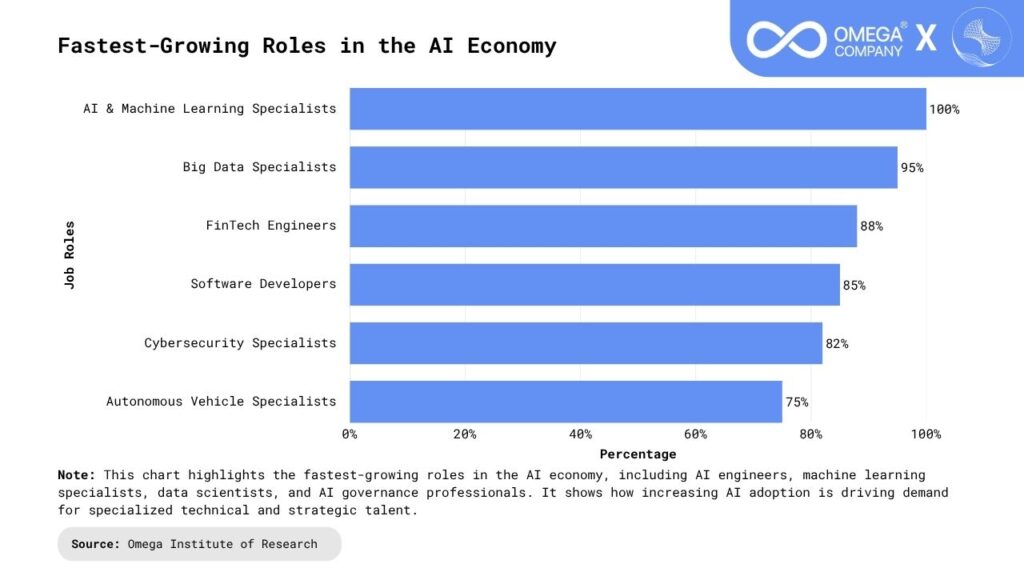
AI and Machine Learning Specialists: As organizations increasingly integrate AI into their operations, AI and Machine Learning Specialists will become essential hires. These professionals develop and optimize the algorithms that power intelligent systems, from predictive analytics and recommendation engines to generative AI applications and autonomous decision-making tools. Their expertise enables businesses to create competitive advantages through automation, personalization, and data-driven insights. As AI adoption expands across industries, demand for talent capable of building, maintaining, and improving these systems is expected to grow significantly.
Data Scientists and Data Engineers: AI is only as effective as the data that supports it, making Data Scientists and Data Engineers critical roles in the AI-driven workforce. Data Scientists transform complex datasets into actionable insights that guide strategic decisions, while Data Engineers build the infrastructure required to collect, store, and process information efficiently. As organizations generate larger volumes of data and rely more heavily on AI-powered analytics, professionals who can manage and extract value from data will remain indispensable to business success.
AI Product Managers: The growing adoption of AI has created a need for professionals who can bridge the gap between technology and business strategy. AI Product Managers ensure that AI initiatives align with organizational goals, customer needs, and market opportunities. They coordinate technical teams, prioritize development efforts, and oversee the successful deployment of AI-powered products and services. As companies continue investing in AI-driven innovation, these professionals will play a central role in turning technological capabilities into measurable business outcomes.
Prompt Engineers and AI Workflow Designers: Generative AI is transforming how work is performed, creating demand for professionals who understand how to maximize the effectiveness of AI systems. Prompt Engineers design and refine interactions that help AI tools produce accurate and valuable outputs, while AI Workflow Designers integrate AI into business processes to improve efficiency and productivity. As organizations seek to automate routine tasks and streamline operations, professionals who can optimize human-AI collaboration and workflow design will become increasingly valuable.
Cybersecurity and AI Security Specialists: As businesses become more dependent on AI-powered systems, protecting digital assets and intelligent technologies will become even more critical. Cybersecurity and AI Security Specialists safeguard organizations against data breaches, cyberattacks, model manipulation, and emerging AI-related threats. Their responsibilities extend beyond traditional security practices to include securing AI models and ensuring compliance with evolving regulations. Given the increasing sophistication of cyber risks, organizations will continue prioritizing security talent as a key hiring area.
Human-AI Collaboration Specialists: Successful AI adoption depends not only on technology but also on how effectively employees use it. Human-AI Collaboration Specialists help organizations redesign workflows, manage change initiatives, and train employees to work alongside intelligent systems. Their role is to ensure that AI enhances productivity rather than creates disruption. As businesses accelerate digital transformation efforts, professionals who can facilitate seamless human-AI integration will become increasingly important.
AI Ethics and Governance Professionals: As AI systems influence more business decisions, organizations face growing pressure to ensure that these technologies operate responsibly and transparently. AI Ethics and Governance Professionals establish policies for ethical AI use, monitor compliance, assess risks, and address concerns related to bias, privacy, and accountability. With governments introducing new AI regulations and stakeholders demanding greater transparency, organizations will need dedicated professionals to manage governance frameworks and maintain public trust.
Software Developers with AI Expertise: Software developers will remain highly valuable in the AI era, but the role is evolving. Modern developers are expected to work alongside AI-powered coding tools that accelerate development, automate repetitive tasks, and improve productivity. Organizations increasingly seek developers who understand both traditional software engineering principles and emerging AI technologies. The most sought-after professionals will be those who can combine technical expertise with creativity, system design capabilities, and strategic problem-solving to build the next generation of AI-enabled applications.
Roles Most Likely to Decline
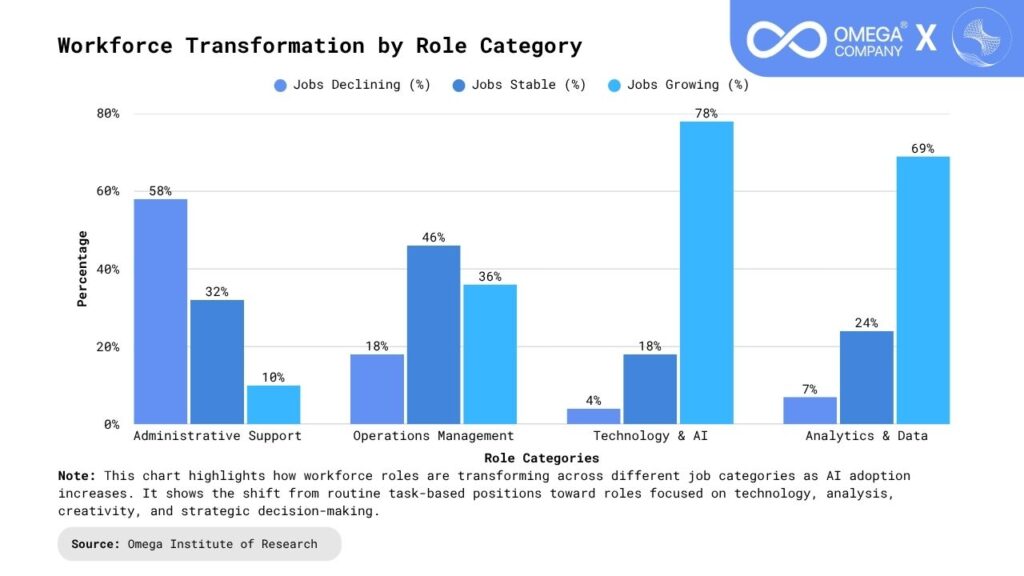
While AI is expected to create numerous opportunities, certain occupations face significant disruption due to automation.
Data Entry Clerks: Data Entry Clerks are among the roles most vulnerable to AI-driven automation because their responsibilities are largely repetitive, structured, and rules-based. Modern AI-powered document processing and intelligent automation systems can rapidly extract, classify, validate, and organize information with greater speed and accuracy than manual processes. As organizations continue investing in digital transformation and workflow automation, the need for large teams dedicated to manual data entry is expected to decline significantly. While some oversight roles may remain, the overall demand for traditional data entry positions is likely to decrease in the years ahead.
Administrative and Clerical Assistants: Advances in AI-powered virtual assistants are transforming many traditional administrative and clerical functions. Intelligent systems can now schedule meetings, manage calendars, organize files, draft routine communications, and handle various administrative workflows with minimal human involvement. As a result, organizations may require fewer employees to perform routine support tasks. While executive assistants and professionals handling complex coordination, relationship management, and strategic support will continue to be valuable, many traditional clerical roles are expected to experience declining demand as automation capabilities improve.
Basic Customer Service Representatives: The rapid advancement of conversational AI is reshaping customer service operations across industries. AI-powered chatbots and virtual assistants can now answer common questions, process transactions, resolve routine issues, and provide 24/7 support without human intervention. This allows organizations to automate a significant portion of customer interactions while reducing operational costs. Although human representatives will remain essential for handling complex, sensitive, or high-value customer situations, many entry-level and routine customer service positions are likely to face increasing automation pressure.
Routine Bookkeeping and Accounting Roles: AI-powered accounting platforms are automating many of the transactional tasks traditionally performed by bookkeeping professionals. Activities such as invoice processing, expense categorization, account reconciliation, payroll administration, and financial reporting can now be completed with minimal manual effort. As these technologies become more sophisticated, demand for professionals focused solely on routine accounting functions is expected to decline. However, accountants who provide strategic financial planning, business advisory services, risk analysis, and regulatory expertise will continue to play a critical role in organizational success.
Basic Content Production Roles: Generative AI tools are rapidly changing the content creation landscape by producing product descriptions, social media posts, blog drafts, marketing copy, and other routine content at scale. This capability reduces the need for professionals whose work primarily involves repetitive content generation. However, AI remains limited in areas requiring originality, emotional intelligence, brand storytelling, and creative strategy. As a result, demand may decline for basic content production roles, while opportunities grow for professionals who focus on content strategy, creative direction, audience engagement, and brand development.
Simple Research and Information Gathering Roles: AI systems can now collect, summarize, and organize information from vast amounts of data in a fraction of the time required by human researchers. Tasks that once involved extensive manual information gathering can increasingly be automated through AI-powered search, analytics, and knowledge management tools. Consequently, organizations may require fewer employees dedicated solely to basic research activities. However, professionals who can critically evaluate information, interpret findings, provide business context, and develop strategic recommendations will remain highly valuable in an AI-driven workplace.
Skills That Will Matter Most
The future of hiring will increasingly revolve around skills rather than job titles. Organizations are looking for employees who can adapt to rapidly changing technologies and evolving business needs.
AI Literacy: As AI becomes embedded in everyday business operations, AI literacy will emerge as a fundamental skill across virtually every profession. Employees will need a working understanding of how AI systems function, where they can add value, and what their limitations are. This does not mean everyone must become an AI engineer, but professionals who can effectively use AI tools, evaluate AI-generated outputs, and identify opportunities for AI-driven improvements will have a significant advantage in the job market. Much like digital literacy became essential in the internet era, AI literacy is expected to become a core requirement in the AI-driven workplace.
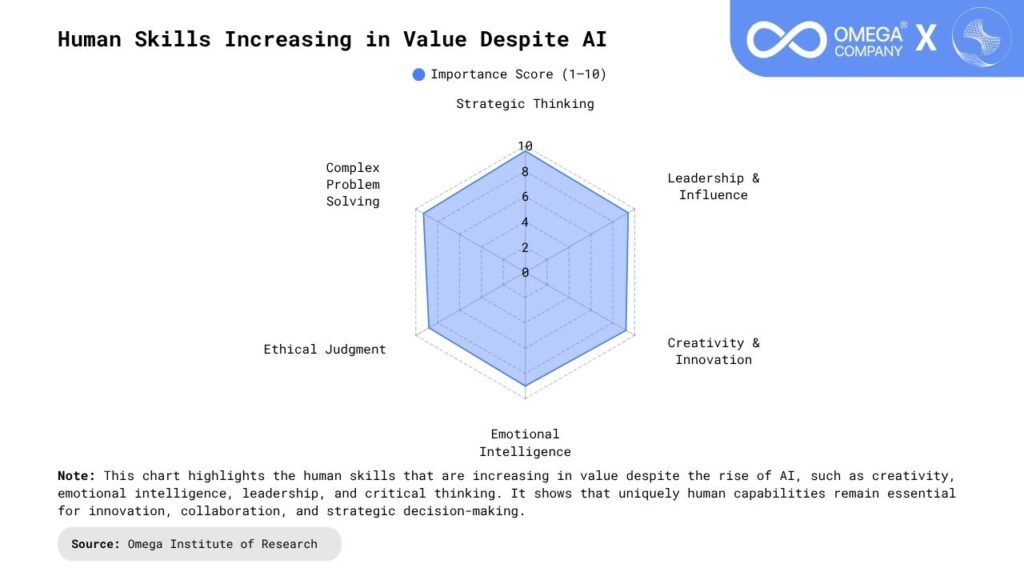
Analytical Thinking: While AI can process vast amounts of information and generate insights quickly, human judgment remains essential for interpreting results and making strategic decisions. Analytical thinking enables professionals to identify patterns, evaluate evidence, solve complex problems, and determine the best course of action in uncertain situations. Organizations increasingly value employees who can combine AI-generated insights with critical reasoning to support business objectives. As automation handles more routine tasks, analytical thinking will become one of the most important differentiators in the workforce.
Creativity: Creativity will remain a uniquely valuable human capability in an age of intelligent automation. Although AI can generate content, ideas, and recommendations, it often relies on existing patterns and data. Human creativity drives innovation by introducing original concepts, challenging assumptions, and developing novel solutions to complex challenges. Organizations seeking to differentiate themselves in competitive markets will continue to rely on employees who can think imaginatively, develop new products and services, and create compelling customer experiences that go beyond what AI alone can produce.
Emotional Intelligence: As automation takes over more technical and repetitive tasks, human-centered skills will become increasingly important. Emotional intelligence encompasses empathy, communication, relationship-building, collaboration, leadership, and conflict resolution capabilities that remain difficult for AI to replicate. Professionals who can understand human needs, inspire teams, build trust, and navigate complex interpersonal dynamics will continue to be highly valued. In an AI-driven workplace, emotional intelligence will be a critical factor in effective leadership, customer engagement, and organizational success.
Adaptability and Continuous Learning: The rapid pace of technological change means that today’s skills may become outdated much faster than in previous generations. As AI continues to evolve, professionals must be willing to learn new tools, acquire new competencies, and adapt to changing job requirements. Organizations increasingly prioritize candidates who demonstrate curiosity, resilience, and a commitment to continuous improvement. In the future workforce, the ability to learn and adapt quickly may be more valuable than any single technical skill, making lifelong learning essential for long-term career success.
Data Literacy: Data is the foundation of AI-powered decision-making, making data literacy an increasingly important skill across all industries and job functions. Professionals must be able to understand data sources, interpret analytics, identify trends, and use insights to support informed business decisions. Even employees in non-technical roles will be expected to work with data-driven tools and metrics on a regular basis. As organizations continue to rely on AI and advanced analytics, individuals who can confidently navigate and apply data insights will be better positioned to contribute value and advance their careers.
Building an AI-Ready Workforce
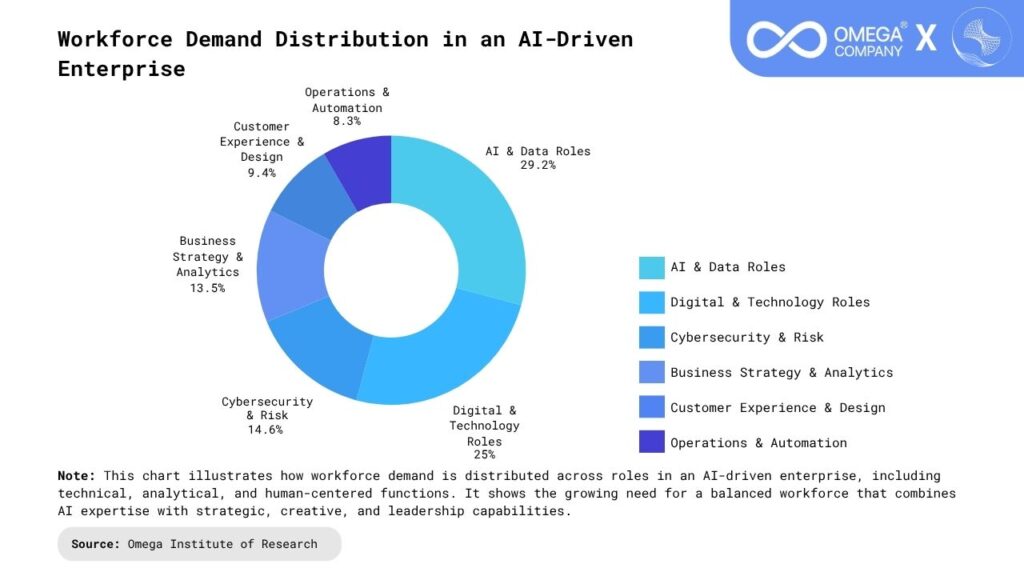
Building an AI-ready workforce requires more than simply hiring new talent; it demands a strong commitment to reskilling and upskilling existing employees. Forward-thinking organizations are investing in training programs focused on AI literacy, data analytics, digital technologies, cybersecurity awareness, and change management to equip their workforce with future-ready skills. These initiatives help address talent shortages, improve adaptability, and strengthen organizational resilience in an increasingly automated environment. At the same time, successful AI adoption requires a cultural shift that encourages continuous learning, innovation, and collaboration between people and intelligent systems. Leaders must foster an environment where employees view AI as a tool for augmentation rather than a threat to job security, helping to build trust and accelerate adoption. Organizations that actively invest in both technology and workforce development will be better positioned to unlock the full value of AI while maintaining a competitive advantage. By providing employees with the necessary support, training, and guidance to embrace new technologies, businesses can create a more agile, productive, and future-ready workforce prepared for long-term success.
Conclusion
The future of hiring will not be defined by a competition between humans and AI but by the ability of organizations and professionals to leverage the strengths of both. While AI will automate many repetitive, routine, and predictable tasks, leading to reduced demand for certain roles, it will also create new opportunities for professionals who can develop, manage, secure, and optimize intelligent systems. As a result, organizations must rethink their talent strategies and prioritize hiring individuals with a blend of technical expertise, analytical thinking, creativity, adaptability, and strong interpersonal skills. At the same time, professionals who embrace continuous learning, develop AI literacy, and adapt to evolving workplace demands will be better positioned for long-term career success. Ultimately, the organizations that thrive in an AI-driven future will be those that successfully combine human ingenuity, strategic thinking, and innovation with the speed, efficiency, and intelligence of AI-powered technologies.
- https://www.weforum.org/publications/the-future-of-jobs-report-2025/digest/
- https://www.ilo.org/publications/generative-ai-and-jobs-refined-global-index-occupational-exposure
- https://www.weforum.org/stories/2025/01/future-of-jobs-report-2025-the-fastest-growing-and-declining-jobs/
- https://www.nexford.edu/insights/how-will-ai-affect-jobs
- https://blog.lewagon.com/skills/the-future-of-work-will-ai-replace-jobs-or-create-new-ones/
Subscribe
Select topics and stay current with our latest insights
- Functions