

- Industries
Industries
- Functions
Functions
- Insights
Insights
- Careers
Careers
- About Us

Human + AI Leadership Models







Leadership is undergoing a defining transformation as artificial intelligence becomes deeply embedded in decision-making, operations, and workforce management, rendering traditional leadership models based solely on human intuition, experience, and authority insufficient for today’s complexity and scale. Organizations are increasingly adopting Human + AI leadership models, where leaders collaborate with intelligent systems to enhance insight, speed, accuracy, and reach, while firmly anchoring decisions in human values, ethics, and accountability. This approach is not about replacing leaders with machines, but about augmenting human capabilities through AI-powered intelligence, allowing leaders to concentrate on strategic vision, empathy, creativity, and complex judgment, while AI handles data-intensive, repetitive, and predictive tasks. As a result, leadership roles, decision rights, governance structures, and organizational culture must be redefined to fully realize the potential of this new paradigm.
What Is Human + AI Leadership?
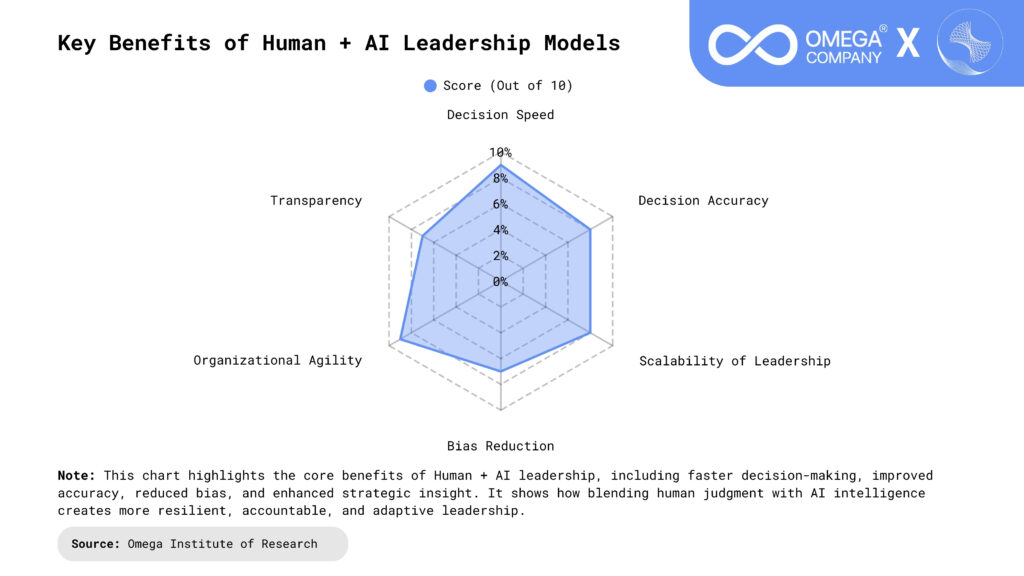
Human + AI leadership is a collaborative leadership framework in which humans and AI systems jointly contribute to planning, decision-making, execution, and continuous learning, combining complementary strengths to achieve better outcomes. In this model, humans bring context, ethical judgment, emotional intelligence, strategic intent, creativity, and accountability, while AI delivers large-scale data processing, pattern recognition, predictive analytics, simulation, and automation. Rather than serving as an occasional tool, AI operates as a persistent cognitive partner embedded directly into leadership workflows, supporting leaders at every level with real-time insights, scenario modeling, and evidence-based recommendations. This partnership enables faster and more informed decisions, reduces bias and uncertainty, and improves consistency across complex organizations. Ultimately, Human + AI leadership reshapes how authority, responsibility, and performance are defined, creating a more adaptive, resilient, and future-ready leadership model.
Why Traditional Leadership Models Are No Longer Enough
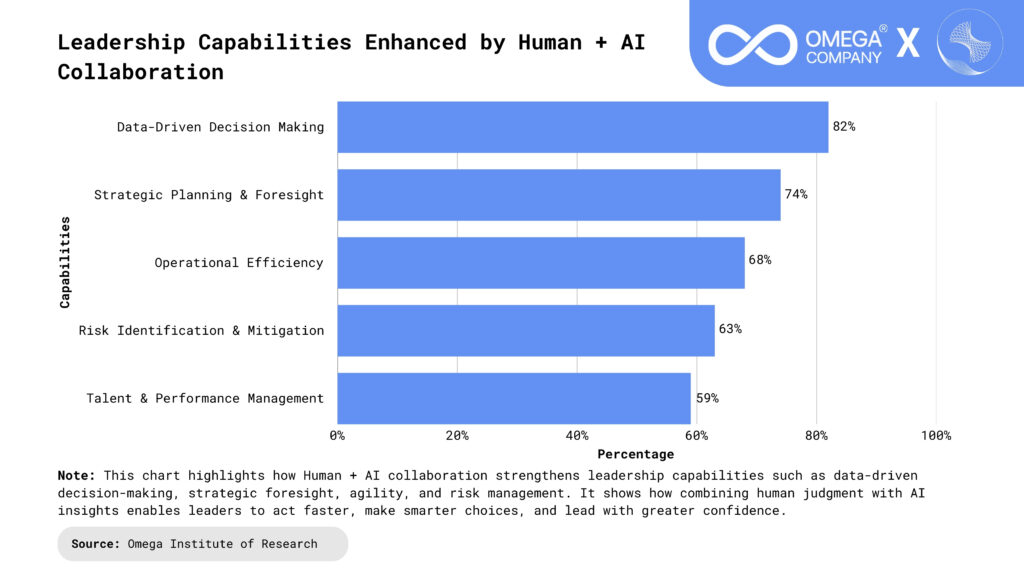
Complexity and Speed of Change: Global markets, regulatory environments, supply chains, and workforce dynamics have become far more interconnected and volatile, making them too complex for human cognition alone. Leaders now face thousands of variables, real-time disruptions, and rapid feedback loops that exceed traditional decision-making capacity and slow down effective responses. Without advanced analytical support, even experienced leaders struggle to anticipate second- and third-order impacts.
Data Overload: Leaders are inundated with data from multiple systems, dashboards, and reports, yet often lack timely, actionable insight. This abundance of information creates analysis paralysis rather than clarity, delaying critical decisions. AI systems can synthesize massive datasets into meaningful patterns and recommendations, enabling leaders to focus on judgment and action instead of manual analysis.
Rising Expectations of Precision: Stakeholders increasingly expect leadership decisions to be evidence-based, transparent, and measurable, especially in areas such as investment, risk, and workforce planning. Intuition alone is no longer sufficient in high-stakes environments. When governed responsibly, AI enhances accuracy, consistency, and explain ability while helping reduce bias and variability in decision-making.
Workforce Transformation: Hybrid work models, global mobility, persistent skills shortages, and multi-generational teams have fundamentally reshaped how work is organized and led. Leaders must balance personalization with scale while maintaining engagement and performance across borders. AI helps enable adaptive, data-driven, and personalized leadership approaches that can be applied consistently across diverse and distributed workforces.
Augmentation Over Automation: The objective is not to automate leadership responsibilities, but to meaningfully augment them through intelligent support. AI strengthens human capabilities by enhancing insight, speed, and consistency, rather than replacing human judgment or authority. This ensures leaders retain agency, creativity, and accountability while operating with greater confidence in complex environments.
Human-in-the-Loop Governance: All critical and high-impact decisions remain under direct human oversight to preserve responsibility and ethical control. AI systems recommend, simulate scenarios, and forecast outcomes, but humans provide context, validate assumptions, and make final calls. This balance reduces risk, prevents overreliance on algorithms, and reinforces trust in AI-supported leadership decisions.
Ethical and Explainable Intelligence: Leadership AI must be transparent, auditable, and explainable to ensure decisions can be understood and justified. Models should align with organizational values, regulatory requirements, and societal expectations. Ethical design and governance are essential to maintain trust among employees, customers, partners, and regulators.
Continuous Learning and Adaptation: Human + AI leadership is dynamic, not static, requiring ongoing learning from both sides. Leaders continuously refine judgment by interpreting AI insights and real-world outcomes, while AI models evolve through human feedback, updated data, and performance evaluation. This shared learning loop enables organizations to adapt faster and remain resilient amid change.
Key Human + AI Leadership Models
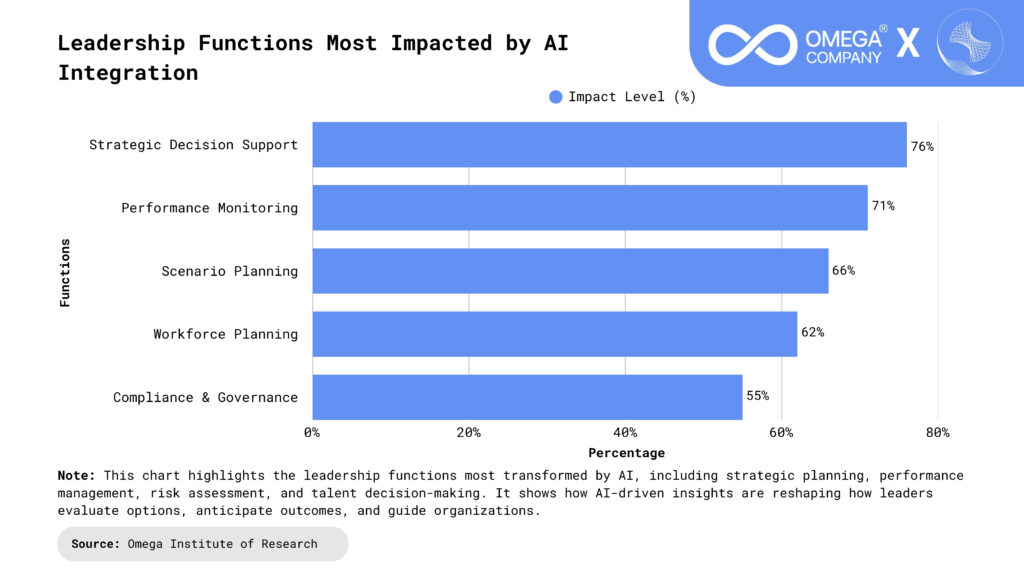
AI-Augmented Strategic Leadership: In this model, AI supports leaders at the strategic level by analyzing market trends, competitive dynamics, geopolitical risks, and long-term scenarios. Advanced simulations and predictive analytics help leaders test strategic options before committing resources. This enables more resilient, forward-looking strategies while preserving human vision, judgment, and accountability.
Data-Driven Operational Leadership: Here, AI partners with leaders to optimize day-to-day operations by identifying inefficiencies, forecasting demand, and streamlining workflows. Real-time dashboards and intelligent alerts allow leaders to intervene proactively rather than reactively. As a result, operational decisions become faster, more consistent, and grounded in evidence.
Human + AI People Leadership: This model centers on talent management, performance, and employee experience, with AI enabling more personalized and inclusive leadership practices. AI can support workforce planning, skills mapping, engagement analysis, and bias-aware evaluations. Leaders use these insights to coach more effectively, support well-being, and build stronger, more diverse teams.
AI-Enabled Decision Orchestration Leadership: In large, complex organizations, leadership decisions are distributed across functions, teams, and geographies. AI acts as a decision-orchestration layer, integrating data, priorities, and constraints to ensure alignment and coherence. This model reduces fragmentation, improves cross-functional coordination, and supports enterprise-wide consistency.
Autonomous-Assisted Leadership: In more advanced environments, certain decisions are fully automated within clearly defined rules, thresholds, and governance frameworks. AI handles high-volume, low-risk decisions, allowing leaders to focus on exceptions, innovation, and long-term strategy. This approach increases speed and efficiency without sacrificing oversight or control.
Skills Required for Human + AI Leaders
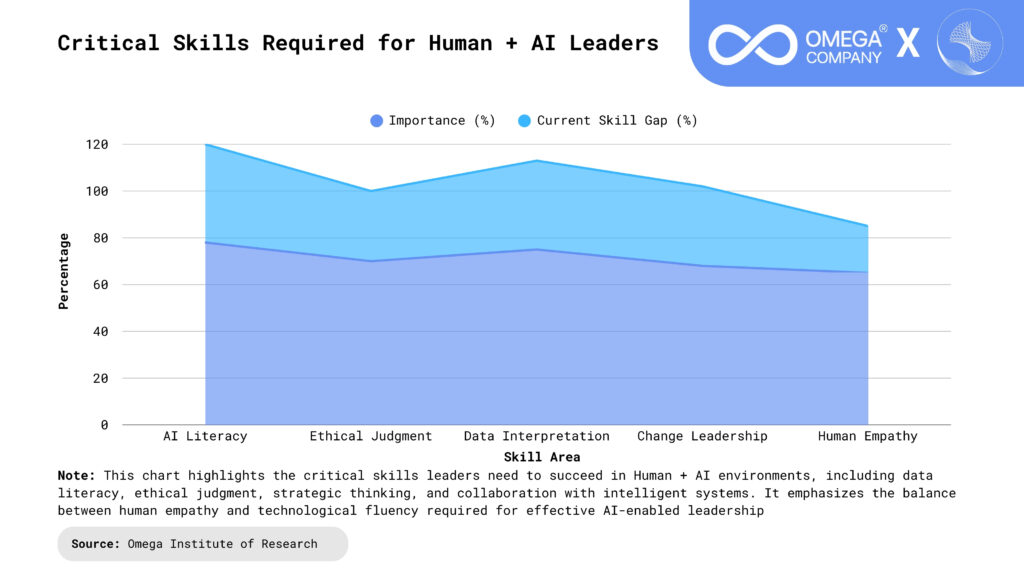
Human + AI leadership demands a new leadership skill set, blending technical literacy with deeply human capabilities:
AI literacy: Leaders must understand how AI systems work, including data inputs, model logic, limitations, and potential biases. This knowledge helps them ask better questions, set realistic expectations, and avoid overreliance on automated outputs. AI literacy also enables leaders to engage meaningfully with technical teams and vendors.
Critical thinking: Human + AI leaders must evaluate AI-generated insights with skepticism and judgment rather than accepting them blindly. They need to assess assumptions, validate results against real-world context, and recognize when AI recommendations may be incomplete or misleading. This skill ensures decisions remain thoughtful, balanced, and accountable.
Ethical reasoning: Leaders must ensure AI-supported decisions align with organizational values, legal requirements, and societal expectations. Ethical reasoning helps identify risks related to bias, fairness, privacy, and transparency before they escalate. It also reinforces trust among employees, customers, and external stakeholders.
Emotional intelligence: As AI reshapes roles and workflows, leaders must guide people through uncertainty, fear, and change with empathy. Strong emotional intelligence enables leaders to communicate clearly, build trust, and sustain engagement during transformation. It also helps maintain a human-centered culture in increasingly digital environments.
Systems thinking: Human + AI leaders must understand the interdependencies between people, technology, data, and processes across the organization. Systems thinking allows leaders to anticipate unintended consequences and manage complexity holistically. This capability is critical for designing resilient, scalable, and sustainable Human + AI leadership models.
Organizational Enablers of Human + AI Leadership
To succeed with Human + AI leadership, organizations must move beyond individual capability building and establish strong, system-level enablers that support consistent, responsible, and scalable adoption.
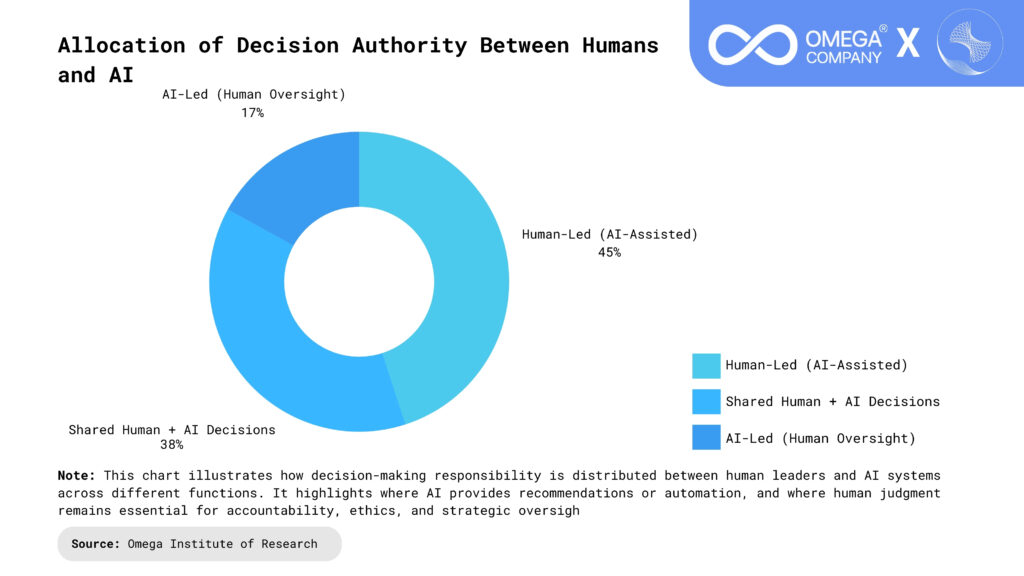
Clear decision rights between humans and AI: Organizations must clearly define which decisions are automated, which are AI-assisted, and which remain fully human-led. This clarity prevents confusion, reduces risk, and ensures accountability is maintained at the right level. Well-defined decision rights also help employees understand how AI influences outcomes.
Robust data foundations and system integration: High-quality, reliable data is the backbone of effective AI-enabled leadership. Organizations must invest in data governance, integration across platforms, and real-time data access to avoid fragmented or misleading insights. Strong data foundations ensure AI outputs are trustworthy and actionable.
AI governance frameworks for accountability and compliance: Formal governance structures are essential to manage risk, ensure regulatory compliance, and align AI use with organizational values. These frameworks should define ownership, monitoring, auditability, and escalation processes. Effective governance builds confidence among leaders, regulators, and stakeholders.
Change management programs to build trust and adoption: Successful Human + AI leadership requires cultural change, not just technology deployment. Structured change management programs help address fear, resistance, and misconceptions about AI. Transparent communication and training are critical to building trust and encouraging adoption across the workforce.
Leadership development programs focused on Human + AI collaboration: Traditional leadership training is no longer sufficient in an AI-enabled environment. Organizations must redesign development programs to include AI literacy, ethical decision-making, and collaboration with intelligent systems. Continuous learning ensures leaders remain effective as technologies evolve.
Risks and Challenges to Address
While Human + AI leadership models offer significant advantages, they also introduce new risks that must be actively managed to avoid unintended consequences.
Over-reliance on AI recommendations: Leaders may become overly dependent on AI outputs, reducing independent judgment and critical thinking. This can lead to poor decisions if models are flawed or context is misunderstood. Maintaining human oversight is essential to preserve balance and accountability.
Lack of transparency in AI decision logic: Black-box AI systems can make it difficult for leaders to understand how conclusions are reached. This lack of explainability undermines trust and complicates accountability. Transparent and interpretable AI models are critical for leadership use cases.
Ethical blind spots and algorithmic bias: AI systems can unintentionally reinforce existing biases or create new ethical risks. Without proper oversight, these issues may go unnoticed until they cause harm. Ongoing monitoring and ethical review processes are essential to mitigate such risks.
Skills gaps among leaders: Many leaders lack the technical and analytical skills needed to work effectively with AI. This gap limits the value of AI investments and increases decision risk. Targeted upskilling and continuous education are necessary to close this gap.
Resistance from employees due to trust concerns: Employees may fear job loss, increased surveillance, or unfair decision-making driven by AI. These concerns can slow adoption and reduce engagement. Building trust through transparency, communication, and inclusion is critical for success.
The Future of Human + AI Leadership Models
Human + AI leadership represents a fundamental shift from leadership defined by authority to leadership practiced as orchestration, where human creativity, empathy, and judgment are deliberately aligned with machine intelligence. The most effective leaders will not compete with AI but collaborate with it, using intelligent systems to extend their cognitive reach, enhance decision quality, and manage complexity at scale while remaining firmly grounded in human values, ethics, and accountability. In this model, leaders act as integrators balancing data, technology, and human insight to guide organizations through uncertainty and change. Organizations that successfully embrace Human + AI leadership models will move faster, make more informed and consistent decisions, and cultivate resilient, adaptive workforces, positioning themselves to innovate continuously and achieve sustainable success in an increasingly AI-driven world.
Conclusion
In this Conclusion Human + AI leadership models represent a fundamental shift in how leadership is defined and practiced, where success depends on the effective collaboration between human judgment and machine intelligence rather than intuition or algorithms alone. By leveraging AI for insights, risk anticipation, and optimization, leaders gain greater clarity and speed, while humans continue to provide purpose, ethical guidance, emotional intelligence, and accountability. However, this model extends beyond technology, requiring investment in leadership capabilities, transparent governance, clear decision rights, and a culture of continuous learning. As leadership evolves into intelligent, adaptive ecosystems, organizations that embrace Human + AI collaboration will build more resilient, inclusive, and future-ready leadership for an increasingly complex world.
- https://managementworld.online/index.php/mw/article/view/1100
- https://siliconvalley.center/blog/redefining-leadership-in-the-age-of-human-ai-teams-from-commanding-to-orchestrating
- https://papers.ssrn.com/sol3/papers.cfm?abstract_id=5331975\
- https://www.potentialproject.com/ai-and-human-leadership
- https://www.hultashridge.com/en/insights/article/human-leader-world-ai/
Subscribe
Select topics and stay current with our latest insights
- Functions