

- Industries
Industries
- Functions
Functions
- Insights
Insights
- Careers
Careers
- About Us


Photonic Computing: The Future of Ultrafast Data Processing







In an age where data is often called “the new oil,” the ability to process, analyze, and act on information faster than ever before has become a strategic advantage, powering everything from artificial intelligence (AI) algorithms and cloud infrastructure to self-driving cars and next-generation healthcare. Yet, traditional electronic processors are beginning to buckle under modern demands, with challenges like heat dissipation, power consumption, and physical size limitations slowing progress. To overcome these barriers, researchers and innovators are turning to photonic computing, a transformative technology that uses light instead of electricity to perform computations promising to redefine the future of ultrafast data processing and unlock possibilities beyond the reach of electronics alone. By enabling faster speeds, higher efficiency, and greater scalability, photonic computing could become the cornerstone of tomorrow’s digital transformation. Its impact is expected to ripple across industries, reshaping how we approach computing, communication, and innovation in the decades ahead.
What Is Photonic Computing?
Photonic computing is the use of light particles, or photons, instead of electrons to perform computational tasks, relying on optical components like lasers, modulators, and waveguides to transmit and manipulate light signals rather than moving electrons through copper wires and transistors. The principle is both simple and powerful: since light can travel at incredible speeds and carry vast amounts of information simultaneously through different wavelengths, a concept known as wavelength-division multiplexing photonic processors can handle data far faster and more efficiently than their electronic counterparts.
To put it into perspective, while traditional computing is like cars moving on a single-lane highway, photonic computing resembles airplanes flying across open skies with virtually unlimited lanes, offering unmatched speed, scalability, and potential for future breakthroughs. This approach not only reduces energy consumption but also minimizes heat generation, two of the biggest hurdles in modern computing. As a result, photonic computing is emerging as a key enabler of next-generation technologies, from AI and quantum research to advanced communication networks.
Why Traditional Electronics Are Nearing Their Limits
For decades, electronic computing has followed Moore’s Law, which predicted that transistor density would double every two years, leading to exponential increases in computing power. While this law held true for a long time, we are now reaching its physical limits.
Heat and Power Problems: As transistors shrink, they pack more activity into tighter spaces, generating excessive heat that becomes increasingly difficult to dissipate. Data centers, which already consume vast amounts of electricity, spend much of it powering cooling systems to prevent overheating. This rising energy demand makes electronics less efficient and environmentally unsustainable.
Speed Bottlenecks: Electrons traveling through metal wires encounter resistance, which slows down data transfer and introduces latency. Even with advanced architectures and optimization, these bottlenecks remain problematic for applications requiring instant processing. Real-time systems like autonomous vehicles and AI-driven decision-making struggle with delays that could impact safety and accuracy.
Rising Costs of Miniaturization: Pushing transistor sizes down to 3nm and 2nm scales requires extremely advanced fabrication methods that are incredibly expensive. The cost of developing and manufacturing such chips often outweighs the performance gains. This economic imbalance makes continuous miniaturization less practical and limits innovation for smaller firms.
Data Growth Outpacing Electronics: The explosion of data driven by 5G, IoT, AI, and cloud adoption is overwhelming existing infrastructure. Traditional electronic processors simply can’t handle this exponential growth without sacrificing efficiency and speed. As demand for real-time analytics increases, electronics struggle to keep pace with the digital world’s insatiable appetite for data.
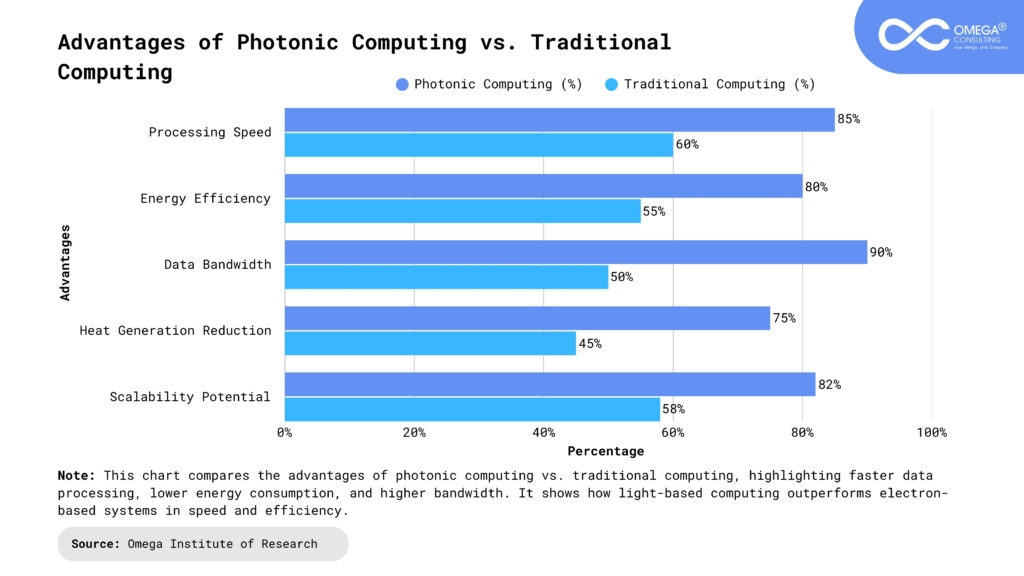
Key Advantages of Photonic Computing
Ultrafast Speeds: Photons move close to the speed of light, giving photonic processors a natural advantage over electron-based systems. Optical circuits can transmit and process data with near-zero latency, opening the door to instant responses in complex systems. This enables breakthroughs in real-time analytics, rapid AI training cycles, and immersive technologies like AR/VR without lag.
Energy Efficiency: Light signals generate minimal heat compared to electrical currents, drastically reducing the energy wasted on cooling systems. For massive data centers, this translates into lower operating costs and improved sustainability. As global energy demands rise, the efficiency of photonic computing offers a greener alternative for the digital future.
Parallel Processing Power: Unlike electrons, photons of different wavelengths can travel simultaneously without interfering with one another. This property allows photonic processors to perform countless parallel operations at once, exponentially boosting computational throughput. Electronics, by comparison, struggle to scale parallelism without hitting power and heat bottlenecks.
High Bandwidth: The internet already relies on optical fibers because of their unmatched bandwidth capacity, and photonic computing brings that power onto the chip. By applying the same principle at the processor level, photonic systems can handle unprecedented volumes of data at lightning-fast speeds. This makes them ideal for next-generation workloads demanding massive throughput.
AI and Big Data Scalability: Modern AI models, autonomous systems, and predictive analytics require enormous computational resources to function effectively. Photonic computing delivers the bandwidth, parallelism, and speed necessary to handle these data-heavy workloads seamlessly. By scaling with the growth of AI and big data, it positions itself as the backbone of future digital intelligence.
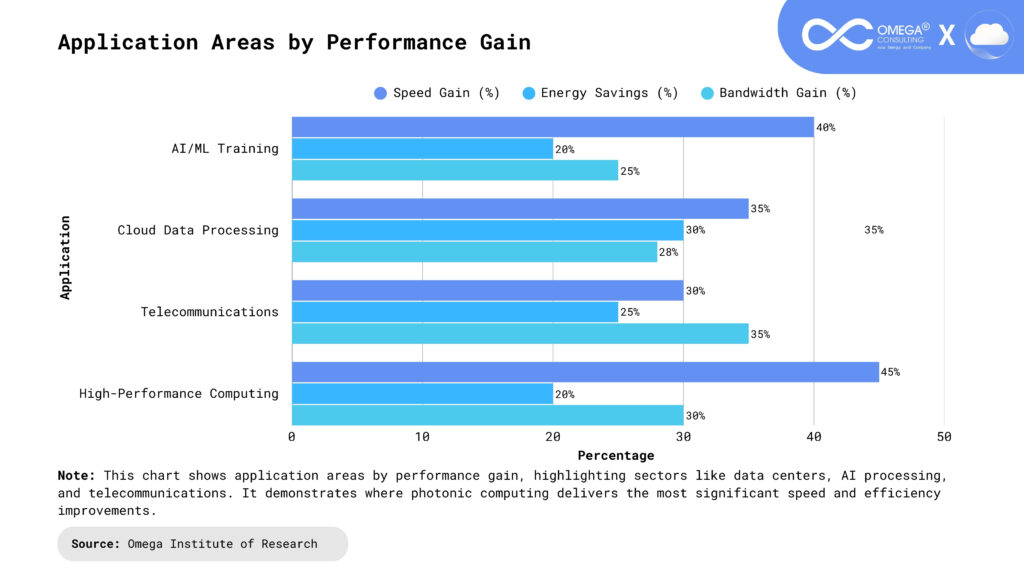
Real-World Applications of Photonic Computing
The promise of photonics is not theoretical it is actively being tested across multiple industries:
Artificial Intelligence (AI) & Machine Learning: Photonic processors can dramatically accelerate AI training by processing massive datasets in record time. What currently takes weeks on traditional GPUs could be reduced to mere hours with optical architectures. This speed advantage allows AI systems to evolve faster, powering breakthroughs in natural language processing, computer vision, and predictive analytics.
Cloud Computing & Data Centers: Data centers consume enormous amounts of energy, much of it wasted in cooling systems due to electronic heat generation. Photonic servers, with their low-latency and energy-efficient designs, could make hyperscale facilities both faster and greener. This not only reduces operational costs by billions but also minimizes the carbon footprint of the digital economy.
Healthcare & Genomics: The analysis of genomic data requires processing petabytes of information, which can be painfully slow on conventional systems. Photonic computing enables rapid sequencing, drug discovery, and disease modeling by handling these massive datasets at light speed. This paves the way for more personalized medicine and faster breakthroughs in global healthcare.
Autonomous Vehicles: Self-driving cars depend on split-second decisions based on sensor data from cameras, LiDAR, and radar. Photonic processors can deliver ultrafast computations with minimal latency, ensuring both safety and performance on the road. By enabling real-time decision-making, they could significantly advance the reliability of autonomous transportation.
Telecommunications: Modern communication networks rely heavily on optical fibers for data transfer, but photonic computing can extend this efficiency to the processing layer. With the rise of 5G and upcoming 6G, the need for ultra-low latency and massive bandwidth is critical. Photonic chips can strengthen network backbones, supporting seamless global connectivity.
Quantum Computing Integration: Photonics is also central to the advancement of quantum technologies, particularly in the area of qubit communication. By using photons for quantum data transfer, error rates can be reduced while computation speeds improve. This synergy between photonic and quantum computing could unlock entirely new frontiers in computational science.
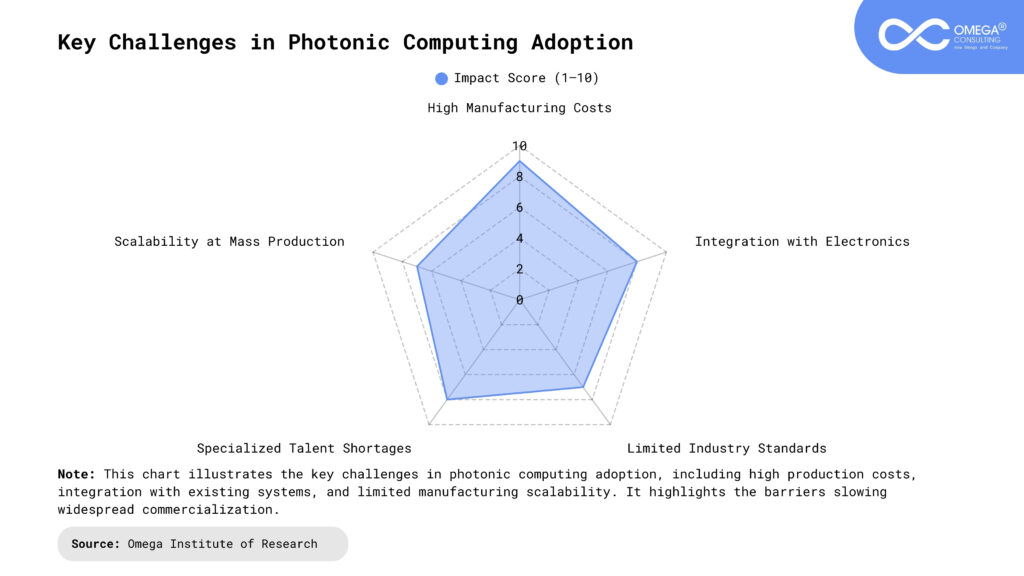
Challenges and Limitations
Despite its potential, photonic computing still faces hurdles before mainstream adoption:
Manufacturing Complexity: Photonic chips require the integration of optical and electronic components on a single substrate, a process that is far more complex than traditional semiconductor fabrication. Current manufacturing techniques are not yet optimized for large-scale, cost-effective production of such hybrid devices. This complexity makes scaling photonic technologies extremely challenging.
High Development Costs: Building photonic processors demands advanced materials, precision equipment, and specialized expertise, all of which drive up costs significantly. At present, developing photonic hardware is more expensive than producing traditional silicon chips. These high initial investments slow adoption, especially among smaller companies and research labs.
Lack of Standards: The photonic ecosystem currently lacks unified architectures, protocols, and design standards that would streamline development. Without industry-wide frameworks, manufacturers face interoperability issues and duplication of effort. This fragmentation is delaying widespread commercial adoption and collaboration.
Hybrid System Needs: In the near future, photonic computing will most likely coexist with traditional electronics in hybrid systems. Electronics may continue handling logic operations, while photonics takes over data transfer and acceleration tasks. Achieving seamless integration between the two remains technically demanding and requires innovative design approaches.
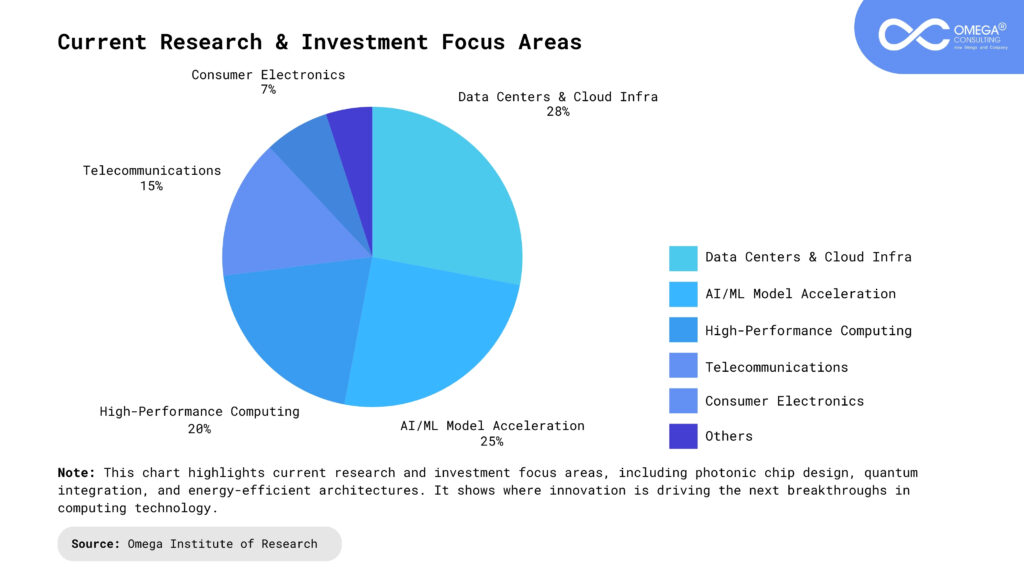
Future Trends in Photonic Computing
Looking ahead, several trends will shape the future of photonic computing:
Hybrid Chips: The most immediate future lies in hybrid chips that combine photonic and electronic components. This approach allows designers to maximize efficiency by letting each system do what it does best. As integration techniques improve, hybrid chips could become the stepping stone toward fully photonic processors.
AI-First Adoption: Given the enormous data requirements of machine learning, AI is expected to be the first major beneficiary of photonic processors. Training and inference workloads could see massive reductions in processing times. By accelerating AI research, photonics may drive breakthroughs in automation, robotics, and natural language processing.
Data-Centric Workloads: Industries like finance, logistics, and healthcare generate huge streams of real-time data. Photonic systems can process this information at light speed, enabling instant decision-making. This could revolutionize sectors that depend on high-frequency trading, supply chain optimization, or medical diagnostics.
Quantum Synergy: Photonics is uniquely suited to advance quantum computing by enabling faster qubit communication and reducing errors. By bridging classical and quantum technologies, photonics may unlock entirely new computational paradigms. The synergy between the two will be a critical driver of next-generation innovation.
Commercial Viability: As silicon photonics research advances, manufacturing costs are expected to decline, making photonic chips more affordable. With economies of scale, adoption will expand beyond research labs into mainstream industries. This cost reduction is the key to unlocking mass adoption worldwide.
Global Impact of Photonic Computing
The rise of photonic computing will have far-reaching implications:
Economic: Lower operational costs in data centers and cloud infrastructures could save organizations billions of dollars annually. This financial advantage would stimulate innovation and open new opportunities for businesses. Entire industries could be restructured around more affordable, efficient computing resources.
Environmental: By reducing heat generation and energy consumption, photonic systems will dramatically cut global carbon emissions. Data centers, which are among the world’s largest energy consumers, could become far more sustainable. This shift supports global climate goals while enabling continued digital growth.
Social: The ability to process information at unprecedented speeds can accelerate breakthroughs in healthcare, education, and smart city technologies. From faster disease detection to real-time urban management, photonics promises to enhance quality of life worldwide. Such advances could close gaps in access to critical services.
Geopolitical: Nations investing heavily in photonic computing will gain a competitive edge in defense, intelligence, and digital infrastructure. Control over this transformative technology could shape global power dynamics in the decades ahead. Photonics may well become a strategic asset in the race for technological supremacy.
Conclusion
Photonic computing represents a paradigm shift in the history of computing. By replacing electrons with photons, it offers solutions to the most pressing challenges in modern data processing: speed, energy efficiency, and scalability. While obstacles remain, the trajectory is clear: photonic computing has the potential to revolutionize industries ranging from AI and healthcare to telecommunications and quantum computing. As research advances and costs decline, the transition from theory to large-scale adoption will accelerate, opening the door to unprecedented innovations. Its impact will extend beyond technology, shaping economies, societies, and even geopolitics in the decades to come. Ultimately, photonic computing is not just an upgrade to existing systems but a foundation for the next era of digital transformation.
- https://opg.optica.org/oe/fulltext.cfm?uri=oe-29-14-22299&id=452939
- https://blog.geetauniversity.edu.in/photonic-computing-for-faster-ai-training-the-future-of-computing/
- https://spj.science.org/page/icomputing/si/Photonic-Computing
- https://www.e-spincorp.com/optical-computing-the-future-of-light-based-processing/
- https://www.rtvws.com/p/photonic-computing-the-next-frontier
Subscribe
Select topics and stay current with our latest insights
- Functions