

- Industries
Industries
- Functions
Functions
- Insights
Insights
- Careers
Careers
- About Us

Redesigning Journeys When Humans are Optional







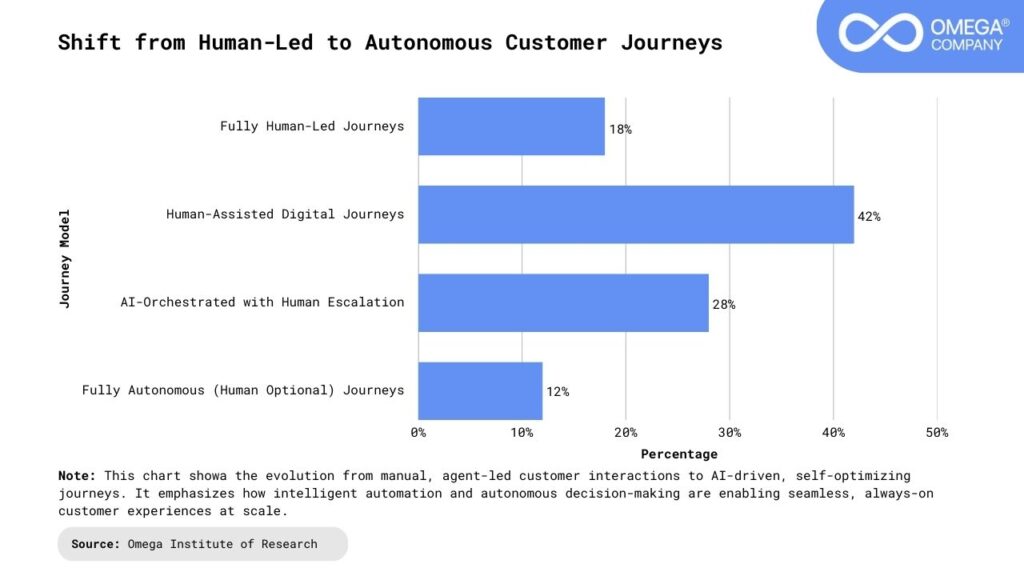
For decades, customer and employee journeys were built around continuous human interaction: people browsed, clicked, called, waited, and eventually received an outcome but this assumption is rapidly breaking down as AI agents, automation platforms, and intelligent systems increasingly operate on their own. Today, many journeys no longer require constant human involvement, making humans optional participants rather than default actors. Redesigning journeys in this context is not about removing people; it is about reimagining how value is delivered when machines can sense, decide, and act autonomously, fundamentally reshaping experiences across industries such as customer service, healthcare, finance, logistics, and enterprise operations.
What Does “Humans Are Optional” Really Mean?
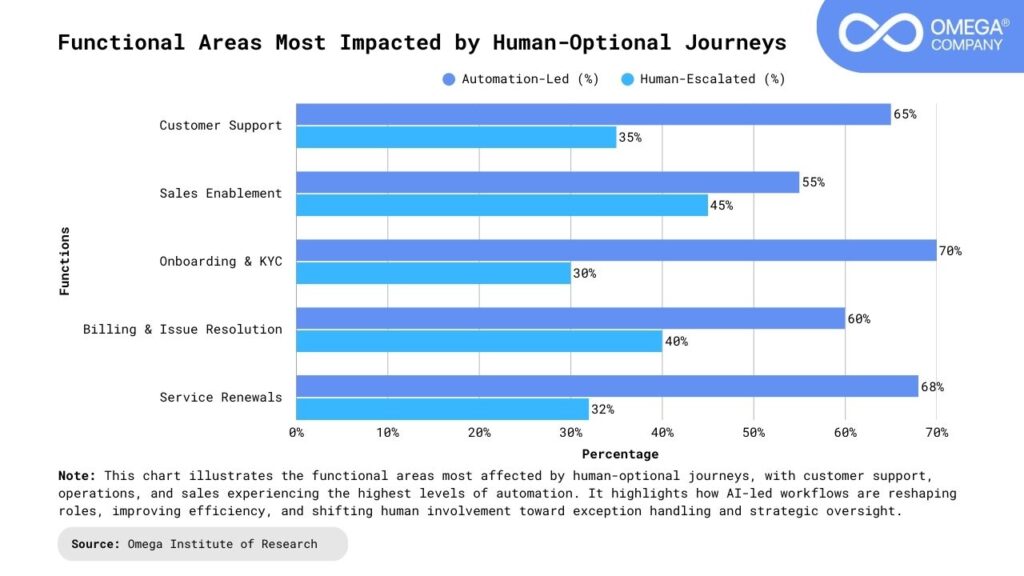
When we say “humans are optional,” it does not mean humans are irrelevant; instead, it reflects a shift where journeys can start, progress, and even complete without direct human intervention, powered by AI models, rules engines, and autonomous agents. These systems make decisions in real time using data, context, and predefined objectives, enabling faster, more consistent, and highly scalable outcomes. Human involvement is intentionally reserved for exceptions, ethical oversight, and strategic input rather than routine execution. This approach reduces friction, minimizes delays, and improves operational efficiency across complex environments. At the same time, it allows organizations to reallocate human talent toward creativity, problem-solving, and long-term value creation, ensuring technology augments human impact rather than replacing it.
Why Traditional Journey Design No Longer Works
Traditional journey design no longer works because it is based on linear steps and predictable human behavior, while autonomous systems operate continuously, adapt in real time, and optimize for efficiency rather than emotion. These legacy models struggle because they focus on touchpoints instead of decisions, prioritize interfaces over underlying intelligence, and assume delays, handoffs, and manual approvals that autonomous systems are designed to remove. As a result, journeys become fragmented, slow, and misaligned with how AI actually functions. In an AI-driven environment, value is created through decision flows, automation logic, and continuous optimization rather than static stages. Redesigning journeys therefore requires a shift from mapping interactions to orchestrating intelligent, end-to-end outcomes.
Principles for Redesigning Optional-Human Journeys
Design for Decisions, Not Touchpoints: The foundation of an optional-human journey is decision-making rather than interaction. Each step in the journey should clearly define what decision is being made, whether it is handled by an AI system, a rules engine, or a human, what data informs that decision, and what escalation path exists when confidence is low. When designed this way, journeys evolve into interconnected decision networks instead of linear sequences of screens, clicks, or handoffs, enabling faster and more intelligent outcomes.
Build for Continuous Flow: Optional-human journeys are designed to operate continuously rather than waiting for manual actions. They are triggered by real-time events and signals, with data ingestion, analysis, and execution happening seamlessly in the background. This allows systems to respond instantly and even act proactively before issues arise. For example, in supply chains, AI systems can automatically reroute shipments based on changing weather conditions, demand fluctuations, or geopolitical risks, ensuring resilience and efficiency without requiring constant human intervention.
Technology Enablers of Autonomous Journeys
Several technologies make human-optional journeys possible:
AI Agents: AI agents act independently across systems, managing tasks, making context-aware decisions, and executing actions without continuous human input. They can coordinate multiple workflows simultaneously, learn from outcomes, and adjust behavior over time. This enables always-on operations that scale efficiently while reducing reliance on manual intervention.
Machine Learning Models: Machine learning models power prediction, personalization, and optimization within autonomous journeys. By analyzing historical and real-time data, they anticipate user needs, detect anomalies, and recommend or trigger next-best actions. Over time, these models improve accuracy and relevance, making journeys smarter and more adaptive.
Event-Driven Architectures: Event-driven architectures allow systems to respond instantly to changes as they occur. Instead of waiting for predefined steps or manual triggers, actions are initiated by real-time signals such as customer behavior, system updates, or external events. This creates responsive, proactive journeys that operate at machine speed.
APIs and Microservices: APIs and microservices enable seamless orchestration across diverse platforms and applications. They allow autonomous systems to exchange data, trigger actions, and scale individual components without disrupting the entire journey. This modularity supports flexibility, resilience, and rapid innovation.
Digital Twins: Digital twins simulate real-world systems, processes, or environments before actions are taken. They allow organizations to test scenarios, evaluate risks, and predict outcomes without real-world consequences. By integrating simulations into decision-making, autonomous journeys become safer, more reliable, and better optimized for long-term performance.
Benefits of Redesigning Journeys Without Constant Human Involvement
Organizations that embrace this shift unlock significant advantages:
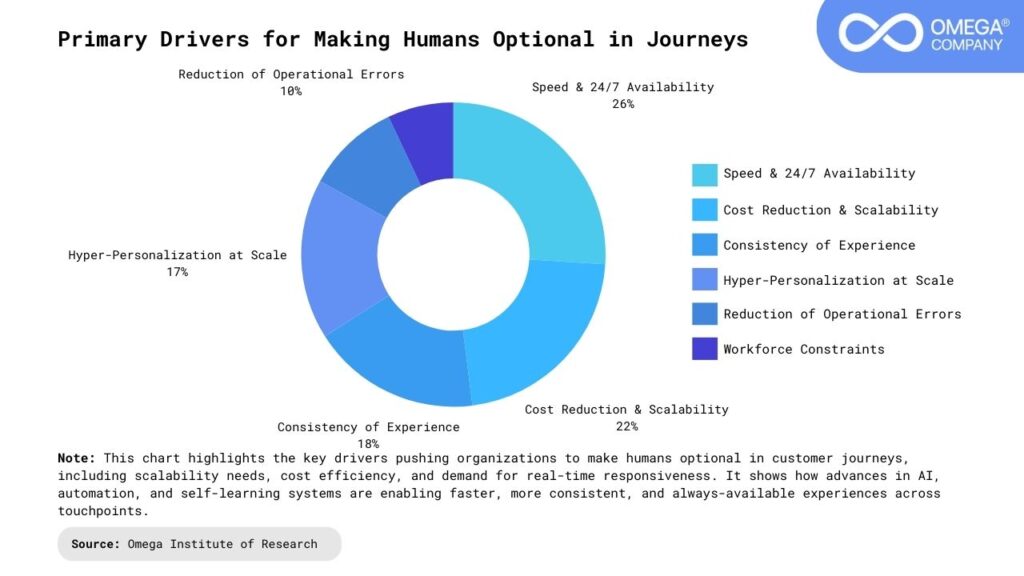
Faster Execution and Reduced Latency: Autonomous journeys eliminate manual handoffs and waiting periods, allowing decisions and actions to occur in real time. Processes move at machine speed, significantly reducing delays across complex workflows. This leads to quicker responses, faster outcomes, and improved overall performance.
Lower Operational Costs: By automating routine and repeatable tasks, organizations reduce dependency on large operational teams. Resources are used more efficiently, lowering labor costs and minimizing rework caused by manual errors. Over time, this creates more predictable and scalable cost structures.
24/7 Availability Without Burnout: Autonomous systems operate continuously without fatigue, downtime, or capacity constraints. Services remain available around the clock, regardless of time zones or peak demand. This ensures reliability while protecting human teams from burnout and overload.
Hyper-Personalized Outcomes at Scale: AI-driven journeys tailor experiences in real time based on data, context, and behavior. Personalization no longer requires manual effort, enabling consistent customization across millions of interactions. This drives higher engagement, satisfaction, and loyalty.
Improved Consistency and Reduced Human Error: Autonomous systems follow defined logic and data-driven rules with high precision. This reduces variability caused by human judgment in routine tasks and minimizes mistakes. The result is more reliable outcomes and stronger trust in processes and decisions.
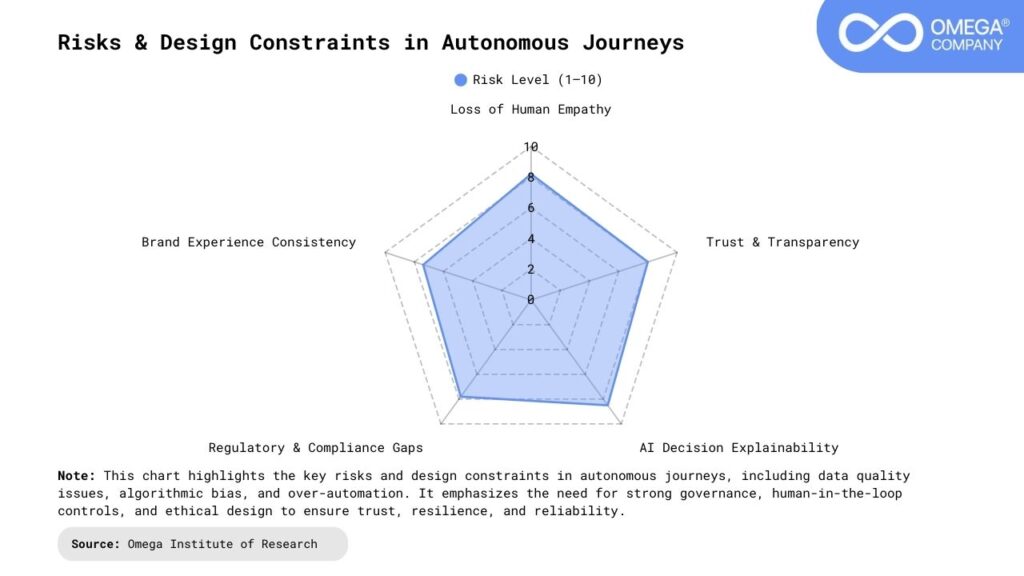
Risks and Ethical Considerations
Autonomous journeys also introduce new risks:
Algorithmic Bias and Unfair Outcomes: Autonomous systems can unintentionally reinforce existing biases present in training data. This may lead to unfair or discriminatory outcomes at scale if left unchecked. Regular audits, diverse data sets, and human oversight are essential to ensure fairness and equity.
Over-Automation Without Accountability: Excessive reliance on automation can blur lines of responsibility when things go wrong. Without clear ownership, errors may go unresolved or escalate quickly. Organizations must define accountability frameworks that clarify when and how humans intervene.
Loss of Transparency in Decision-Making: AI-driven decisions can become opaque, making it difficult to understand how outcomes are produced. This lack of explain ability can erode trust among users, regulators, and internal teams. Implementing explainable AI and clear documentation helps maintain visibility and confidence in autonomous journeys.
The Future: Invisible, Intelligent Journeys
The future of journey design is invisible, where users no longer navigate complex processes but simply experience seamless outcomes as intelligent systems anticipate needs, act proactively, and learn continuously in the background. Interactions fade into the flow of daily life, reducing friction and cognitive effort for users. Redesigning journeys when humans are optional is not solely about efficiency or speed; it is about building resilient, adaptive systems that can operate reliably in dynamic environments. These systems are designed to handle scale, uncertainty, and change without constant supervision. Ultimately, the goal is to create intelligent journeys that work for humans, align with human values, and deliver meaningful outcomes even when people are not directly involved.
Conclusion
As AI and automation continue to mature, the most successful organizations will be those that redesign journeys from the ground up by assuming autonomy by default and human involvement by choice. In this new paradigm, journeys are no longer guided step by step through predefined interactions but are intelligently orchestrated by adaptive systems that learn, optimize, and respond in real time. When humans are optional, design becomes more strategic, systems become more resilient and responsive, and experiences become seamless and effortless for those they serve. This approach allows organizations to focus human talent on high-value tasks such as oversight, creativity, and decision-making while machines handle routine processes, enabling greater scalability, consistency, and efficiency. Ultimately, embracing this shift positions organizations to deliver smarter, faster, and more personalized experiences while maintaining trust and accountability.
- https://www.frontiersin.org/journals/human-dynamics/articles/10.3389/fhumd.2022.915978/full
- https://www.qeh.ox.ac.uk/blog/how-do-journeys-unknown-change-human-identities
- https://www.sciencedaily.com/releases/2025/12/251207031335.htm
- https://uxdesign.cc/why-is-designing-for-inclusion-still-treated-as-optional-c3f9fd759c03
- https://www.naceweb.org/career-development/best-practices/redesigning-workplace-connectedness
Subscribe
Select topics and stay current with our latest insights
- Functions