

- Industries
Industries
- Functions
Functions
- Insights
Insights
- Careers
Careers
- About Us

Soft Robotics: Flexible Machines Transforming Delicate Manufacturing







Soft robotics is a strategic enabler of next-generation manufacturing, allowing automation in delicate, variable, and high-risk processes that traditional rigid robots cannot handle. Using flexible materials and AI-driven control systems, these robots safely manage fragile goods and precision tasks across industries like food, electronics, and pharmaceuticals. For C-suite leaders, soft robotics offers a clear pathway to boost productivity, reduce waste, improve safety, and enable scalable human–machine collaboration delivering agile, ESG-aligned, and future-ready operations. It also supports faster product innovation cycles and greater customization capabilities in competitive markets. As adoption scales, it strengthens supply chain resilience and positions organizations at the forefront of Industry 4.0 transformation.
What is Soft Robotics?
Soft robotics is an advanced automation approach that uses flexible, compliant materials and AI-driven control systems to perform tasks that are too delicate, variable, or risk-sensitive for traditional rigid robots. Inspired by biological systems such as muscles and plant movements, soft robots can bend, stretch, and adapt in real time enabling safe handling of fragile goods, micro-components, and precision materials. For executive teams, soft robotics represents a new automation capability layer, one that extends robotics into previously manual, high-risk, or high-loss processes. As sensor intelligence and smart materials mature, soft robotics is evolving into a scalable, enterprise-grade solution across sectors such as food processing, electronics, pharmaceuticals, and healthcare manufacturing.
Why Soft Robotics Matters in Delicate Manufacturing
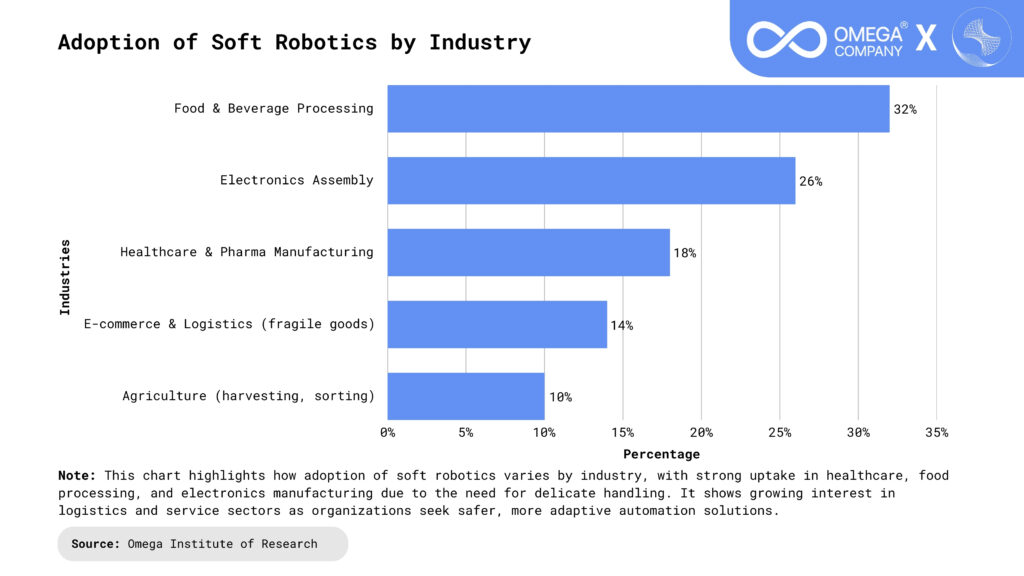
Reduced Product Loss and Quality Risk: Soft robotics minimizes breakage, deformation, and contamination directly improving yield, consistency, and customer satisfaction. For industries with tight margins or regulatory requirements, this translates into measurable financial and compliance benefits. It also enhances brand reliability by ensuring consistently high product quality across batches.
Agility in High-Variability Production: Unlike rigid automation, soft robotic systems dynamically adjust to changing product shapes, materials, and packaging formats enabling flexible production lines without major reconfiguration costs. This flexibility allows manufacturers to respond quickly to market demand shifts and product customization trends.
Workforce Safety and Collaboration: Soft robots are inherently safer due to their compliant structure, enabling closer human–machine collaboration and reducing workplace injuries supporting both operational continuity and ESG commitments. They also create more ergonomic work environments, reducing repetitive strain and improving employee well-being.
How Soft Robotic Systems Work
Soft robotic systems typically include:
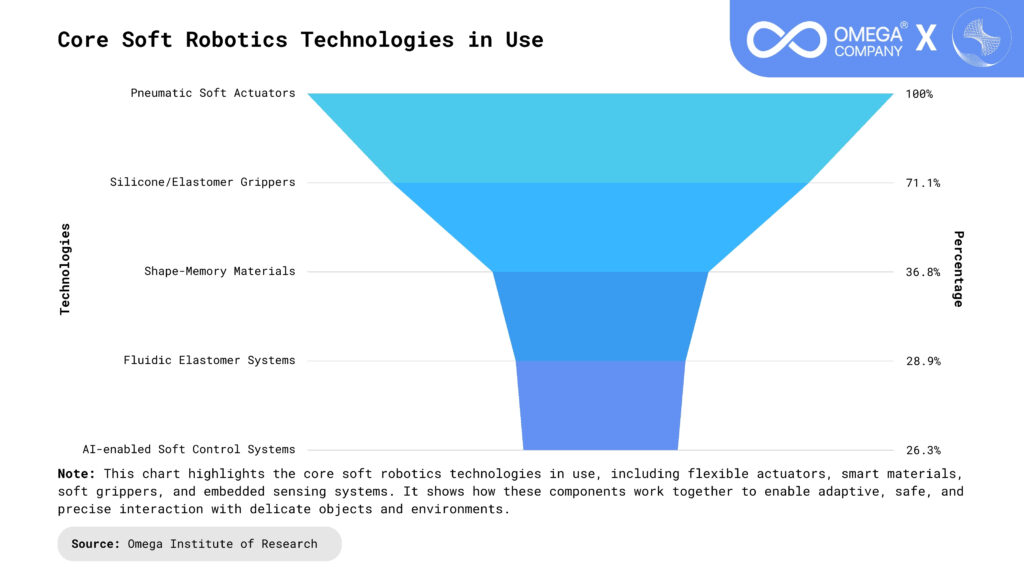
Flexible Actuators: Pneumatic, hydraulic, or cable-driven systems deliver smooth, controlled motion without rigid joints supporting both delicate handling and industrial throughput. They can precisely modulate grip strength and movement speed based on product sensitivity and handling requirements. This ensures consistent performance across varying production volumes while reducing mechanical wear and maintenance costs.
Elastic Materials: Silicone, rubber, and fabric composites enable safe interaction with fragile or irregular products while reducing mechanical complexity. These materials conform naturally to product shapes, allowing a single gripper to handle multiple SKUs without tool changes. Their durability and resilience also contribute to longer operational life and reduced downtime in continuous production environments.
Sensor-Driven Control Systems: Embedded sensors provide real-time feedback on force, pressure, and position ensuring consistent quality and reducing defects. Advanced analytics and AI-driven calibration enable systems to learn and optimize handling patterns over time. This leads to predictive quality control, reduced waste, and improved traceability for regulated industries.
Modular Integration: Plug-and-play end-effectors integrate with existing robotic arms and production lines minimizing disruption and enabling phased deployment. This modularity allows manufacturers to scale automation gradually without significant capital overhauls. It also supports rapid ROI realization by enabling targeted automation of high-impact production stages first.
Key Benefits of Soft Robotics in Manufacturing
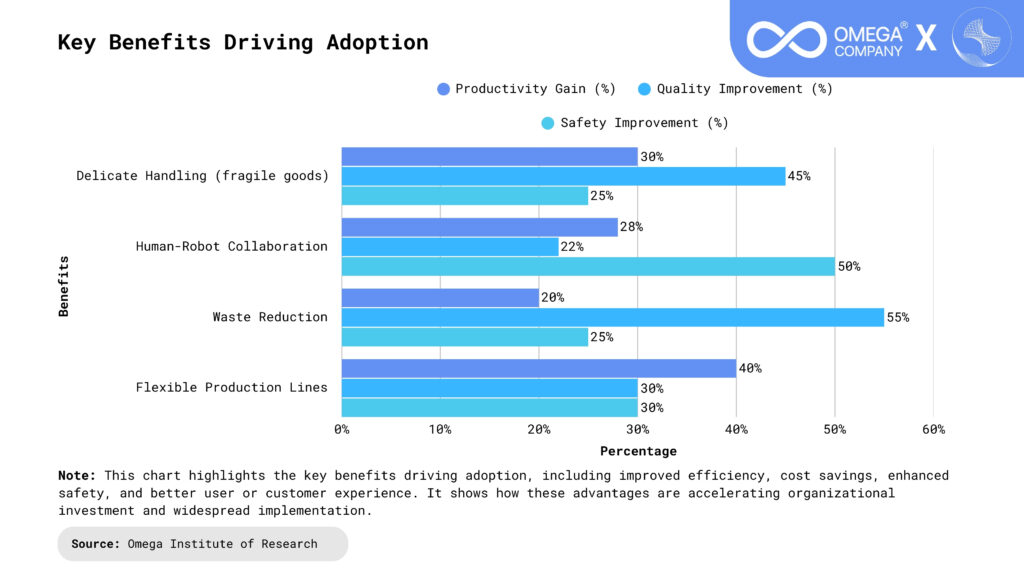
Higher Yield, Lower Waste: Soft robotics reduces product damage and rejection rates, delivering direct improvements in margin and cost efficiency. Consistent handling precision also improves batch uniformity, reducing the need for rework and quality interventions. Over time, these gains compound into measurable savings across raw materials, packaging, and logistics.
Improved Workforce Safety: Safer collaboration reduces injury risk and insurance costs while improving employee productivity and retention. Reduced exposure to repetitive strain and hazardous tasks enhances long-term workforce well-being. This supports stronger compliance with workplace safety regulations and strengthens employer brand reputation.
Operational Flexibility and Faster Changeovers: Soft robotic systems support rapid reconfiguration, allowing companies to respond quickly to market demand, product customization, and seasonal shifts. Manufacturers can switch between product lines with minimal downtime and limited retraining requirements. This agility enables faster go-to-market cycles and better responsiveness to customer expectations.
Lower Energy and Operating Costs: Lightweight designs and simplified mechanics reduce energy consumption supporting cost optimization and sustainability targets. Reduced mechanical complexity also lowers maintenance requirements and spare parts dependency. Together, these efficiencies contribute to lower total cost of ownership across the system lifecycle.
Faster ROI on Automation Investments: Modular architectures and lower integration complexity enable faster deployment cycles and reduced capital expenditure compared to traditional automation. Companies can implement automation incrementally, focusing on high-impact use cases first. This phased approach accelerates payback periods while reducing financial and operational risk.
Emerging Innovations in Soft Robotics
Recent breakthroughs are accelerating the adoption of soft robotics:
Multi-Material 3D Printing: Multi-material 3D printing is significantly accelerating design cycles in soft robotics by enabling engineers to rapidly prototype and iterate complex, flexible components. This approach allows manufacturers to combine rigid and elastic materials within a single structure, producing highly customized robotic parts tailored to industry-specific requirements. As a result, production costs decrease while innovation speed increases, making it feasible for even mid-sized manufacturers to adopt soft robotic solutions.
Bio-Inspired Actuation: Bio-inspired actuation systems replicate natural movement patterns found in organisms such as octopuses, worms, and human muscles, allowing soft robots to achieve exceptional flexibility and control. These systems enhance dexterity and precision, enabling robots to handle fragile or irregular objects with minimal risk of damage. This capability is particularly transformative in sectors like electronics assembly, food processing, and minimally invasive healthcare procedures.
AI-Driven Control Systems: AI-driven control systems are transforming soft robotics by enabling machines to learn from their environments and adapt in real time. Through machine learning algorithms, robots can optimize grip strength, movement patterns, and task execution dynamically based on continuous feedback. This not only improves operational accuracy but also reduces error rates and downtime in complex manufacturing environments.
Sustainable Materials: The integration of sustainable materials into soft robotics is aligning the technology with global circular manufacturing and ESG goals. Bio-based polymers and recyclable elastomers reduce environmental impact while maintaining the flexibility and durability required for industrial use. These materials also enable safer human-robot interaction, as they are often non-toxic and biodegradable.
Challenges and Limitations
Despite their advantages, soft robotics still faces several challenges:
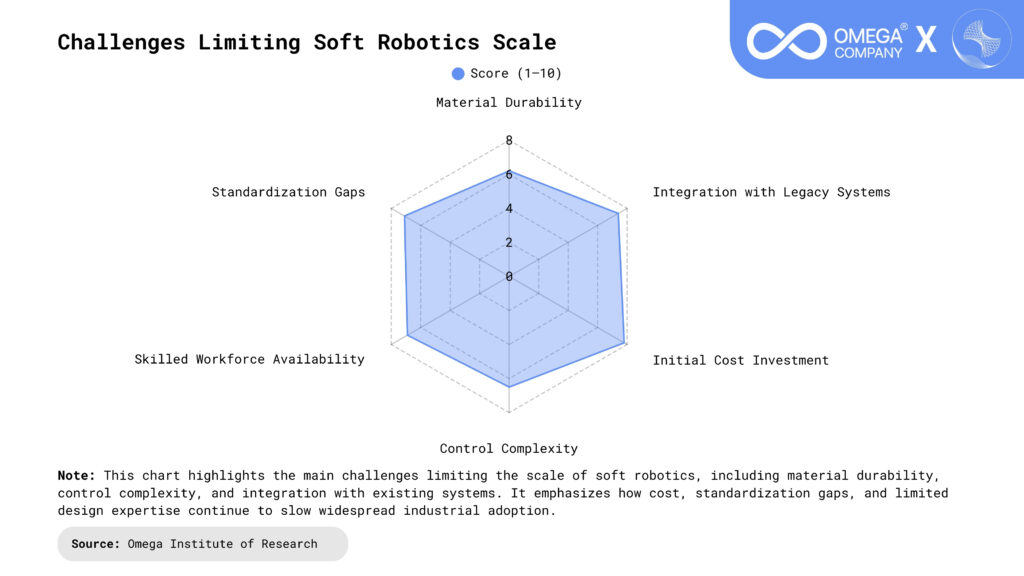
Material Durability and Lifecycle Costs: Soft robotic systems rely on flexible polymers and elastomers that can degrade under continuous mechanical stress, temperature variation, and chemical exposure. This can lead to shorter component lifespans and increased maintenance cycles compared to rigid automation systems. For enterprises operating at scale, this introduces greater variability in maintenance planning and spare part management across facilities. As adoption expands, organizations must account for lifecycle performance, environmental exposure conditions, and reliability testing to ensure consistent operational uptime and cost predictability.
Precision and Repeatability Constraints: Because soft robotic structures deform dynamically, achieving high precision and repeatability can be more complex than with rigid robotic arms particularly in micro-assembly or high-tolerance manufacturing environments. Variations in pressure, material elasticity, and environmental conditions can influence movement accuracy and positioning stability. While advances in sensors and AI-driven control are improving consistency, executive teams must recognize that not every precision-critical process is immediately suitable for full soft robotic automation. Strategic deployment requires aligning use cases with the current maturity level of control systems and performance requirements.
Integration with Legacy Automation Infrastructure: Most existing factories are designed around rigid robotic architectures, PLC systems, and fixed workflows. Integrating soft robotics into these environments may require middleware, interface adaptation, or reconfiguration of production processes. This can increase implementation complexity, extend deployment timelines, and require cross-functional coordination between operations, IT, and engineering teams. At an enterprise level, successful integration depends on clear system architecture planning, interoperability standards, and phased deployment strategies that minimize disruption to ongoing production.
Standardization and Enterprise-Scale Deployment: The soft robotics ecosystem is still evolving, with variations in actuator technologies, materials, and control platforms limiting standardization across vendors. This lack of uniformity can create interoperability challenges when scaling across multiple plants, regions, or product lines. Differences in design frameworks and control interfaces may also impact training, maintenance, and supplier management. As the market matures, industry standards and best practices are expected to improve consistency, but organizations must currently approach large-scale deployment with careful vendor selection and long-term scalability planning.
The Future of Soft Robotics in Manufacturing
Soft robotics is emerging as a core capability in next-generation manufacturing, enabling the automation of delicate, high-variability processes while maintaining speed, precision, and consistency. Its human-like dexterity allows enterprises to extend automation into areas once dependent on manual labor, unlocking new efficiency and productivity gains. Strategically, it will strengthen human–machine collaboration, localized production, and resilient supply chains, while helping organizations deliver customized products at scale, reduce waste, and meet evolving ESG and regulatory demands positioning soft robotics as a mainstream enterprise automation platform in the Industry 5.0 era.
Conclusion
Soft robotics marks a fundamental shift in industrial automation, extending robotics into delicate, high-variability, and risk-sensitive processes that were previously difficult to automate, making it a strategic investment in agility, resilience, and long-term competitiveness for C-suite leaders. Across industries such as food processing, electronics, and healthcare manufacturing, it is already delivering measurable outcomes reducing product loss, improving worker safety, lowering operational costs, and increasing production flexibility while aligning with sustainability goals and human-centric manufacturing models. Organizations that move early to pilot, scale, and integrate soft robotics into their broader digital and automation strategies will be best positioned to build future-ready operations that can adapt to market volatility, regulatory change, and evolving customer expectations.
- https://thinkrobotics.com/blogs/learn/soft-robotics-the-future-of-flexible-and-adaptive-machines?srsltid=AfmBOoq-pBmLUL5Z_vwLOXRJpMW7tfIg1cWTkiZh5WoXtAqyc86twG2y
- https://pmc.ncbi.nlm.nih.gov/articles/PMC7805834/
- https://www.oaepublish.com/articles/ss.2023.51
- https://www.bisinfotech.com/the-future-of-soft-robotics-technology/
- https://soft-gripping.com/discover/soft-robotics-vs-hard-robotics/
Subscribe
Select topics and stay current with our latest insights
- Functions