

- Industries
Industries
- Functions
Functions
- Insights
Insights
- Careers
Careers
- About Us

The Companies Winning With AI Are Changing How They Work







The impact of AI on business is increasingly being determined by how organizations change their ways of working, not simply by how quickly they adopt new technologies. Companies are moving beyond isolated AI pilots and beginning to redesign how employees perform work, how teams collaborate, how decisions move through the organization, and how resources are allocated. The strongest results are emerging where AI is connected to business processes and organizational priorities rather than treated as a standalone technology investment. This shift is changing the economics of knowledge work by increasing the speed at which information can be processed, decisions can be supported, and routine activities can be executed. It is also forcing organizations to reconsider traditional roles, management structures, skills, and performance expectations. As AI becomes increasingly embedded in daily operations, competitive advantage will depend on the ability to redesign work continuously and create an operating environment where human expertise and machine intelligence reinforce each other.
The Shift From AI Adoption to Work Transformation
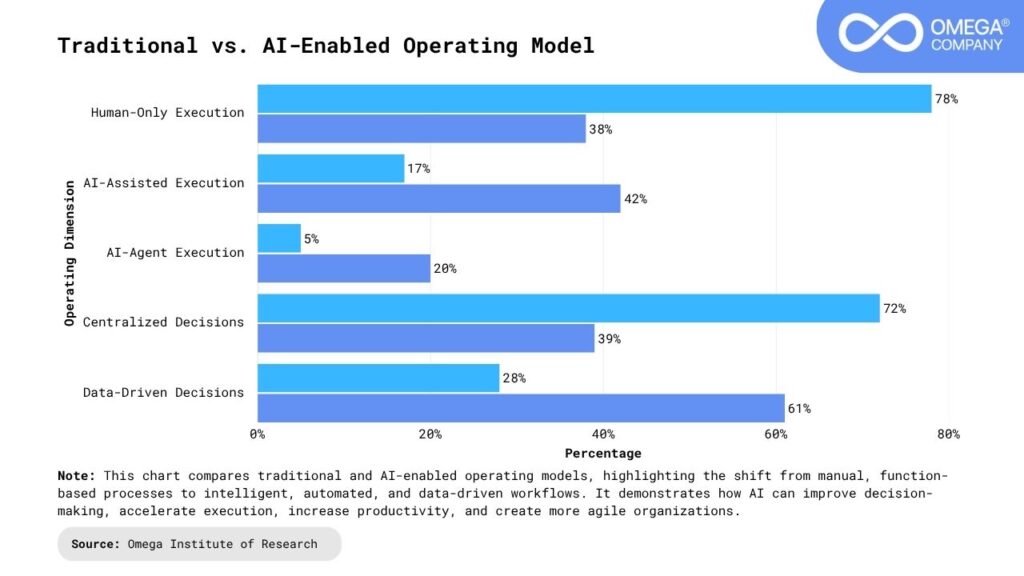
AI adoption typically begins with tools, platforms, and individual use cases. Work transformation begins when organizations reconsider the underlying processes those tools support. Companies are examining which activities create value, which consume unnecessary time, and which can be augmented or executed by AI. This changes the focus from deploying technology to redesigning work around business outcomes. Instead of asking where AI can be inserted into an existing process, leaders are increasingly asking how the process itself should operate if AI is available. This distinction creates opportunities to remove unnecessary steps, accelerate decision cycles, improve access to knowledge, and allow employees to focus on higher-value responsibilities. The result is an operating model that uses AI as an integrated capability rather than an additional layer of technology.
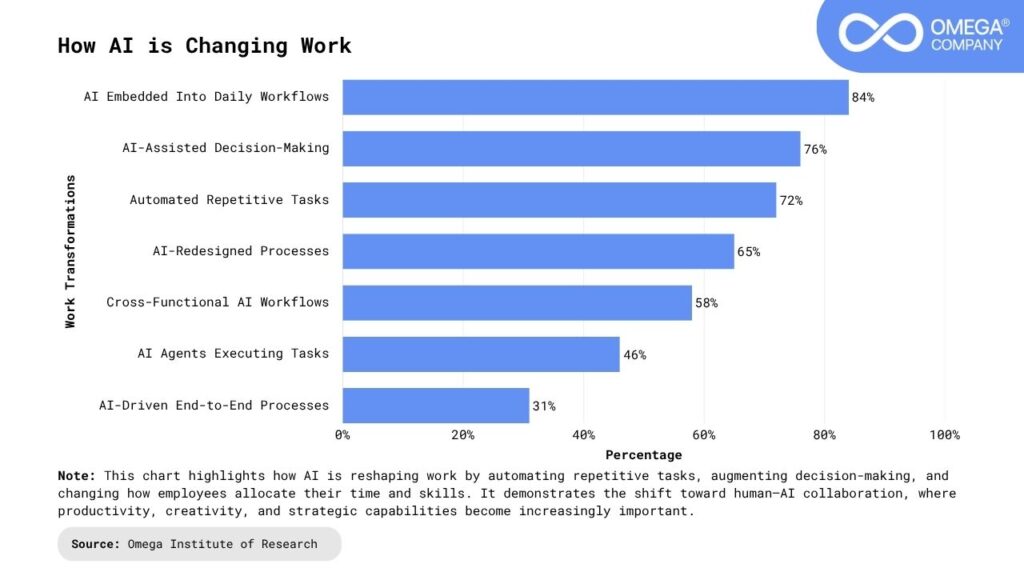
The New Architecture of Work
Separating Tasks From Outcomes: Organizations are beginning to distinguish between completing individual activities and achieving business outcomes. AI can absorb many repetitive tasks, allowing employees to focus on the outcomes those activities were intended to support. This encourages companies to redesign roles around value creation rather than task completion.
Rebuilding Processes Around Intelligence: Traditional processes are often designed around human information-processing limitations. AI can analyze larger volumes of information and provide support at greater speed, allowing companies to redesign workflows around faster access to intelligence and more continuous decision-making.
Creating Digital Colleagues: AI assistants and agents are increasingly becoming part of everyday work. They can support research, analysis, documentation, coordination, customer interactions, and other activities. Organizations must therefore define how digital systems interact with employees and how responsibility is shared.
Increasing the Span of Individual Capability: AI can allow employees to perform activities that previously required assistance from specialized functions. A business professional may be able to conduct research, analyze data, prepare communications, or create initial deliverables with AI support. This can increase organizational capacity without requiring every capability to exist as a separate role.
Designing for Continuous Adaptation: AI capabilities are evolving rapidly, making fixed operating models increasingly difficult to sustain. Organizations need processes that can be regularly reviewed and redesigned as new capabilities become available.
How Leadership Is Changing
Moving From Oversight to Orchestration: Leaders increasingly need to coordinate people, AI systems, data, and automated workflows. Their role shifts from monitoring every activity toward designing an environment in which different capabilities work together effectively.
Redefining Strategic Decision-Making: AI can rapidly analyze market conditions, customer behavior, operational data, and potential scenarios. Leaders can use these capabilities to broaden the information available for strategic decisions while retaining responsibility for judgment and direction.
Delegating With Intelligent Support: AI can provide employees with decision support that previously required escalation to managers or specialists. This can allow organizations to distribute appropriate decisions closer to the point of execution.
Increasing the Importance of Judgment: As AI becomes better at generating information and recommendations, human judgment becomes more important in determining what should be pursued, challenged, prioritized, or rejected. Leadership increasingly centers on context, trade-offs, accountability, and strategic interpretation.
Building Organizational Confidence: Leaders must also create confidence around AI adoption. Employees need clarity about expectations, responsibilities, acceptable use, and how AI will affect their work. Trust becomes an important component of successful transformation.
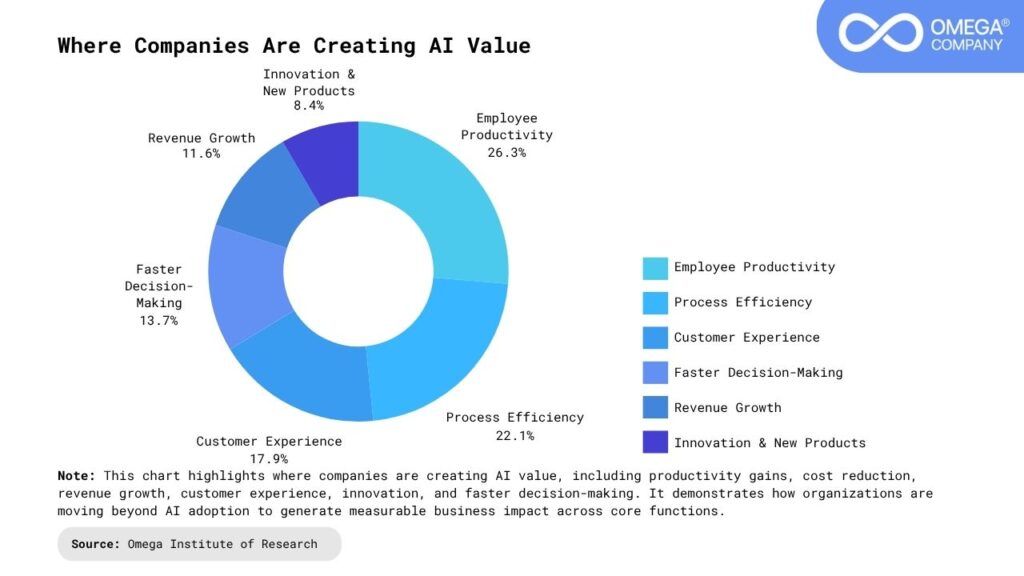
Where the New Way of Working Creates Value
Faster knowledge work: AI can reduce the time required to research, summarize, compare, draft, and analyze information. This allows knowledge-intensive teams to move more quickly from information gathering toward decision-making and execution.
More responsive customer operations: AI can help organizations understand customer needs, personalize interactions, resolve routine requests, and identify issues requiring human intervention. This can create more responsive customer experiences while allowing employees to concentrate on complex interactions.
Higher operating capacity: Organizations can use AI to increase the amount of work teams can manage without proportionally increasing headcount. The opportunity is particularly significant in processes involving repetitive information processing and coordination.
Shorter innovation cycles: AI can accelerate research, ideation, prototyping, testing, documentation, and analysis. Organizations can therefore experiment more frequently and move ideas toward implementation faster.
Better use of specialized talent: By reducing repetitive administrative and analytical work, AI can allow experts to dedicate more time to activities requiring experience, creativity, judgment, and relationship management.
More dynamic resource allocation: AI-supported analysis can help organizations identify changes in demand, capacity, costs, and performance. This can support faster adjustments in workforce, capital, and operational resources.
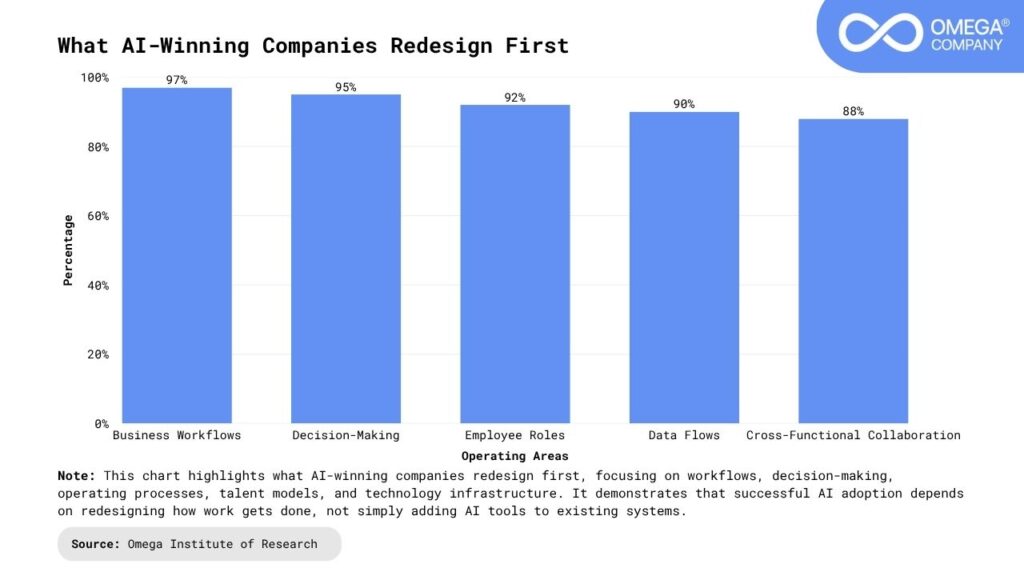
The Workforce Model Is Being Rewritten
Jobs are becoming collections of AI-supported activities: Traditional job descriptions often group together many different tasks. AI can automate or augment some of those activities, creating roles that are increasingly designed around higher-value responsibilities.
Skills are becoming more important than static roles: Organizations may increasingly focus on what employees can do rather than relying solely on traditional job titles. AI changes the value of technical, analytical, communication, creative, and strategic capabilities.
Employees become AI supervisors: Some employees will increasingly monitor AI outputs, validate recommendations, manage automated processes, and intervene when systems encounter exceptions. This creates new responsibilities that did not exist in traditional workflows.
Teams can operate with greater leverage: AI can expand the capabilities of small teams, allowing them to perform broader ranges of activities. This may lead organizations to reconsider team size, specialization, and collaboration models.
Learning becomes continuous: Employees need to adapt as AI capabilities change. Continuous learning, experimentation, and practical AI education will become increasingly important for maintaining workforce relevance.
The Operating Model Behind AI Advantage
Clear ownership: AI-enabled processes require clear accountability for both the process and its outcomes. Employees and managers must understand who owns decisions when AI is involved.
Integrated technology: AI should connect with the systems where employees actually perform work. Disconnected AI tools can create additional complexity instead of improving productivity.
Reliable information: Organizations need accessible and trustworthy data for AI systems to produce useful outputs. Data quality becomes increasingly important as AI moves deeper into operational processes.
Flexible workflows: Processes should be designed to accommodate changing AI capabilities rather than becoming permanently tied to a particular technology or tool.
Embedded governance: Responsible AI practices need to become part of normal operations. Governance should address security, privacy, accuracy, compliance, and accountability without unnecessarily slowing experimentation.
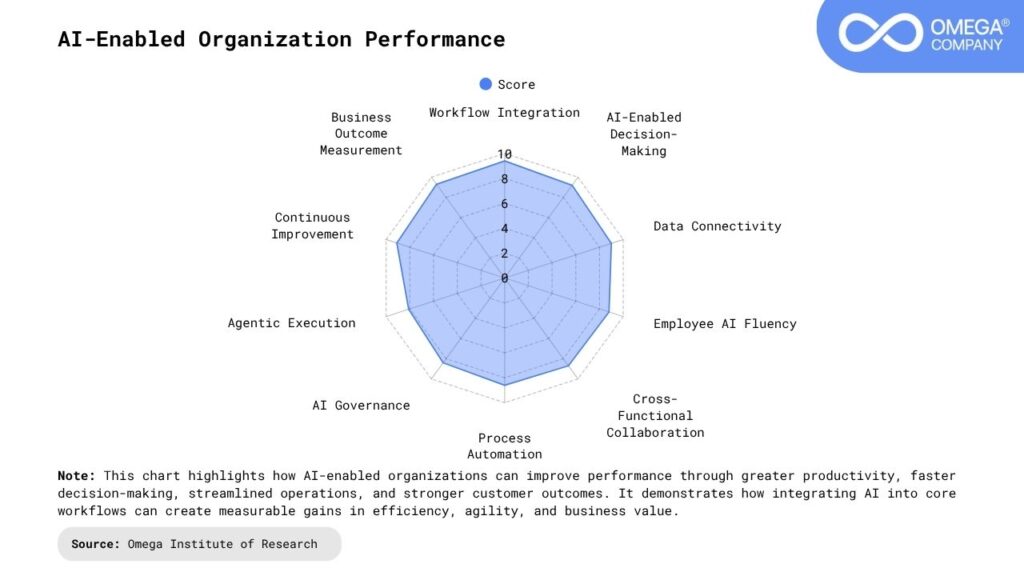
Outcome-based measurement: Organizations should measure whether AI is improving the underlying business process rather than simply measuring how frequently employees use AI tools.
Challenges Created by the New Way of Working
Organizational inertia: Established processes, structures, and responsibilities can make it difficult to redesign work even when better approaches are available. Transformation often requires challenging assumptions that have existed for years.
Unclear role boundaries: As AI performs parts of multiple jobs, responsibilities can become ambiguous. Organizations need to redefine ownership and expectations.
AI-generated errors: Increased reliance on AI creates new risks when outputs are accepted without appropriate validation. Human review remains important for decisions where errors can create significant consequences.
Technology fragmentation: Rapid experimentation can result in multiple AI platforms, overlapping applications, and inconsistent practices. Organizations need sufficient coordination to prevent AI adoption from increasing complexity.
Employee capability gaps: Providing AI tools does not automatically create AI capability. Employees need to understand how to use, evaluate, and integrate AI into their work effectively.
Management resistance: Leaders may continue to manage teams using traditional processes even when AI has changed the nature of work. Management practices must evolve alongside technology.
Inadequate measurement: Companies may struggle to demonstrate whether AI investments are creating measurable economic value. Clear baselines and outcome metrics are necessary.
Security and governance risks: Connecting AI to sensitive organizational data and business systems can introduce new risks. Governance must evolve as AI becomes more deeply integrated.
The Emergence of AI-Native Operating Models
AI-native organizations are beginning to move beyond the idea of employees simply using AI applications. In these models, intelligence is embedded into the operating architecture itself. AI can support research before decisions are made, monitor processes while they operate, identify exceptions as they occur, and help employees determine appropriate next actions. Digital agents may increasingly coordinate defined workflows across applications, while human employees retain control over higher-value decisions and exceptions. This creates organizations that operate with greater levels of continuous intelligence rather than relying entirely on periodic reporting and manual coordination. The emerging model is therefore less about replacing individual jobs and more about creating a different distribution of work between people and intelligent systems.
Future Outlook
The next phase of AI transformation will increasingly focus on organizational design. Companies will experiment with smaller, more capable teams, AI-supported management structures, dynamic workflows, and increasingly autonomous digital agents. Work will become less defined by fixed sequences of manual tasks and more by outcomes supported through intelligent systems. Leaders will need to continually reassess which responsibilities belong to people, which can be delegated to AI, and where human judgment creates the greatest value. Organizations that can redesign processes quickly will be better positioned to capture improvements in productivity, speed, innovation, and customer experience. Over time, the most important competitive capability may be the ability to repeatedly adapt the operating model as technology changes.
Conclusion
AI is changing the competitive landscape because it is changing the way companies can work. The organizations gaining the greatest advantage are not simply adding AI tools to existing processes. They are reconsidering how work is structured, how teams operate, how decisions are made, how employees use their time, and how technology supports execution. They are building operating models in which AI handles more information-intensive and repetitive activities while people concentrate on judgment, creativity, leadership, relationships, and complex problem-solving. This transformation requires more than technology investment. It requires changes to processes, roles, skills, management practices, data, governance, and performance measurement. Companies that successfully make these changes can create significantly greater organizational capacity and adaptability. Ultimately, the companies winning with AI will be those that treat AI not as another tool inside the organization, but as a reason to rethink how the organization works.
- https://www.cio.com/article/4203967/companies-winning-with-ai-operate-differently-heres-how.html
- https://www.mindset.ai/blogs/how-ai-is-changing-the-way-we-work-and-why-most-companies-are-still-behind
- https://mitsloan.mit.edu/ideas-made-to-matter/how-ai-reshaping-workflows-and-redefining-jobs
- https://www.des-show.com/ai-changing-employees-work/
- https://johnspence.com/ai-midmarket-companies-business/
Subscribe
Select topics and stay current with our latest insights
- Functions