

- Industries
Industries
- Functions
Functions
- Insights
Insights
- Careers
Careers
- About Us

The Hidden Cost of Making Decisions Too Slowly







Every organization makes hundreds of decisions across operations, customers, technology, people, finance, and strategy. Some decisions are highly visible, while others appear insignificant at the time. Yet, when decisions remain unresolved for too long, their cost can spread across the organization. Projects lose momentum, employees work with incomplete direction, opportunities become harder to capture, and leaders spend increasing amounts of time revisiting the same issues. Slow decision-making is therefore not simply an administrative problem. It can become an operating constraint that affects execution, productivity, customer responsiveness, and growth. High-performing organizations do not attempt to make every decision immediately. Instead, they create an environment where decisions are made at the appropriate level, with sufficient information, clear accountability, and a pace that matches the importance of the issue.
When Decision Delay Becomes an Operating Cost
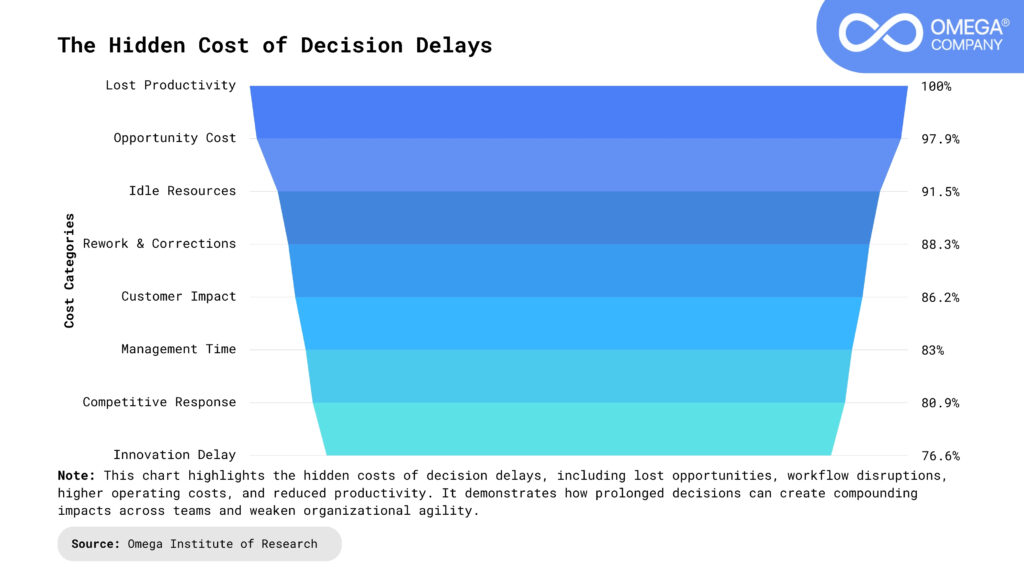
Work Continues Around Unresolved Decisions: Employees rarely stop completely when a decision is pending. They often make assumptions, create temporary solutions, or continue with the existing process. When the eventual decision changes direction, that work may need to be repeated. The organization therefore pays not only for the original delay but also for the rework created by uncertainty.
Small Delays Create Larger Dependencies: A decision about one process can affect several others. A delayed hiring decision can affect workload distribution. A delayed technology decision can affect implementation. A delayed customer decision can affect sales and delivery. As organizations become more interconnected, the consequences of one unresolved issue can extend well beyond its original scope.
Management Time Becomes a Hidden Expense: Unresolved decisions generate follow-up messages, meetings, escalations, status checks, and repeated discussions. Leaders may spend significant time reviewing issues that have already been analyzed but have not reached a conclusion. This reduces the amount of leadership capacity available for strategic priorities.
Temporary Workarounds Increase Complexity: When teams cannot obtain a decision, they often create workarounds to keep operations moving. These solutions may initially appear practical, but repeated workarounds can introduce additional processes, manual effort, and inconsistencies. Over time, the organization may become more complicated simply because important decisions were postponed.
The Compounding Impact of Waiting
Delays Can Disrupt Entire Workflows: Business activities rarely operate independently. A delayed decision can prevent another team from starting its work, which can then affect another stage of the process. The result is a chain of delays that may be significantly larger than the original decision cycle. Over time, these interruptions can reduce overall operational efficiency and create unnecessary pressure across multiple teams. What begins as a small delay can therefore become a broader execution problem.
Opportunities Can Lose Their Value: Market opportunities are often time-sensitive. Customer interest can change, competitive conditions can shift, and available resources can move elsewhere. When an organization takes too long to decide whether to pursue an opportunity, the opportunity itself may become less attractive or more difficult to capture. The organization may eventually act, but the conditions that made the opportunity valuable may no longer exist. Decision speed therefore becomes part of the organization’s ability to capture value when it appears.
Execution Momentum Can Decline: Teams perform differently when priorities remain uncertain. Repeated pauses can make employees less confident about where to invest their effort. Clear decisions create forward momentum because people understand what needs to happen and why. When momentum is repeatedly interrupted, teams may spend additional time revisiting previous discussions rather than progressing toward outcomes. Over time, this can create frustration and reduce confidence in the organization’s ability to execute.
Delayed Decisions Can Increase Future Costs: Waiting does not always preserve resources. In some cases, it allows problems to become larger. An inefficient process may require more employees to manage later, a customer issue may become more difficult to resolve, or a technology limitation may become more expensive to replace. The cost of addressing an issue can increase simply because action was postponed. Delayed action can also consume management attention that could have been directed toward higher-value priorities. In this way, the cost of waiting can become embedded in future operating expenses and execution complexity.
Why Organizations Become Slow at Making Decisions
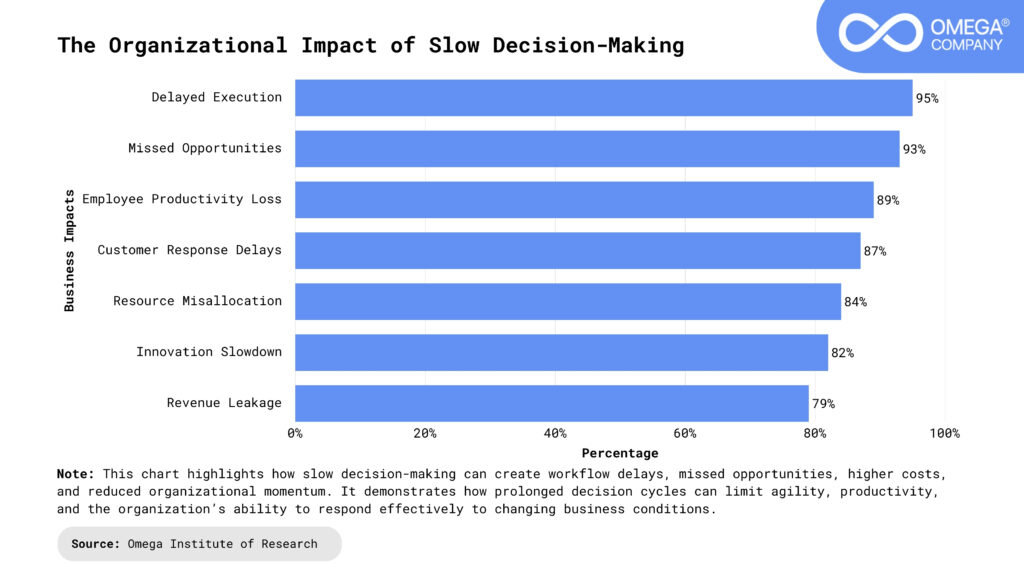
Unclear Decision Ownership: A decision becomes difficult when several people are involved but no one has clear responsibility for making the final call. Teams may continue discussing the issue because everyone assumes another stakeholder has the authority to conclude it. This creates unnecessary cycles of meetings, follow-ups, and additional analysis. Clear ownership removes ambiguity and establishes accountability for moving the decision forward.
Too Many Approval Layers: Additional approvals can provide control, but excessive layers can slow even routine decisions. When every issue requires escalation, senior leaders become involved in matters that could have been resolved closer to the work. This increases executive workload while reducing the autonomy of operational teams. Over time, approval-heavy processes can make the organization slower without necessarily improving decision quality.
Waiting for Complete Certainty: Business decisions rarely come with perfect information. Organizations that wait for every uncertainty to disappear may continue analyzing an issue long after enough information exists to act responsibly. Additional analysis can eventually produce diminishing returns while the business continues absorbing the cost of delay. Effective decision-making requires knowing when the available evidence is sufficient to move forward.
Fear of Making the Wrong Choice: When employees believe that mistakes will be punished more heavily than inaction, they may avoid making decisions independently. This can create a culture where escalating an issue feels safer than taking ownership. Employees may become focused on protecting themselves rather than solving the underlying business problem. Leaders can reduce this behavior by distinguishing responsible mistakes from careless decisions.
Too Many Opinions Without Clear Authority: Input can improve decision quality, but unlimited participation can create confusion. The organization needs to distinguish between people who provide expertise and the person who ultimately owns the decision. Without this distinction, discussions can continue even after the relevant perspectives have already been considered. The goal should be informed participation without allowing consultation to replace accountability.
Designing a Decision-Making System for Speed and Clarity
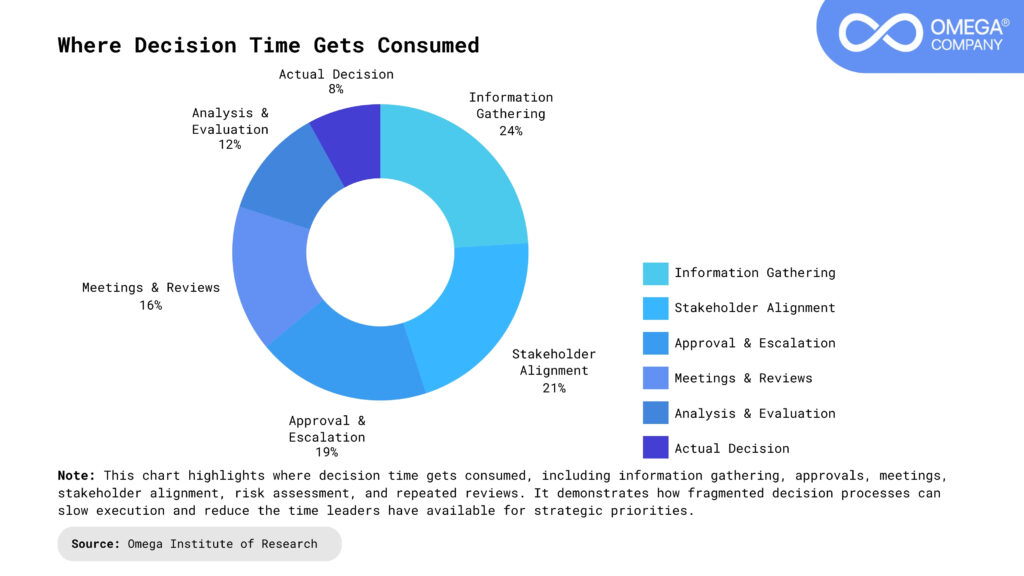
Defining Who Decides: Every important decision should have a clearly identified owner. Other stakeholders can provide information, expertise, or recommendations, but responsibility for the final decision should remain clear. This structure reduces ambiguity and makes it easier for teams to understand where a decision currently stands. It also creates a clear point of accountability when follow-up action is required.
Matching the Process to the Decision: A routine operational decision should not require the same process as a major strategic investment. Organizations can differentiate decisions according to financial impact, customer impact, risk, complexity, and reversibility. This allows low-risk decisions to move quickly while maintaining stronger controls around high-impact choices. The objective is to apply the right level of process rather than the maximum level of process.
Separating Reversible and Irreversible Decisions: Some decisions can be tested and changed if the results are not satisfactory. Others have long-term consequences and are difficult to reverse. Recognizing this difference helps organizations move quickly when experimentation is possible while applying greater scrutiny where necessary. This distinction also prevents teams from treating every decision as though it carries the same level of risk. Greater flexibility can then be built into decisions where correction is relatively easy.
Establishing Decision Timeframes: Open-ended decisions encourage continuous discussion. Setting reasonable timeframes creates a point at which the organization must move from analysis to action or formally explain why additional consideration is required. Timeframes also make decision progress more visible to stakeholders. This reduces the likelihood that important issues remain unresolved simply because no deadline exists.
Defining the Information Required: Teams can reduce unnecessary analysis by determining what information is essential before a decision is made. This prevents every new question from becoming a reason to restart the process. A defined information threshold can also help leaders distinguish between useful analysis and analysis that adds little incremental value. The result is a more disciplined transition from information gathering to action.
How Leadership Can Reduce Decision Friction
Moving From Approval to Empowerment: Leaders cannot remain the final decision-maker for every operational issue as a company grows. Empowering teams within clearly defined boundaries allows decisions to move closer to the people who understand the work. This can reduce unnecessary escalation and allow executives to focus on strategic decisions. Effective empowerment also requires clear accountability so that autonomy does not become ambiguous.
Providing Context Instead of Constant Direction: Employees make stronger decisions when they understand organizational priorities, constraints, customer expectations, and desired outcomes. Context reduces the need for repeated instructions and allows teams to operate with greater independence. It also helps employees make decisions that remain aligned with broader business objectives. Leaders therefore create leverage when they provide clarity rather than attempting to control every individual action.
Creating Clear Escalation Rules: Not every issue needs executive involvement. Leaders can establish clear conditions for escalation so that teams know when they should solve a problem themselves and when senior intervention is appropriate. This prevents both unnecessary escalation and situations where important risks remain unresolved. Clear escalation rules can become especially valuable as organizations increase in size and complexity.
Evaluating the Decision Process, Not Only the Outcome: A reasonable decision can sometimes produce an unexpected result. Leaders should examine whether the available information was used appropriately, whether risks were considered, and whether the decision followed the defined process. This creates a healthier environment for responsible decision-making. It also allows organizations to improve the system itself rather than simply assigning blame after an unfavorable outcome.
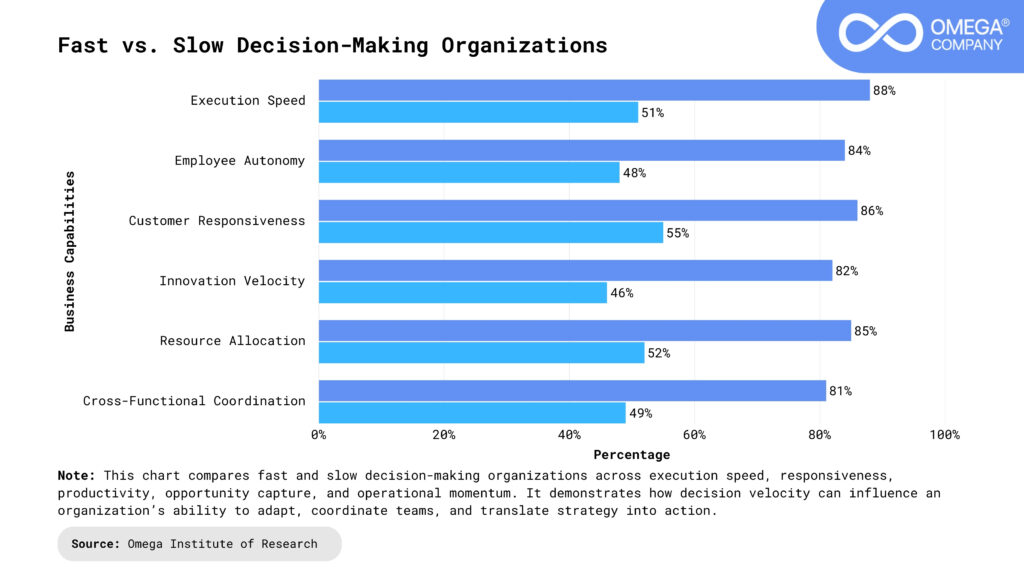
Where Faster Decisions Create Business Value
Improving Customer Responsiveness: Customers often experience the consequences of internal decision delays even when they are not aware of the underlying process. Faster decisions can help customer-facing teams resolve issues, respond to opportunities, and deliver solutions with less internal friction. This can make the customer experience more consistent across different touchpoints. It also reduces the amount of time employees spend waiting for internal confirmation before responding.
Accelerating Project Execution: Projects can lose time when teams repeatedly wait for approvals, requirements, or resource decisions. Clear decision ownership helps projects maintain momentum and reduces unnecessary pauses. Faster resolution of project-level questions can also prevent small issues from becoming larger execution problems. Over time, this can improve the organization’s ability to move initiatives from planning to measurable results.
Improving Resource Allocation: People, budgets, technology, and management attention are limited. Timely decisions allow organizations to move resources away from low-value activities and toward priorities that require greater capacity. This creates greater flexibility when business priorities change. It also reduces the risk of valuable resources remaining committed to initiatives that no longer justify their original investment.
Increasing Employee Productivity: Employees spend less time waiting, following up, or revisiting unresolved issues when decision processes are clear. This creates more capacity for meaningful work and reduces administrative friction. Faster decisions can also improve collaboration because teams have clearer inputs and fewer unresolved dependencies. Productivity therefore improves not simply through greater effort, but through fewer barriers to execution.
Creating Greater Organizational Responsiveness: A company that can identify a change and respond without excessive internal delay can adapt its operations more effectively. Responsiveness becomes particularly important when customer expectations, technology, or business conditions change quickly. Faster internal coordination allows organizations to translate external changes into operational action more efficiently. Over time, decision responsiveness can become an important part of organizational adaptability.
The Role of Data and Technology in Decision-Making
Making Information Easier to Access: Decision-makers cannot act quickly when critical information is scattered across different systems, documents, or teams. Reliable and accessible information reduces the time required to understand the situation before making a decision. Centralized access can also reduce repeated requests for the same information across departments. The objective is to make relevant information available when and where the decision requires it.
Turning Data Into Decision Support: Data should help answer practical business questions rather than simply generate additional reports. The most useful information connects directly to the decision being considered and clarifies potential outcomes, risks, and trade-offs. Too much disconnected information can create another form of decision friction. Effective decision support therefore focuses on relevance, context, and actionability.
Automating Routine Decisions: Some operational decisions follow predictable rules. When appropriate, technology can automate approvals, notifications, routing, and other repetitive actions. This allows employees and leaders to focus their attention on decisions that require judgment. Automation can also create greater consistency by applying defined rules across recurring situations.
Using AI to Reduce Analysis Time: AI can support decision preparation by organizing information, identifying patterns, summarizing large amounts of content, and helping teams evaluate different scenarios. Its role is most valuable when it reduces the effort required to understand a problem while keeping accountability with the appropriate decision-maker. AI can accelerate preparation, but organizations still need clear governance around how its outputs are reviewed and used. The objective should be faster and better-informed decision preparation rather than removing human accountability.
The Risks of Moving Too Quickly
Speed Without Strategic Alignment: Fast decisions are not automatically effective decisions. If teams do not understand the organization’s priorities, different functions may move quickly in conflicting directions. This can create duplicated work, inconsistent customer experiences, or competing investments. Decision speed therefore needs to operate within a clear strategic framework.
Reducing Necessary Oversight: Certain decisions require appropriate financial, legal, operational, security, or customer review. Removing these controls simply to increase speed can create greater problems later. The objective should be to eliminate unnecessary friction rather than eliminate necessary governance. Effective organizations distinguish between controls that protect value and processes that simply slow execution.
Creating Decision Fatigue: Employees cannot operate at maximum decision speed indefinitely. Constant urgency can reduce concentration and encourage superficial choices. Organizations need to distinguish genuine time-sensitive decisions from routine matters that can follow normal processes. Creating different decision rhythms can help employees preserve attention for decisions that genuinely require judgment.
Confusing Urgency With Importance: A request that arrives quickly is not necessarily more important than a strategic issue. Organizations need prioritization mechanisms that prevent urgent interruptions from continuously displacing important decisions. Without prioritization, teams may spend most of their time reacting rather than progressing against strategic objectives. Clear priorities help leaders determine which decisions truly require immediate attention.
Optimizing for Speed Instead of Value: The purpose of faster decision-making is not to reduce the number of hours spent deciding. It is to improve the organization’s ability to convert information into valuable action. Speed should therefore remain connected to outcomes. A faster process that produces poor alignment, unnecessary risk, or weak execution does not create meaningful business value. The goal is disciplined speed moving quickly when action is justified while maintaining the level of rigor the decision requires.
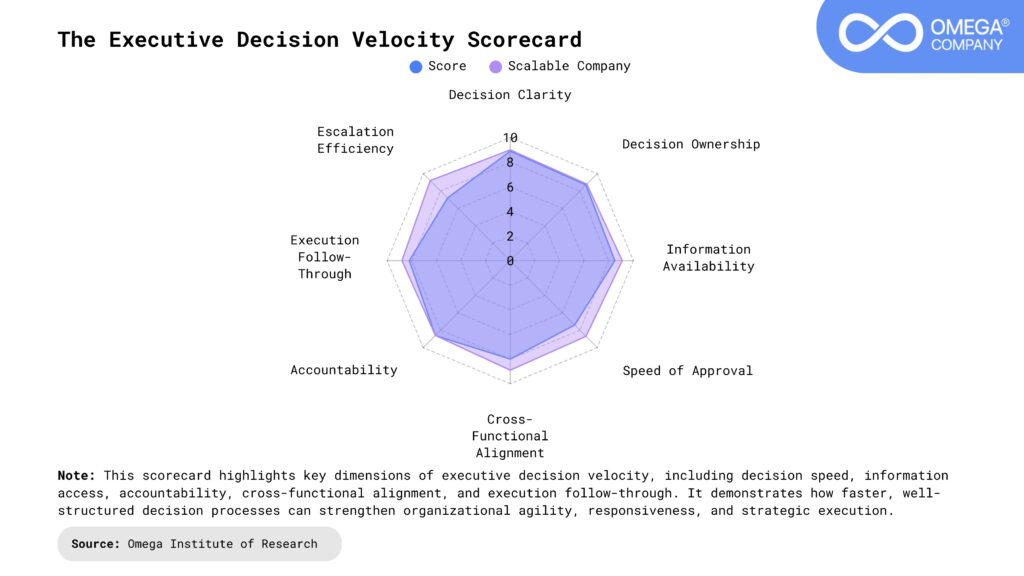
Future Outlook: Building Organizations That Can Decide at the Speed of Change
As businesses become more connected and operating environments continue to change, decision-making will become increasingly important to organizational responsiveness. Technology will shorten the time required to gather and analyze information, while AI will support more sophisticated decision preparation and scenario evaluation. At the same time, organizations will need clearer decision rights and stronger accountability to prevent information abundance from creating additional delays. The future of decision-making will therefore be less about simply becoming faster and more about becoming more intentional. Companies will need to understand which decisions deserve deep analysis, which can be delegated, which can be automated, and which should move immediately. The ability to make those distinctions will become an important part of building an adaptable operating model.
Conclusion
The hidden cost of making decisions too slowly is the accumulation of everything that remains unresolved while the organization waits. Projects lose momentum, employees create workarounds, management attention is consumed, opportunities become harder to capture, and operational complexity can increase. Addressing the problem requires more than asking leaders and employees to make faster choices. Organizations need clear ownership, appropriate delegation, decision-specific governance, accessible information, and processes that connect decisions directly to execution. Sustainable performance comes from knowing when to analyze, when to delegate, when to test, and when to act. The objective is not to make every decision faster, but to ensure that the right decisions move forward with the level of speed, clarity, and accountability the business requires.
- https://crescointl.com/the-hidden-cost-of-slow-decision-making/
- https://www.sifars.com/nl/blog/decision-latency-hidden-cost-enterprise-growth/
- https://lmaccounts.ie/blog/hook/the-hidden-cost-of-weak-decision-making-frameworks-in-smes
- https://coaches.scalingup.com/blog/hidden-cost-of-waiting-delayed-decisions-business-growth
- https://designsprintx.com/articles/slow-decision
Subscribe
Select topics and stay current with our latest insights
- Functions