

- Industries
Industries
- Functions
Functions
- Insights
Insights
- Careers
Careers
- About Us

The Power of Digital Twins in Business Innovation







In today’s ever-evolving digital landscape, businesses are constantly searching for innovative ways to unlock their true potential and stay ahead of the competition. Enter Digital Twinning – a game-changing technology that is revolutionizing growth strategies across industries through digital transformation. Digital twin technology is reshaping the landscape of modern business operations and strategies. This innovative approach enables companies to create digital replicas of physical assets, processes, or systems, offering unprecedented insights and capabilities. By bridging the physical and digital worlds, digital twins are driving optimization, enhancing decision-making, and fostering innovation across various industries.
What Is Digital Twin Technology?
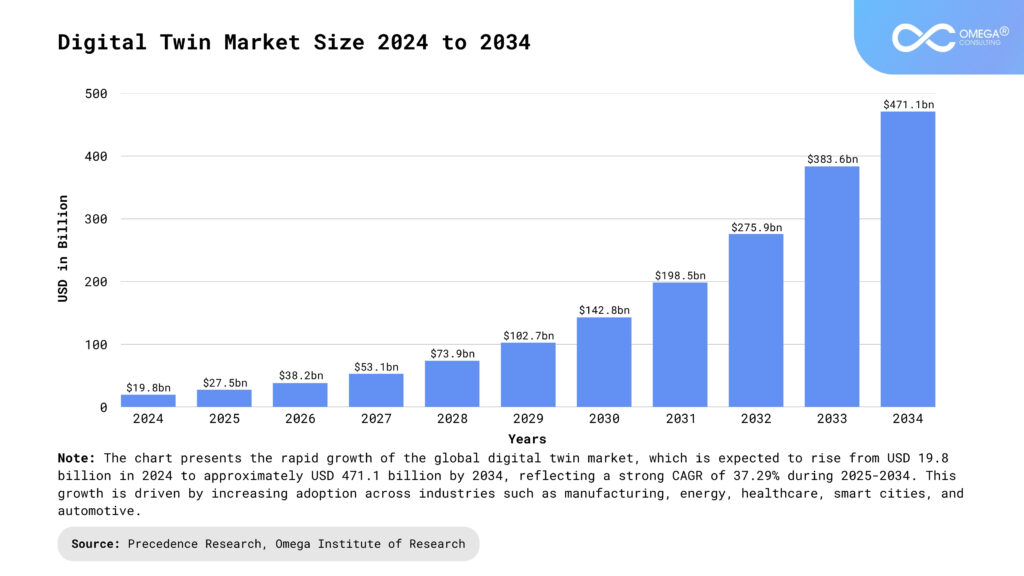
A digital twin is a virtual replica of a physical system, process, or object that uses real-time data and AI to simulate, analyze, and optimize performance. These digital replicas allow businesses to predict outcomes, simulate various scenarios, and improve decision-making without disrupting actual operations. By integrating IoT sensors, machine learning, and big data, digital twins provide deep insights into asset performance, enabling predictive maintenance, optimizing efficiency, and preventing costly failures. From jet engines to entire cities, this technology revolutionizes engineering and innovation by allowing businesses to test, monitor, and refine operations in a risk-free digital space, ultimately enhancing decision-making, reducing downtime, and driving sustainable advancements.
Types Of Digital Twins
Process Digital Twin: A process digital twin integrates multiple systems to provide a complete view of factory operations. It enables real-time adjustments to variables like material input and production conditions without disruption. Businesses can run risk-free simulations, optimize workflows, and monitor KPIs for improved efficiency. For instance, a process twin can simulate an entire manufacturing plant, ensuring seamless operations and better decision-making.
System Twin: A system digital twin replicates how different components interact within a plant or facility, offering a holistic view of operations. It enables businesses to optimize system performance, identify inefficiencies, and enhance decision-making through predictive analytics. Large enterprises, such as Unilever, use system twins to automate processes, reduce waste, and improve resource management for greater efficiency.
Asset Twin: An asset digital twin creates a virtual model of physical objects like machines, vehicles, or buildings, providing real-time insights into their condition and performance. By integrating multiple component twins, it helps businesses detect inefficiencies, extend asset lifespan, and reduce maintenance costs. Companies like Kaeser use asset twins to track equipment usage, shifting from product sales to consumption-based billing.
Component Twin: A component digital twin focuses on individual machine parts, such as sensors or valves, allowing real-time monitoring and predictive maintenance. It helps manufacturers assess reliability, ensure timely repairs, and maintain operational efficiency. By preventing unexpected failures, component twins contribute to smoother production and higher product quality.
Benefits Of Digital Twin In Business
Real-Time Process Simulation and Optimization: Digital twins allow businesses to simulate various operational scenarios and identify potential bottlenecks without interrupting real-time processes. This capability helps organizations virtually test changes in production lines, forecast the effects of supply chain disruptions, and optimize workforce allocation and scheduling, ultimately leading to smoother and more efficient operations.
Enhanced Predictive Maintenance: By continuously analyzing real-time data from equipment and machinery, digital twins can anticipate potential failures before they happen. This predictive capability significantly reduces unplanned downtime and maintenance costs. For example, a global manufacturing company applied digital twin technology to monitor machine performance and achieved a 30% reduction in unexpected downtime.
Improved Resource Utilization and Cost Savings: Digital twins enable businesses to better utilize resources by simulating different production scenarios. This helps in minimizing waste, optimizing energy consumption, and identifying cost-saving opportunities, contributing to overall operational efficiency and sustainability.
Data-Driven Decision Making: With AI-powered insights, digital twins support businesses in making faster and more informed decisions. They enable companies to respond swiftly to market changes, improve financial forecasting accuracy, and enhance product lifecycle management, all of which strengthen competitive advantage.
Digital Twin Technologies
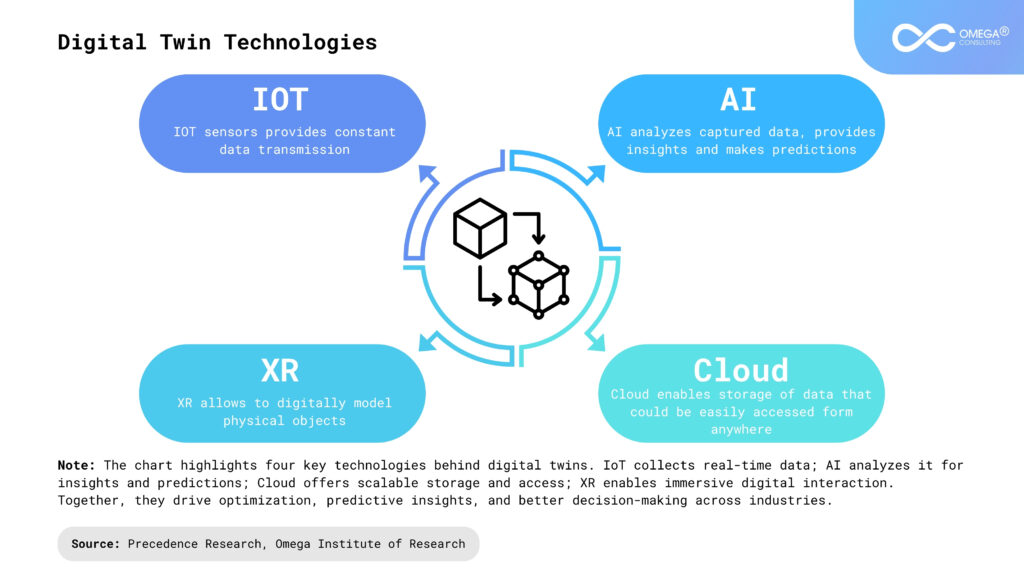
Internet of Things (IoT): The Internet of Things (IoT) enables digital twins to collect continuous real-time data from physical assets through sensors embedded in equipment, products, or environments. This data ensures that the digital model remains an accurate reflection of the physical object, allowing for constant monitoring, anomaly detection, and performance tracking.
Cloud computing: Cloud computing provides scalable storage and processing power to handle the large volumes of data generated by digital twins. It allows organizations to run complex simulations, access data remotely, and collaborate seamlessly, while reducing infrastructure costs and enabling quick integration with other advanced technologies.
Artificial Intelligence (AI): Artificial Intelligence (AI) processes the collected data using advanced analytics, machine learning, and predictive algorithms to generate insights. AI enhances the decision-making capabilities of digital twins by forecasting potential failures, optimizing operations, and recommending actions that improve efficiency and reduce costs.
Extended Reality (XR): Extended Reality (XR), including VR, AR, and MR, offers immersive visualization of digital twins. It allows users to interact with digital replicas in real-time, enhancing training, remote maintenance, design collaboration, and operational understanding, making complex data more intuitive and actionable.
Applications Of Digital Twin Technology
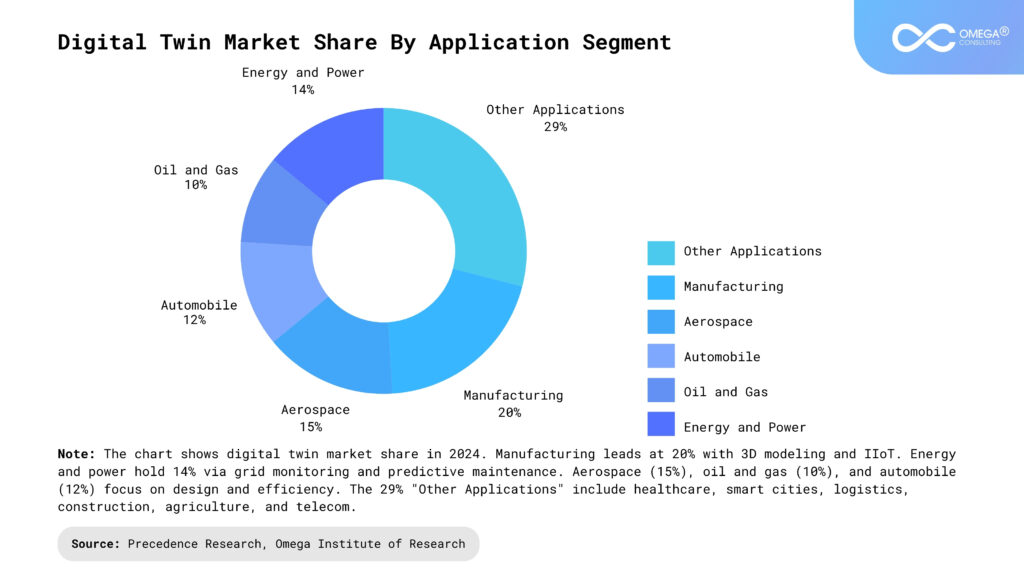
Manufacturing: Digital Twin Technology is set to transform the manufacturing sector by redefining how products are designed, produced, and maintained. By optimizing processes and reducing production time, digital twins significantly enhance industrial efficiency and productivity, ensuring seamless operations and minimizing downtime.
Automobile: In the automotive industry, digital twins create virtual models of connected vehicles, continuously tracking behavioural and operational data. This enables precise analysis of vehicle performance, connectivity features, and predictive maintenance needs. Additionally, digital twins enhance the consumer experience by enabling personalized and customized vehicle services.
Retail: Customer experience is at the heart of the retail industry, and digital twins are reshaping how businesses engage with consumers. Virtual twins of customers allow for personalized styling and tailored shopping experiences. Moreover, digital twins improve store layout planning, strengthen security measures, and optimize energy consumption, leading to a more efficient retail ecosystem.
Healthcare: By integrating IoT data, digital twins are revolutionizing healthcare, from reducing costs to enhancing patient monitoring and preventive care. They enable predictive diagnostics and personalized treatment plans, ensuring better patient outcomes while improving overall healthcare efficiency.
Challenges When Adopting Digital Twins
Data Integration: Integrating data from diverse sources and ensuring its accuracy is a significant challenge. Companies must invest in robust data management systems and ensure seamless data flow between physical and digital worlds. Inconsistent or incomplete data can compromise the reliability of the digital twin.
High Implementation Costs: The initial investment required for digital twin technology can be substantial. Companies need to allocate resources for software development, hardware installation, and employee training. This financial barrier can be particularly daunting for small and medium-sized enterprises.
Cybersecurity Risks: As digital twins rely on interconnected systems and vast amounts of data, they are vulnerable to cyber threats. Ensuring the security of digital twin ecosystems is critical to protect sensitive information and prevent operational disruptions. Implementing robust cybersecurity measures is essential to mitigate these risks.
Future Trends of Digital Twins
Integration with Extended Reality (XR): The combination of Digital Twins with VR and AR will create immersive, interactive simulations that enhance training, remote collaboration, maintenance, and decision-making, improving understanding and problem-solving across industries.
Digital Twins as a Service (DTaaS) through Cloud: Cloud-based DTaaS models will make Digital Twin technology more accessible and affordable by reducing infrastructure costs, providing scalable solutions, and simplifying implementation for businesses of all sizes.
5G Connectivity for Efficient Data Transfer: With high speed, low latency, and broad coverage, 5G will enable real-time synchronization between physical assets and their digital counterparts, improving remote monitoring, control, and rapid decision-making across sectors like healthcare, autonomous vehicles, and manufacturing.
Sustainability and Environment-Friendliness: Digital Twins will play a crucial role in advancing sustainability by optimizing energy usage, reducing waste, minimizing carbon emissions, and supporting eco-friendly operations in areas like smart buildings, manufacturing, and urban planning.
Digital Twin Ecosystems for Smart Cities: In smart cities, interconnected Digital Twin ecosystems will enable synchronized management of traffic, infrastructure, energy, waste, and public services, improving efficiency, reducing environmental impact, and enhancing the overall quality of urban life.
Conclusion
Digital twin technology is revolutionizing growth strategies across industries by providing real-time insights, enabling simulation and optimization, and uncovering untapped opportunities. By leveraging the power of internet of things (IoT) sensors, artificial intelligence, and analytics, businesses can unlock their true potential and stay ahead of the competition. While implementing digital twins comes with its challenges, the benefits, including improved operational efficiency and enhanced customer experiences, far outweigh the costs. The potential of digital twins is immense, and businesses that embrace this technology will be well-positioned to thrive in the evolving digital landscape.
- https://www.linkedin.com/pulse/power-digital-twin-development-business-thomas-j-cleland-zmkfc
- https://ariafina.co/automatizaci%C3%B3n-para-transformar-tu-negocio/the-power-of-digital-twin-technology-how-virtual-models-are-optimizing-business-processes
- https://arc-group.com/digital-twin-technology/
- https://www.sciencedirect.com/science/article/pii/S277266222300005X
- https://legaladvantage.net/2025/03/the-power-of-digital-twins-revolutionizing-industries-and-protecting-innovation-through-patents/
Subscribe
Select topics and stay current with our latest insights
- Functions