

- Industries
Industries
- Functions
Functions
- Insights
Insights
- Careers
Careers
- About Us

The Real ROI of AI Isn’t Headcount Reduction







The return on investment from AI is increasingly being measured through a narrow lens: how many roles can be eliminated, how much labor cost can be reduced, or how much work can be completed with fewer employees. While workforce efficiency can contribute to financial performance, treating headcount reduction as the primary measure of AI value can overlook the broader economic impact of intelligent technologies. AI can increase the capacity of existing teams, accelerate decision-making, improve customer experiences, reduce operational friction, strengthen innovation, and enable employees to spend more time on higher-value activities. The more important question for leaders is therefore not how many employees AI can replace, but how much additional business value the organization can generate from the capabilities it already has. A stronger ROI model evaluates AI through revenue, productivity, speed, quality, customer value, risk, innovation, and organizational capacity.
Why the Traditional AI ROI Equation Is Too Narrow
Many organizations begin AI business cases by comparing technology costs with potential labor savings. This creates a straightforward financial calculation, but it can fail to capture the value created when employees become more productive rather than being removed from the organization. An analyst who completes research in hours instead of days creates additional capacity even if their position remains unchanged. A sales team that can prepare for more customer conversations can potentially increase commercial activity without proportional hiring. A product team that can test more concepts can increase innovation capacity without simply reducing its workforce. AI ROI therefore needs to account for the economic value of improved capability, not only reduced expense.
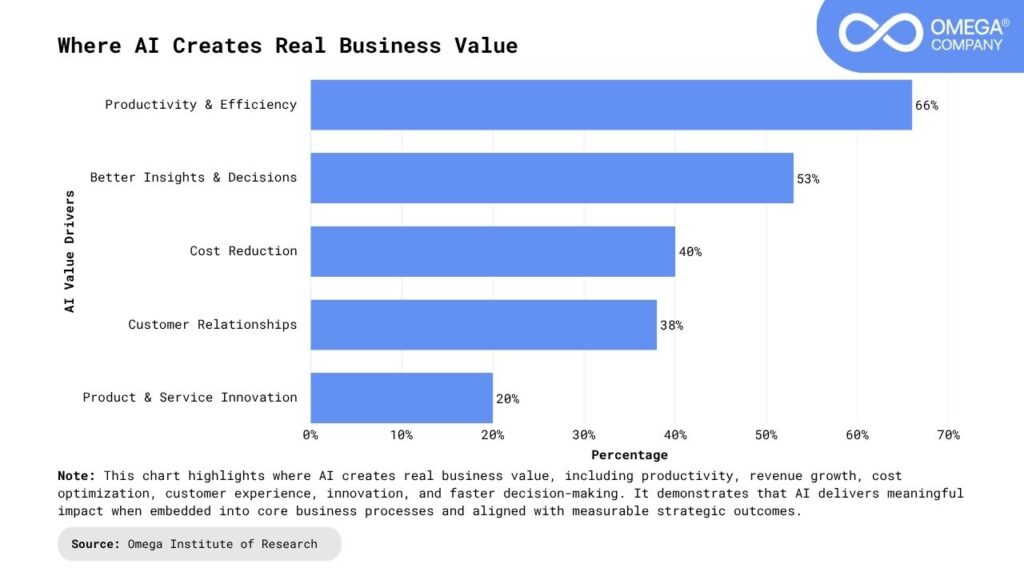
The New Economics of AI Value
Capacity Released From Routine Work: AI can reduce the time employees spend on repetitive research, documentation, reporting, data preparation, administrative coordination, and other low-value activities. The immediate economic benefit is not necessarily fewer employees but more productive capacity within the existing workforce. Organizations can redirect this capacity toward customer engagement, strategic analysis, innovation, problem-solving, and execution. The value increases when leaders deliberately reinvest released capacity into measurable business priorities rather than allowing it to be absorbed by lower-impact activities.
Revenue Capacity Can Expand: AI can strengthen commercial productivity by helping sales and marketing teams research prospects, personalize communications, analyze customer behavior, prepare proposals, and identify opportunities. These capabilities can enable existing teams to manage greater commercial activity without proportional increases in resources. The economic value therefore extends beyond cost reduction into revenue generation and growth capacity. Organizations should assess whether AI enables employees to pursue more opportunities, improve conversion processes, shorten sales cycles, or increase customer lifetime value.
Decision Cycles Can Become Shorter: Organizations can lose value when important decisions depend on slow information gathering, fragmented data, and manual analysis. AI can accelerate these processes by helping teams process information, identify patterns, compare scenarios, and prepare decision inputs more efficiently. Faster decision cycles can create economic value by enabling organizations to respond more quickly to customer demand, market changes, operational disruptions, and emerging opportunities. While the benefit may not appear as a direct expense reduction, it can improve execution, responsiveness, and resource allocation.
Quality Can Become an Economic Metric: AI ROI should extend beyond productivity and cost savings to include improvements in accuracy, consistency, compliance, reliability, and output quality. Reducing errors can lower rework, prevent customer issues, minimize operational disruptions, and reduce hidden operating costs. Organizations should therefore measure the economic impact of quality improvements alongside efficiency gains. A process that becomes slightly faster but significantly more reliable can create substantial long-term value.
Organizational Capacity Can Increase: AI can enable teams to manage greater volumes of work without expanding resources at the same rate. This is particularly valuable where demand fluctuates, workloads scale quickly, or activities require significant information processing and coordination. Greater capacity can provide organizations with flexibility during periods of growth without requiring every increase in demand to be matched by proportional hiring. AI-supported teams can absorb additional workloads while maintaining service levels and supporting higher levels of business activity.
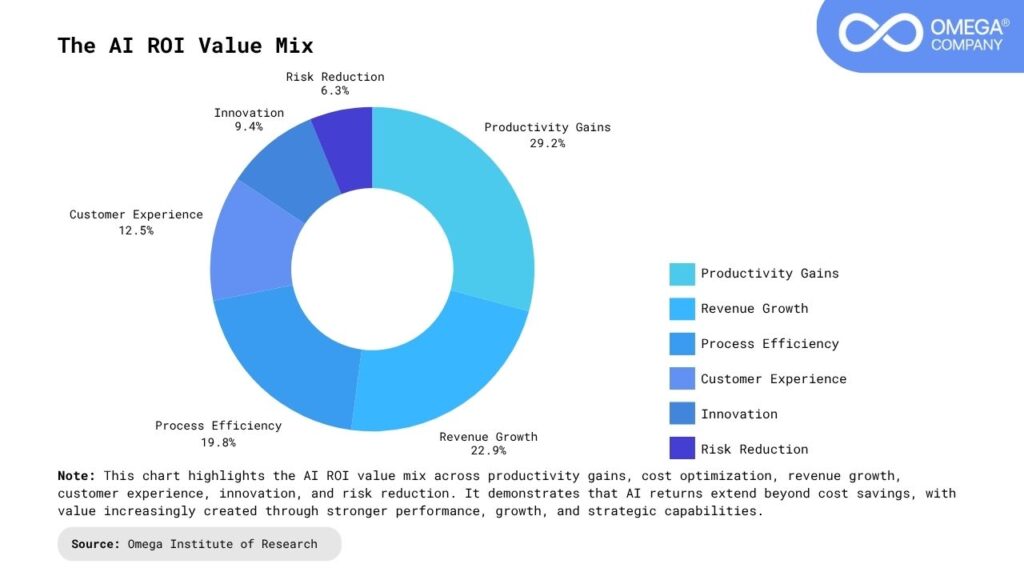
Where the Value Actually Appears
Productivity Without Workforce Contraction: The most immediate opportunity may be to increase the amount of valuable work employees can complete within the same working period. AI can support research, preparation, analysis, drafting, and coordination while employees retain responsibility for judgment, decision-making, and execution. This shifts the ROI conversation from cost per employee toward value generated per employee, allowing organizations to capture greater economic value when productivity improvements contribute to growth, customer outcomes, or increased operating capacity.
Faster Customer Response: Customer-facing teams can use AI to identify customer needs, summarize interactions, prepare responses, and surface relevant information more quickly. Faster access to accurate information can reduce response times, improve consistency, and help employees handle larger volumes of customer interactions. The financial impact can emerge through stronger retention, increased service capacity, improved customer experiences, and reduced effort associated with routine customer operations.
Higher-Value Employee Time: One of the most important benefits of AI is its ability to change how employees allocate their time. As routine activities decline, employees can devote more attention to creativity, strategic thinking, relationship management, decision-making, and complex problem-solving. Organizations capture greater value when this additional capacity is intentionally redirected toward activities with higher economic contribution rather than simply reducing workloads without changing how employee time is used.
Greater Innovation Through Experimentation: AI can reduce the time and effort required to research ideas, develop prototypes, analyze alternatives, and test new concepts. This enables organizations to explore a broader range of possibilities without requiring proportional increases in resources or development time. Although innovation value may take longer to materialize than immediate cost savings, successful experimentation can generate new products, services, revenue opportunities, operating models, and customer experiences.
Reduced Operational Leakage: Organizations frequently lose value through delays, rework, duplicated activities, errors, inefficient handoffs, and fragmented information flows. AI can help identify process inefficiencies, automate selected activities, improve information access, and reduce avoidable sources of operational leakage. These improvements can create meaningful financial impact even without direct workforce reductions by improving the economics, reliability, and efficiency of the overall operating process.
Rethinking What Employees Represent in an AI Economy
Employees Become Value Multipliers: The economic role of employees can evolve as AI takes on more information-intensive and repetitive activities. Rather than viewing people primarily as labor costs, organizations can increasingly see employees as decision-makers, problem-solvers, and capability owners supported by intelligent systems. This perspective encourages leaders to invest in better workflows, AI-enabled tools, training, and decision support that strengthen human performance. The objective becomes increasing the value generated by each employee rather than simply reducing the number of employees.
Roles Can Become Broader: AI can enable employees to perform activities that previously required support from specialized teams or separate organizational functions. A business professional, for example, may be able to conduct preliminary research, analyze information, prepare documents, and develop initial recommendations with AI assistance. This can increase individual capability while reducing unnecessary handoffs, delays, and coordination requirements. Broader roles can also create more flexible operating structures and allow organizations to allocate talent more efficiently across changing business priorities.
Expertise Can Be Applied More Effectively: Highly skilled employees often spend significant time on preparation, documentation, information gathering, and administrative activities surrounding their core expertise. AI can reduce portions of this supporting workload, allowing specialists to devote more time to complex analysis, judgment, problem-solving, and high-value client or business activities. The economic benefit comes from generating greater value from scarce expertise rather than simply increasing the volume of work completed. This can be particularly important in functions where specialized talent is expensive, limited, or difficult to scale.
Human Judgment Becomes More Valuable: As AI becomes increasingly capable of generating information, analysis, and recommendations, organizations will need employees who can interpret context, challenge assumptions, evaluate trade-offs, and make accountable decisions. Human judgment remains important when decisions involve ambiguity, competing priorities, organizational consequences, or situations where available data does not provide a complete answer. AI ROI should therefore consider the value created through better-informed human decisions. Strong economic outcomes can emerge when machine speed and analytical capability are combined with human judgment, accountability, and business context.
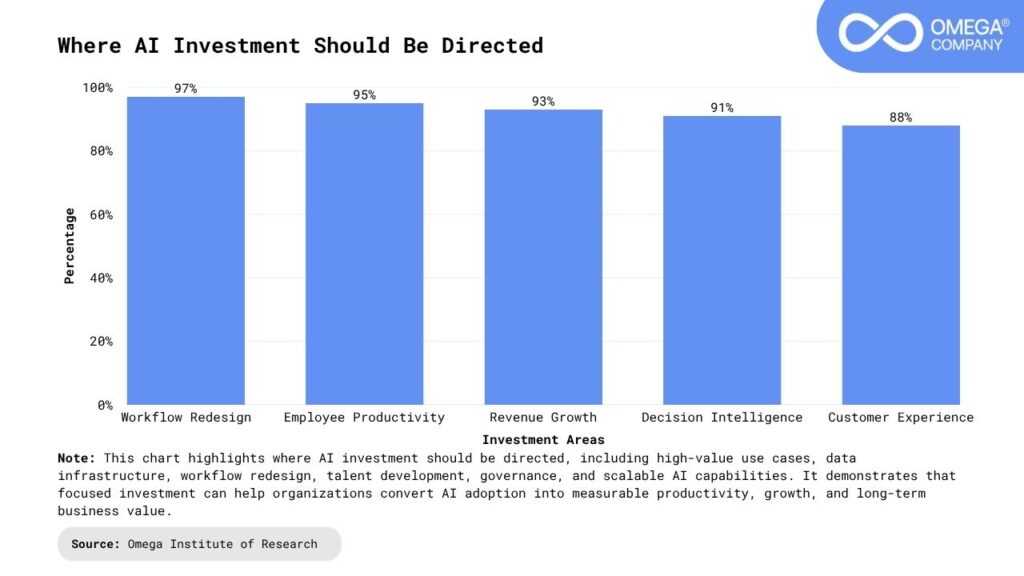
Measuring AI Beyond Labor Savings
Revenue Impact: Leaders should examine whether AI contributes to new revenue, increased sales activity, stronger conversion, improved retention, or expanded customer relationships. AI-enabled insights can help commercial teams identify opportunities faster, personalize engagement, and improve the effectiveness of revenue-generating activities. Organizations should connect these improvements to measurable commercial outcomes rather than treating AI adoption as a technology investment alone. This provides a clearer view of how AI contributes to sustainable business growth.
Time Recovered: Time saved through AI can be converted into economic value when employees use that capacity for higher-value activities. Measuring hours saved alone is not enough; organizations need to track what happens to the recovered capacity and whether it contributes to meaningful business outcomes. Leaders should identify where additional employee capacity is being redirected and measure its impact on productivity, innovation, customer engagement, or execution. This helps distinguish genuine value creation from time savings that simply result in lower workload.
Cycle-Time Improvement: Reducing the time required to complete important business processes can create value across operations. Faster decisions, product development, customer service, research, and execution can improve responsiveness and allow organizations to act on opportunities more quickly. Shorter cycle times can also reduce bottlenecks and improve coordination between teams. Organizations should measure both the time reduction and the downstream business impact to understand the full economic contribution of AI.
Quality Improvement: Fewer errors, less rework, stronger consistency, and better compliance can create measurable financial benefits. Quality should therefore be included in AI business cases alongside productivity and cost considerations. Improvements in accuracy can reduce operational disruptions, customer complaints, remediation costs, and avoidable resource consumption. Measuring these outcomes helps organizations capture value that may otherwise remain hidden within operational processes.
Customer Value: AI can influence customer satisfaction, retention, personalization, response time, and service capacity. Faster and more relevant interactions can strengthen customer experiences while enabling teams to manage higher volumes of demand. These improvements can ultimately affect revenue, customer loyalty, and customer lifetime value. Leaders should connect AI initiatives to specific customer outcomes rather than evaluating customer impact only through technology adoption metrics.
Risk Reduction: AI can support monitoring, anomaly detection, compliance processes, cybersecurity activities, fraud identification, and operational controls. These capabilities can help organizations identify potential issues earlier and strengthen their ability to respond to emerging risks. Avoided losses, reduced exposure, fewer compliance failures, and improved operational resilience can form an important component of AI ROI. Risk-related value should therefore be incorporated into business cases even when the financial benefit is based on losses prevented rather than revenue directly generated.
The Risks of Measuring AI Only Through Headcount
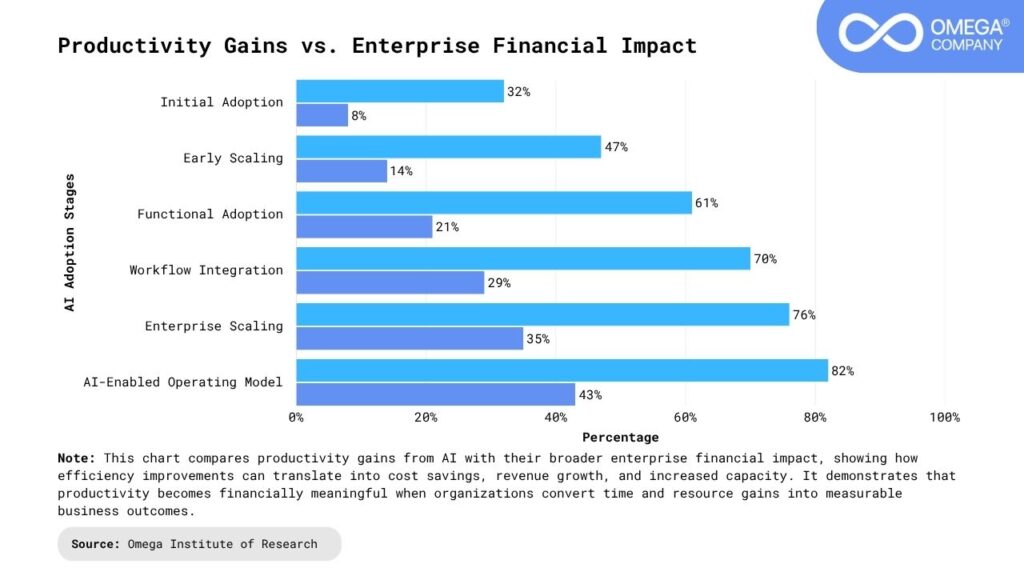
Underestimating Productivity Gains: If organizations focus exclusively on positions eliminated, they may overlook significant increases in employee productivity. Teams can produce substantially more value without reducing their size, particularly when AI removes repetitive work and accelerates information-intensive processes. This additional capacity can support higher workloads, faster execution, and greater strategic focus. A headcount-only metric therefore captures only one dimension of the economic impact created by AI.
Discouraging Growth: If every productivity improvement is converted immediately into workforce reduction, employees and managers may associate AI primarily with cost cutting rather than business expansion. This can limit willingness to experiment, adopt new capabilities, and redesign workflows around AI. Organizations may also miss opportunities to use additional capacity for new markets, products, customer initiatives, and innovation. A broader value approach can position AI as a mechanism for expanding organizational capability.
Losing Critical Expertise: Aggressive workforce reductions can remove institutional knowledge that remains important for managing AI-enabled operations. Some expertise becomes more valuable when combined with AI rather than becoming unnecessary, particularly when employees provide context, judgment, and oversight. Losing experienced employees can also create knowledge gaps that are costly and difficult to rebuild. Leaders should therefore distinguish between automatable activities and the expertise required to manage, validate, and improve those activities.
Ignoring Revenue Opportunities: A narrow cost-reduction model can prioritize expense savings over opportunities to increase revenue, improve customer relationships, or create new products and services. AI can strengthen sales productivity, personalization, market intelligence, product development, and customer engagement. These opportunities may generate greater long-term economic value than reducing the cost of existing processes alone. AI business cases should therefore evaluate both efficiency gains and potential sources of incremental growth.
Reducing Transformation to Automation: AI can fundamentally change how businesses operate, but a headcount-centered ROI model may encourage organizations to focus on automating individual tasks rather than redesigning entire capabilities. True transformation can involve changes to workflows, decision rights, operating models, customer experiences, and organizational structures. Focusing only on task automation can limit the broader benefits that AI can deliver across the enterprise. Leaders should evaluate how AI can improve the end-to-end economics and effectiveness of critical business capabilities.
Creating Short-Term Metrics: Workforce reductions can produce visible financial results quickly, while innovation, customer value, improved decision-making, and increased organizational capacity may take longer to materialize. Overemphasizing immediate savings can therefore create an incomplete picture of AI performance. Leaders should establish measurement horizons that capture both near-term efficiency and longer-term business outcomes. This enables organizations to evaluate whether AI is creating sustainable economic value rather than only delivering short-term cost improvements.
The Emergence of the Capacity-Driven Enterprise
The next phase of AI adoption may increasingly focus on what organizations can accomplish with the workforce and resources they already possess. AI can expand team capacity, enable experts to handle broader responsibilities, and accelerate execution across business functions, creating an economic model that goes beyond simple workforce substitution. Instead of asking how many people are required to perform a fixed amount of work, organizations can ask how much additional value can be generated when employees have access to intelligent capabilities. This shift is important because growth and productivity can occur simultaneously, allowing companies to potentially serve more customers, launch more products, analyze more opportunities, and execute more initiatives without increasing resources at the same rate.
The Future of AI-Enabled Business Value
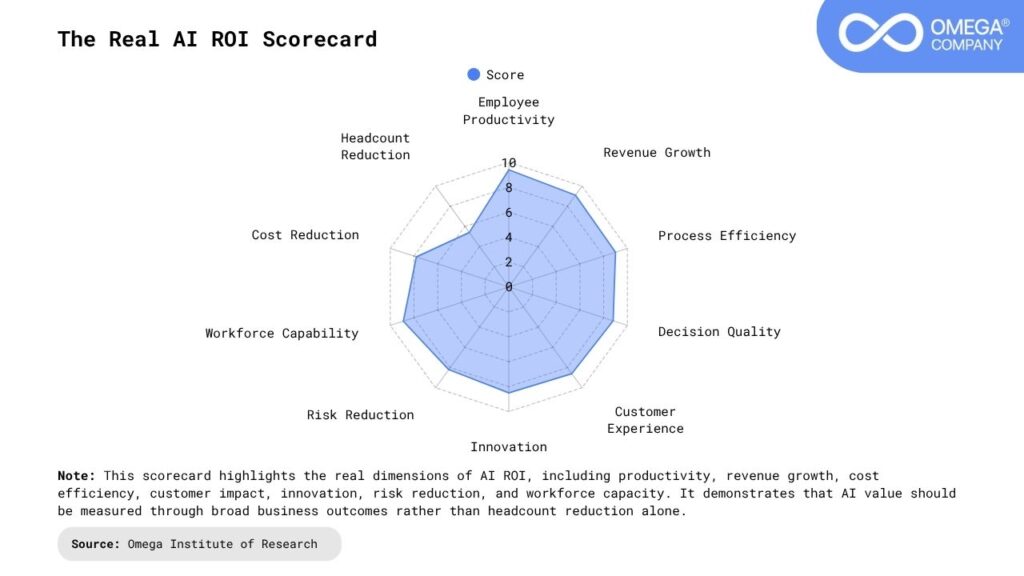
As AI becomes embedded across business processes, the strongest ROI frameworks will increasingly measure overall organizational performance rather than isolated automation savings. Companies will evaluate how AI influences revenue generation, employee capacity, customer relationships, decision speed, innovation, quality, and risk alongside traditional cost metrics. The workforce may therefore become more valuable rather than simply smaller, as employees supported by intelligent systems take on broader responsibilities, make faster decisions, and focus more time on activities where human expertise creates greater value. Organizations that capture these benefits will need to redesign processes, operating models, and management practices so that productivity gains translate into measurable improvements in growth, customer value, operational performance, and long-term business outcomes.
Conclusion
The real ROI of AI is not defined by how many employees a company can eliminate, but by how much more value the organization can create with AI-enabled people, processes, data, and technology. Headcount reduction can be one possible financial outcome of automation, but it represents only one component of a broader value equation. The greater opportunity is to increase employee capacity, accelerate decision-making, improve quality, strengthen customer experiences, reduce operational leakage, expand innovation, and create new sources of revenue. Organizations that treat AI as a business capability rather than simply a cost-reduction tool can redirect released capacity toward higher-value priorities and build stronger operating models. Over time, this approach can help businesses increase productivity, improve resilience, support sustainable growth, and generate greater economic value from both human talent and technology investments.
- https://opag.io/insights/real-roi-ai-intangible-capital-formationhttps://opag.io/insights/real-roi-ai-intangible-capital-formation
- https://www.forbes.com/sites/jasonwalker/2026/05/19/the-roi-on-ai-driven-layoffs-is-zero-why-are-leaders-still-doing-it/
- https://think.design/blog/the-real-roi-of-ai-lies-in-reallocation-not-reduction/
- https://www.kinfolkhq.com/resources/blog/the-real-roi-of-ai-in-hr
- https://solutionsreview.com/business-intelligence/ai-doesnt-cut-headcount-but-cuts-time-between-idea-output/
Subscribe
Select topics and stay current with our latest insights
- Functions